
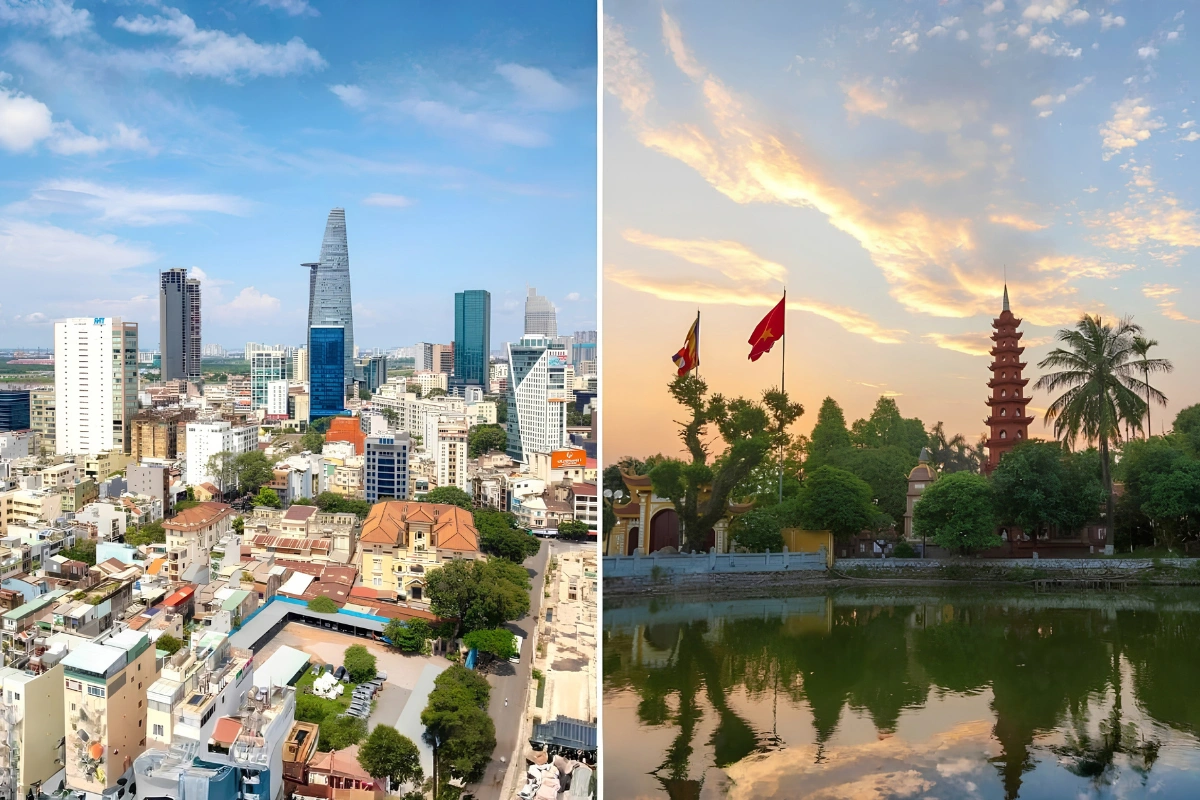


Saigon vs Hanoi: struggling to choose? The 2025 merger made Ho Chi Minh City vastly larger in area and population. However, Hanoi remains about 10% cheaper with distinct four-season weather. Read on to discover authentic culture, food differences, and real costs to decide which city perfectly fits your upcoming Vietnam travel plans.
Saigon vs Hanoi used to be a genuinely close call on paper, two cities within a few hundred thousand people of each other. That is no longer true 📈. I am Vani, founder of Truly Voyage. Since July 2025, Ho Chi Minh City absorbed two entire provinces while Hanoi’s own boundary stayed exactly where it was. This guide covers what the new size gap actually means, which city is genuinely cheaper, which one has real seasons, and which one actually suits the trip you are planning ✈️.

Table of Contents
ToggleWhich City Is Actually Bigger Now?
Ho Chi Minh City, by a genuinely new margin. Hanoi was not part of the 2025 merger wave at all, so the gap between the two cities just got much wider.
A Gap That Did Not Exist a Year Ago
Hanoi was not part of the 2025 merger wave at all. Its outer boundary has been unchanged since it absorbed Ha Tay province, Me Linh district and four communes from Hoa Binh back in 2008 🏛️. In the 2025 nationwide reform, only Hanoi’s internal wards were restructured, down to 126 units, while its provincial-level boundary stayed exactly where it was (Source: Wikipedia, Hanoi).
Ho Chi Minh City’s area and population both jumped in July 2025, when it absorbed the entirety of Binh Duong and Ba Ria-Vung Tau provinces in a single administrative act. The city is now roughly twice Hanoi’s 3,359.84 square kilometres, and 1.6 times its 8,855,946 population (Source: Wikipedia, Ho Chi Minh City). That specific gap did not exist before mid-2025. The old Ho Chi Minh City sat at roughly 9.9 million people, genuinely close to Hanoi’s own population, not the decisive scale difference the two cities show on paper today 🏙️.
| Metric (Post-July 2025) | Hanoi | Ho Chi Minh City |
|---|---|---|
| Land Area | 3,359.84 km² | ~6,772 km² |
| Population | ~8.85 Million | ~14.1 Million |
| Status | Unchanged Boundary | Absorbed 2 Provinces |

Vani Tips:
do not assume this size gap shows up anywhere you will actually notice as a visitor. Hanoi’s Old Quarter and Ho Chi Minh City’s District 1 feel roughly as dense and walkable relative to each other as they always did. The new gap lives almost entirely in territory neither city’s tourist core touches.
Which City Is Actually Cheaper?
Hanoi, by about 10.7 percent overall including rent 💰. Most of that gap comes from rent specifically, not food or everyday costs.
Where the Price Gap Actually Comes From
Per Numbeo’s cost of living data, Hanoi runs about 10.7 percent cheaper than Ho Chi Minh City including rent, and about 5.2 percent cheaper excluding it (Source: Numbeo, Cost of Living Comparison Between Ho Chi Minh City and Hanoi). That gap is driven mainly by rent, not day-to-day spending. A one-bedroom apartment in Hanoi’s city centre runs roughly 10,523,577 VND a month, against 14,958,570 VND for the same size and location in Ho Chi Minh City, close to a 30 percent difference 🏠. A three-bedroom shows a similar roughly 31 percent gap.
Food and grocery prices, by contrast, sit much closer together between the two cities 🛒. An inexpensive meal runs about 52,500 VND in Hanoi against 54,611 VND in Ho Chi Minh City, barely a few percent apart, and a mid-range restaurant meal for two shows a similarly narrow gap. If you are visiting for a short trip and eating out most meals, the cost difference between the two cities will barely register. If you are staying long enough that rent matters, Hanoi’s advantage becomes real money rather than a rounding error.

Ready to Explore Vietnam Your Way?
Let us design a perfect itinerary balancing budget and authentic local experiences for your upcoming trip.
Which City Has Better Weather for You?
Hanoi, if a real change of season matters to you 🌦️. It has a genuine cool winter that Ho Chi Minh City simply does not have.
A Real Climatic Difference, Not Marketing Language
Hanoi genuinely has a cool winter, with January highs and lows of roughly 20 to 21 and 14 to 16 degrees Celsius, light-jacket weather that Ho Chi Minh City simply does not have (Source: WeatherSpark, Compare the Climate and Weather in Hanoi and Ho Chi Minh City). Ho Chi Minh City’s January still runs 32 to 33 degrees Celsius, essentially indistinguishable from its summer highs ☀️. Hanoi’s annual temperature swing is about double Ho Chi Minh City’s, a genuinely four-season year against an effectively two-season one, dry and wet, both consistently hot.
Both cities share a similar rainy season, running May through September, with Hanoi slightly wetter month to month 🌧️. Humidity runs more consistently high in Ho Chi Minh City throughout the year. If cooler weather and an actual seasonal shift matter to your trip, Hanoi is a destination of the two cities that delivers it. If you want predictable warmth you can plan around without checking a forecast, Ho Chi Minh City’s lack of a real winter is the point in its favour, not a downside.
Vani Tips:
if you are visiting Hanoi specifically for the cool season, pack real layers, not just a light jacket. A 14 degree Celsius morning feels considerably colder after weeks of tropical heat elsewhere in Vietnam than the number alone suggests 🧣.
Which One Should You Actually Pick?
Taste the difference before you decide on geography alone. Pho and coffee culture genuinely differ between the two cities, and neither version is the diluted one.

Two Real, Documented Differences
Saigon-style pho runs sweeter, with rock sugar and turnip added to the broth, and comes with a full herb plate on the side: Thai basil, sawtooth coriander and bean sprouts 🍜. Hanoi-style keeps the broth clear and plain, built around the broth’s own character, with condiments kept minimal, lime, vinegar and a garlic-chili paste rather than a full herb garnish (Source: VnExpress, Su khac biet giua pho Ha Noi va pho TP HCM). This is a real, Michelin-chef-documented difference tracing back to the post-1954 migration, when northerners carried the dish south and it localised to southern tastes over time. It is not a lazy regional stereotype.
Coffee culture differs just as concretely ☕. Saigon’s ca phe sua da and bac xiu, an extra-milk variant that is a Saigon-specific term, are casual, all-day drinks. They are ordered over a morning newspaper as easily as late at night with friends, used as a social pretext more than a ritual. Hanoi’s ca phe nau is stronger, made with unsweetened condensed milk and typically served without ice, treated closer to a slow ritual than a quick pick-me-up, often enjoyed on cool mornings specifically (Source: VnExpress, Khac biet van hoa uong ca phe cua Ha Noi va Sai Gon). Neither city’s version is the authentic original with the other a copy. They developed differently, and both are worth trying on their own terms.

Vani Tips:
order pho and coffee in both cities if your trip covers both, specifically to notice the difference rather than assuming one bowl or one cup tells you everything. The contrast is the actual point, not a ranking exercise.
Case Study: Mark & Sarah’s Step-by-Step City Selection
To make this practical, let’s look at how our recent clients, Mark and Sarah, decided between the two cities for their 3-week remote working holiday:

- Step 1: Assessing Weather Needs: Traveling in January, they desperately wanted a break from the tropical heat. Hanoi’s crisp 18°C weather immediately won over Saigon’s 32°C.
- Step 2: Budgeting for a Longer Stay: Because they were staying long enough to rent an apartment rather than a hotel, Hanoi saved them nearly 30% on accommodation costs.
- Step 3: Lifestyle & Pacing: They preferred slow, contemplative mornings sipping strong ca phe nau by the lake over the fast-paced, modern rush of a financial hub.
- Result: They chose Hanoi as their primary base. This proves that analyzing your personal travel pace and seasonal preferences yields a far better trip than just picking a popular name on a map.
So Which City Actually Suits You?
Hanoi if you want a real change of season, a slower rhythm and lower costs. Ho Chi Minh City if you want consistent warmth, business energy and a wider day-trip radius.
A Judgment Call, Grounded in the Numbers Above
This is my own editorial judgment, built on everything above rather than a single sourced ranking. Hanoi suits travellers who want a genuine change of season, a cool winter escape from tropical heat, a slower and more contemplative daily rhythm, and lower costs, especially on longer stays where the rent gap actually compounds. It also puts you closer to northern heritage sites: Ha Long Bay, Sapa, and the Old Quarter itself 🚂.
Ho Chi Minh City suits travellers prioritising business or nightlife energy, consistent warm weather with no cold season to plan around, and direct access to the Mekong Delta 🌴. Since the 2025 merger specifically, it also offers a genuinely wider day-trip radius than it used to, including Vung Tau’s beaches, all inside the same municipal government now. Neither city is a universally better choice. They are built for different kinds of trips.
Vani Tips:
if your trip is long enough for both, do not force a ranking at all. Hanoi and Ho Chi Minh City work well as a genuine two-city trip precisely because they differ this much, rather than one being a lesser version of the other.
Looking for the Perfect North-to-South Journey?
Why choose one when you can experience both? Browse our meticulously crafted tour collections across Vietnam.
Is This Even a Fair Comparison Anymore?
Less than it used to be, honestly. A city 1.6 times another’s population and twice its land area is not really the even matchup this comparison implies.
My Honest Take on the New Gap
I want to be direct about something most travel content glosses over 📝. Comparing Ho Chi Minh City and Hanoi head to head made more intuitive sense a year ago, when the two cities sat within a few hundred thousand people of each other and roughly comparable land area. Today’s Ho Chi Minh City, at 1.6 times Hanoi’s population and twice its land area, is not really the even matchup the format of this comparison implies.
None of that changes the actual travel decision much, though. Almost all of Ho Chi Minh City’s new scale sits in absorbed industrial and coastal territory that neither city’s actual tourist experience touches. District 1 and the Old Quarter remain the genuine comparison points for most visitors, and they are closer in scale to each other than the city-wide statistics suggest. Treat the population and area figures as an interesting, genuinely new fact about Vietnam’s administrative map, not as evidence that a Hanoi trip is somehow now a lesser experience than a Ho Chi Minh City one.
Vani Tips:
if a competitor’s guide still describes the two cities as roughly equal in scale, that alone tells you the content has not been updated since before July 2025. Treat the rest of its facts with the same suspicion.
Frequently Asked Questions About Saigon vs Hanoi
Is Hanoi or Ho Chi Minh City bigger?
Quick Answer: Ho Chi Minh City, now by a much wider margin.
Since July 2025 it covers 6,772 square kilometres against Hanoi’s 3,359.84, roughly twice the land area, and 1.6 times the population.
Was Hanoi part of the 2025 merger?
Quick Answer: No.
Hanoi’s outer boundary has been unchanged since it absorbed Ha Tay province in 2008. Only its internal wards were restructured in 2025.
Which city is cheaper to visit?
Quick Answer: Hanoi, by about 10.7 percent overall including rent, per Numbeo data.
The gap comes mainly from rent, roughly 30 percent cheaper, while food and grocery prices sit much closer together.
Which city has better weather?
Quick Answer: Depends what you want.
Hanoi has a genuine four-season year with a real cool winter. Ho Chi Minh City stays consistently hot year-round with an effectively two-season, dry-and-wet climate.
Does Hanoi have a real winter?
Quick Answer: Yes.
January highs and lows run roughly 20 to 21 and 14 to 16 degrees Celsius, light-jacket weather that Ho Chi Minh City, at 32 to 33 degrees in January, simply does not have.
How is Hanoi pho different from Saigon pho?
Quick Answer: Hanoi pho keeps the broth clear and plain with minimal condiments.
Saigon pho is sweeter, with rock sugar added and a full herb plate served on the side.
What’s the difference between Hanoi and Saigon coffee?
Quick Answer: Saigon’s ca phe sua da and bac xiu are casual, all-day drinks.
Hanoi’s ca phe nau is stronger and unsweetened, typically served without ice and treated closer to a slow ritual.
Which city should I actually visit?
Quick Answer: Hanoi for a real change of season, a slower rhythm and lower costs.
Ho Chi Minh City for consistent warmth, business energy and a wider day-trip radius since the 2025 merger.
Conclusion
Stop trying to pick a winner between these two cities and pick a season instead. If you are travelling in December or January and want an actual cool-weather break, that alone should send you to Hanoi over Ho Chi Minh City. No other factor in this guide comes close to mattering as much. Every other difference here, the rent, the pho, the coffee, is worth knowing. The season is the one that should actually decide your flight 🧳.
Further Reading & Resources
- Wikipedia, Hanoi — Hanoi’s unchanged boundary since 2008 and its 2025 ward restructuring. Direct Link
- Wikipedia, Ho Chi Minh City — post-merger population and area figures. Direct Link
- Numbeo, Cost of Living Comparison Between Ho Chi Minh City and Hanoi — the full cost of living and rent comparison. Direct Link
- WeatherSpark, Compare the Climate and Weather in Hanoi and Ho Chi Minh City — seasonal temperature and rainfall data. Direct Link
- VnExpress, Su khac biet giua pho Ha Noi va pho TP HCM — the Michelin-chef-documented pho differences. Direct Link
- VnExpress, Khac biet van hoa uong ca phe cua Ha Noi va Sai Gon — the coffee-culture comparison. Direct Link

Vani is the Founder and Lead Travel Designer at Truly Voyage. With over a decade of experience and a deep passion for her Vietnamese heritage, she specializes in crafting bespoke, unhurried itineraries. Vani is dedicated to helping travellers experience the authentic soul of Southeast Asia with absolute financial security and 24/7 on-ground support.
0 Comment