


Basket boat Hoi An rides often bring to mind chaotic spinning, loud music, and tipping pressure. Worried about tourist traps in Cam Thanh? This guide reveals practical steps to avoid inflated prices, request a serene nature route, and handle the wild performance safely. Read on to master your Thung Chai experience!

The paddle stops moving and for one full second nothing happens. Then the boat starts to turn, slowly at first, and your paddler’s grin widens as the spin accelerates into something closer to a fairground ride than a peaceful float through palm leaves 💦. Water sprays off the rim in a wide, glittering arc. Somewhere behind you, a speaker is playing a song you did not choose, at a volume you did not agree to, and you are laughing anyway because there is genuinely no dignified way to sit through this 😂.
A basket boat ride gets sold online as pure, uncomplicated fun, and for most of the actual water time, it is. What almost nothing online tells you is what happens in the thirty seconds before you push off the dock, and the thirty seconds after the spinning stops, and that gap in the story is exactly where this guide starts.
Table of Contents
ToggleWhat is a Thung Chai (Basket Boat)?
A thung chai is a round, woven bamboo vessel, waterproofed with resin and traditionally used by Central Vietnamese fishermen long before anyone thought to spin one for a camera (Source: National Geographic). That working history is real 🛶. The most popular explanation for why it is round, however, deserves more scepticism than most guides give it.
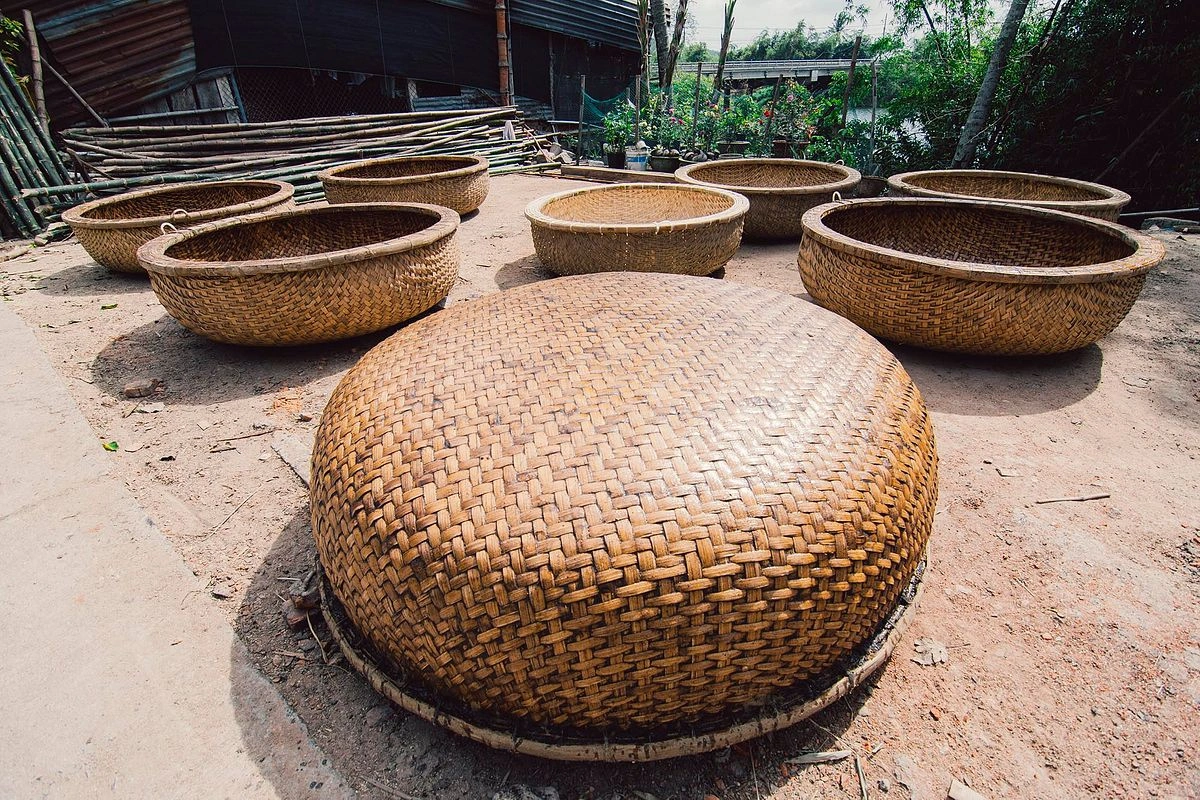
Run your hand along the rim of one before you climb in and the construction becomes obvious, split bamboo woven tight in a circular pattern, sealed watertight with a coating that traditionally mixed tree resin with cattle dung, now more often replaced with tar or modern sealant. The shape itself is the boat’s whole engineering trick, no keel, no defined bow or stern, just a shallow, buoyant bowl that floats in water too thin for a conventional hull and turns on a dime once someone decides to make it spin.
Fishermen along this stretch of coast have relied on that same shallow-draft advantage for generations, working narrow tidal channels and shrimp ponds no conventional boat could navigate, long before a single tourist ever climbed aboard for a photo 📸.
Vani Tips:
The French-colonial story about round boats dodging a boat tax is a genuinely fun piece of folklore, but no historian has actually documented it, so tell it as a legend, not a fact, if a guide repeats it to you. Hoi An’s own heritage research body has reviewed the available evidence and found no documentary source that definitively settles where or when the thung chai actually originated (Source: Hoi An Heritage).
The Tax-Dodge Story, Told Honestly
Here is the version you will hear most often, since it is a genuinely good story and travels well. French colonial administrators, the legend goes, taxed boat ownership, and fishermen too poor to pay argued that their new, circular creations were not boats at all, simply large woven baskets, and therefore untaxable 💡. It is a satisfying tale, ingenuity outsmarting bureaucracy, and it shows up in nearly every basket-boat article written in English.
What those articles rarely mention is that Hoi An’s own heritage research organisation has examined the competing theories directly, including a folk account tracing the design back to the 10th century and another linking it to the Nguyen Lords period centuries before the French arrived, and concluded that no source actually confirms any origin story. Tell the tax legend if you like. Just tell it as a legend.
Want to Experience the Best of Central Vietnam?
From serene boat rides to ancient town walks, let us craft your perfect journey without the tourist-trap hassle.
The Coconut Forest Route
Your paddler pushes off from a small dock inside Bay Mau, the water coconut wetland at the mouth of the Thu Bon river, and the route winds through narrow channels between dense stands of Nypa palm 🌴. The fronds are low enough in places that they will brush the top of your head if you are not paying attention. Most rides run somewhere between fifty minutes and an hour, though the exact length shifts depending on your specific operator and how much time gets spent on the performance stage of the ride versus the quieter paddling in between.
What the Quiet Version Actually Looks Like
Ask for this alternative and the ride changes character almost immediately 🌿. Instead of steering toward the open water where the spinning performance usually happens, your paddler threads further into the palm-lined channels, water calm enough to hear individual leaves moving in the breeze, the light through the canopy shifting from bright open sky to a filtered green shade.
You will likely still pass other boats doing the loud version somewhere along the route, but the difference between the two experiences, requested versus default, is significant enough that it is worth the ten seconds it takes to ask before you climb in.
Vani Tips:
If you want the quiet, nature-focused version of this ride instead of the performance, say so before you leave the dock. Paddlers can take you deeper into the calmer parts of the forest instead of doing the spin, and most are genuinely happy to adjust once they know that is what you actually want rather than assuming every visitor wants the loud version by default.

The Spinning Performance (Gangnam Style)
Do not expect one fixed song anymore, since boatmen now pick whatever tune gets your particular group cheering, so the soundtrack is more improvised than the ride’s own nickname suggests. The performance itself, though, follows a fairly consistent shape regardless of which song is playing 🎶.

Your paddler brings the boat to open water, checks that you are holding on, and begins spinning the vessel in tight, accelerating circles, water arcing off the rim while music plays from a speaker mounted somewhere on the boat or nearby. It is loud, it is a little disorienting, and it is genuinely fun in the specific way a fairground ride is fun, brief, silly, and over before you have fully processed what happened.
Vani Tips:
Do not expect one fixed song anymore. Boatmen now pick whatever tune gets your particular group cheering, so the soundtrack is more improvised than the nickname of this ride suggests, and the exact tune matters far less than simply being ready to laugh at yourself for the two minutes it takes.
The Part That Happens After the Music Stops
This is the moment the online marketing skips entirely, and it is the moment worth actually preparing for. Once the spinning ends, you are sitting in a boat you cannot easily exit on your own, and this is precisely when tip pressure tends to arrive, sometimes gently, sometimes considerably less gently.
Recent visitor accounts from 2025 and 2026 describe paddlers pushing hard for tips well beyond a reasonable amount at exactly this point in the ride (Source: Truly Voyage cluster research), when saying no feels awkward given your physical position. Knowing that this moment is coming, and having a clear number already decided in your head, makes it far easier to handle calmly when it arrives.
Tired of Haggling with Touts?
Get peace of mind by securing transparent, fixed-price excursions with our expert local team.
Ticket Prices & Scams to Avoid
The fair price is roughly 150,000 to 250,000 VND per boat, on top of a separate 30,000 VND site-entrance fee, and if someone quotes you 400,000 or 500,000 VND per person on the riverbank, walk away and book through a fixed-price platform instead. This is a highly important number to remember in this guide 💳.
A quick note on how these prices get quoted, since it causes genuine confusion. Some operators price per boat, which typically carries two passengers plus your paddler, while others quote per person for the same experience. Both approaches describe roughly the same real cost once you do the maths, and neither is inherently the honest one or the scam one. What separates a fair quote from an inflated one is not which pricing model a shop uses, it is whether the final number, however it is presented, lands anywhere near the 150,000 to 250,000 VND per boat range or several multiples above it.
Do the arithmetic yourself before you agree to anything, since a per-person quote that seems reasonable in isolation can still work out to an inflated total once you multiply it across your group. A fair per-boat price split between two passengers lands somewhere around 75,000 to 125,000 VND each, a useful benchmark to keep in mind if a shop only ever quotes per person and you want to sanity-check the total against what a fair boat rate would actually cost.
Vani Tips:
The fair price is roughly 150,000 to 250,000 VND per boat, on top of a separate 30,000 VND site-entrance fee. If someone quotes you 400,000 or 500,000 VND per person on the riverbank, walk away and book through a fixed-price platform instead, since that step removes almost the entire on-water renegotiation problem before it can start.
Where the Inflated Quotes Actually Come From
The pattern is consistent enough to name directly. Touts positioned along the road leading into Cam Thanh, sometimes flagging down cars directly, sometimes claiming a false urgency about limited availability or a closed road, quote prices several times higher than what the actual boat station charges 🚫. Walk past them toward the water itself, or better yet, book your ride in advance through a platform with a fixed, published price, and this specific pressure point disappears almost entirely, since you arrive already holding a confirmed booking rather than negotiating blind on the riverbank.
Vani Tips:
A tip of 20,000 to 50,000 VND per boatman is generous and appropriate. You do not owe several hundred thousand dong just because the spinning performance made you clap, and knowing that number in advance, before anyone asks, is a highly effective defence against the post-performance pressure this ride is increasingly known for.
| Item | Fair Price |
|---|---|
| Basket boat ride | 150,000-250,000 VND per boat |
| Site entrance fee | 30,000 VND per person |
| Boatman tip | 20,000-50,000 VND, generous |
| Red flag | 400,000+ VND per person quoted riverside |
Table 1: Fair pricing guide and red flags for the basket boat ride in Cam Thanh.
Case Study: A Step-by-Step Real Traveler Experience
To illustrate how these tips work in reality, here is a step-by-step breakdown of a recent traveler’s smooth and stress-free basket boat ride:
- Step 1: Smart Booking: Instead of haggling with riverside touts quoting an inflated 400,000 VND, Sarah arrived with a pre-booked ticket secured via a trusted platform. This skipped the negotiation phase entirely. 📱
- Step 2: Requesting Serenity: Before stepping off the dock, she politely asked her paddler to navigate the quieter palm-lined channels first, allowing her group to enjoy the rustling leaves away from the loud speaker crowds. 🌿
- Step 3: The Big Spin & Graceful Tipping: When the inevitable spinning finale began in the open water, they fully embraced the fun. As soon as the boat stopped spinning, she immediately handed the boatman a pre-planned 30,000 VND tip with a smile, completely avoiding any awkward post-ride pressure to pay more. 💵

Before You Go
Decide your tip amount before you climb into the boat, not after the spinning stops and someone is looking at you expectantly. Book ahead through a fixed-price platform if you can, and if the quiet version of this ride sounds better to you than the loud one, say so at the dock, not halfway through.
None of this preparation costs you anything, and all of it removes the specific pressure points that turn an otherwise fun half-hour into a stressful one ✨.
If a basket boat ride is one stop on a wider Cam Thanh visit, my Bay Mau Coconut Forest guide covers the wetland’s ecosystem and wartime history in full, the parts of this destination that exist well beyond the spin.
FAQ: Basket Boat Hoi An
Find quick answers to common questions about the Hoi An basket boat ride below to ensure you arrive fully prepared.
How much does a basket boat ride cost in Hoi An?
Quick Answer: Roughly 150,000 to 250,000 VND per boat, plus a separate 30,000 VND site-entrance fee.
Some operators quote per person instead, which works out to a broadly similar total cost once you do the math for your whole group.
Is the Hoi An basket boat ride a scam?
Quick Answer: The ride itself is legitimate and genuinely enjoyable, but roadside touts quoting several times the fair price are a real problem.
Book through a fixed-price platform to avoid these inflated riverside quotes entirely.
What is a thung chai basket boat?
Quick Answer: A round, woven bamboo boat traditionally used by Central Vietnamese fishermen for generations.
They are waterproofed with resin and are now incredibly popular for tourist rides through Hoi An’s water coconut forest.
How long does the coconut forest basket boat ride last?
Quick Answer: Typically fifty minutes to an hour in total.
The exact duration depends on the operator and how much time the ride spends on the spinning performance itself versus the quieter wetland channels.
Do you have to tip on the Hoi An basket boat ride?
Quick Answer: A tip of 20,000 to 50,000 VND per boatman is generous and appropriate.
You are not obligated to pay more than that, regardless of any high-pressure tactics applied after the performance ends.
Further Reading & Resources
Explore more about the heritage and stories behind Vietnam’s unique round boats with these verified resources.
- Hoi An Heritage (official city heritage research body) — Reflections on the Basket Boat in Hoi An – Direct Link
- National Geographic — The basket boats of Vietnam – Direct Link
- Truly Voyage cluster research — Hoi An content cluster verification notes, 2026 – Direct Link

Vani is the Founder and Lead Travel Designer at Truly Voyage. With over a decade of experience and a deep passion for her Vietnamese heritage, she specializes in crafting bespoke, unhurried itineraries. Vani is dedicated to helping travellers experience the authentic soul of Southeast Asia with absolute financial security and 24/7 on-ground support.
0 Comment