


The best time to visit Mui Ne depends entirely on your travel priority: choose December through February for peak kitesurfing winds (20–30 knots), or March through April for warm sunshine and swimmable seas. Don’t let generic guides mislead you—November still averages over 90mm of rain despite being marketed as the dry season.
Work out the best time to visit Mui Ne and most content hands you the same flattened pitch: November to April, sunny and calm, book whenever suits you.
The wind and rain data genuinely disagree with parts of that, once you actually check month by month rather than repeating the season-long summary.
I am Vani, founder of Truly Voyage. Across our travel blog, where I share firsthand experiences, honest advice, and boots-on-the-ground reality, I would rather give you the real shape of the season than the marketing version. Booking.com named Mui Ne one of its trending global destinations for 2026 (Source: VietnamPlus), and the reason is specific: reliable wind, not uniformly dry, calm weather.
Here is when that wind actually peaks, why November still carries real rain despite the dry-season label, and the honest trade-off you accept by timing your trip around kitesurfing rather than swimming. A quick administrative note before the season detail: since July 2025, this area sits as Mui Ne Ward within Lam Dong province, not the old Binh Thuan provincial city listing you will still see on some booking sites.
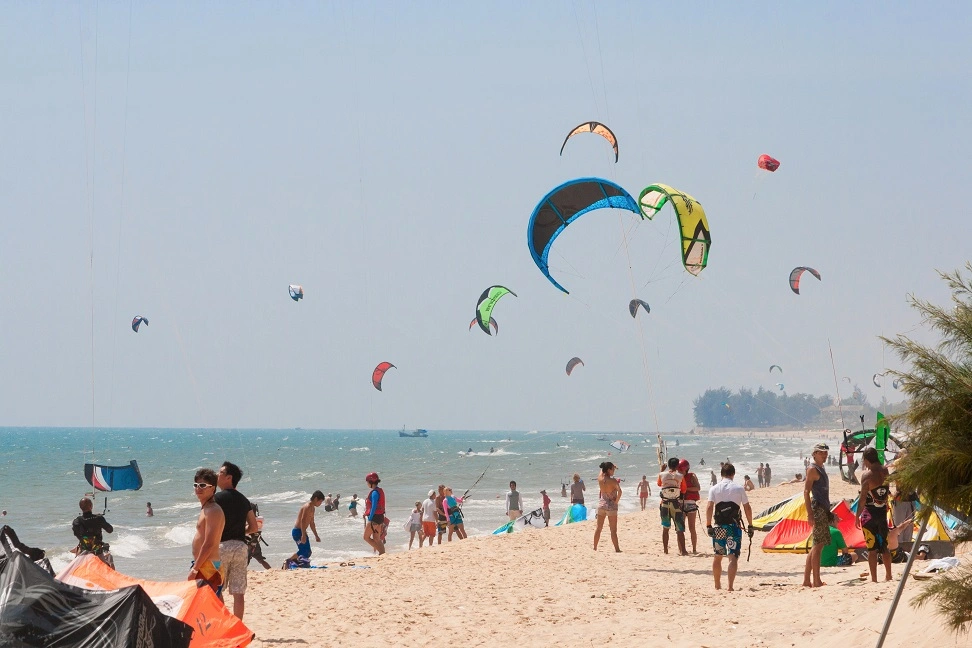
Table of Contents
ToggleWhen Does Kitesurf Wind Season Actually Run?
Wind season runs November through April, with the strongest, most reliable wind from December through February, 20 to 30 knots, driven by the northeast monsoon (Source: Muine Kite School). This is the specific window to target if kitesurfing or windsurfing is your main reason for the trip.
Two independent kite-school operators agree closely on both the season window and its internal shape. November, March, and April carry solid wind too, just less consistently than the three-month December to February core, and the off-season, when wind drops to unreliable and often too light to ride, runs May through October. My Mui Ne kitesurfing guide covers lesson costs, schools, and booking detail in full if that side of the trip is what brought you here; this guide focuses specifically on timing.
The Daily Pattern Within the Season
Even inside peak season, wind is not constant across the day. It typically picks up around mid-morning, strengthens through the afternoon, and drops off again by early evening, a pattern confirmed independently by a second kite school’s own conditions guide (Source: Vietnam Kiteboarding School).
That matters for planning your actual days here, not just your travel dates: mornings suit sightseeing—such as embarking on a Mui Ne Jeep tour across the windswept White Sand Dunes—and calmer water activities, while afternoons are when the waters fill with kite lines and the lesson schedule shifts into gear.

Shoulder months follow a looser version of the same pattern rather than a completely different one. November, March, and April still see wind build through the day on most days, it is simply less guaranteed to reach the same strength or show up every single day the way it does through the December to February core, which is the practical difference between planning a trip specifically for wind and planning one where wind is a welcome bonus.
Is November Really Part of the Dry Season?
Climate datasets disagree on exact numbers but agree on the shape: November still carries real rainfall, cited anywhere from 91 to 209 millimetres depending on the source (Sources: weather2travel.com, climate-data.org), despite being marketed as part of the dry season. The genuinely driest window sits more precisely from December or January through April, peaking in February and March.
Two Datasets, Two Different Numbers
I want to show the actual disagreement rather than quietly picking one figure and presenting it as settled. Two independent climate-data providers track Mui Ne, and while they agree closely on the overall shape of the year—driest around February and March, rain building from April, peaking around September and October, tapering through November and December—their absolute numbers diverge meaningfully.
| Month | Source A (mm) (Source: weather2travel.com) | Source B (mm) (Source: climate-data.org) |
|---|---|---|
| January | 44 | 16 |
| February (driest) | 17 | 3 |
| March | 28 | 13 |
| April | 59 | 39 |
| May | 150 | 111 |
| June | 181 | 112 |
| July | 183 | 103 |
| August | 189 | 99 |
| September | 217 | 142 |
| October (wettest) | 255 | 160 |
| November | 209 | 91 |
| December | 127 | 65 |
Table 1: Monthly rainfall comparison for Mui Ne across two independent climate datasets (in millimeters).

Notice November specifically: even the lower of the two figures, 91mm, is not a trivial amount of rain, and it sits well inside the window most listings market as the start of the dry season. The genuinely driest stretch, by both datasets, runs more precisely from December or January through April, peaking hardest in February and March.
Temperatures stay warm and narrow year-round regardless, roughly 25 to 32°C by day, cooling only marginally in December through February, so heat is never really the variable that should drive your date choice here. That narrow temperature band is actually useful information in its own right: unlike destinations where you are also weighing uncomfortable heat against rain, here the only real variables worth planning around are wind and rainfall, since you will be comfortable in shorts and a t-shirt whichever month you land in.
Unsure Which Month Matches Your Vietnam Journey?
Our local travel planners balance beach conditions, cultural highlights, and seasonal winds across every stop in your itinerary.
What Trade-Off Do You Accept By Visiting in Peak Wind Season?
Peak wind season creates choppier seas and stronger currents, a real, documented trade-off. If swimming and calm water matter more to you than wind, the shoulder months around March and April genuinely balance both better than the December to February peak.
What Visitors Actually Report
This is not a theoretical trade-off. A kite school’s own conditions guide describes the December to February sea as choppy, genuinely well suited to advanced riders and freestyle (Source: Muine Kite School), while March and April bring noticeably calmer water better suited to beginners and, by extension, casual swimmers.
Visitor reports on the ground back this up directly: one December visitor described the ocean as so choppy from the wind that swimming became genuinely impossible against the size of the waves, while a September visitor, well outside peak wind season, described conditions as comfortable for board sports and casual swimming alike (Source: Tripadvisor).

One independent travel writer frames the whole trade-off plainly: the wind and warm water that make this coast excellent for watersports are the same forces that leave the beaches themselves looking, in their words, distinctly less inviting for a classic swim-and-sunbathe stop than a destination built around calm sand (Source: Indie Traveller). If you are weighing coastal atmospheres before booking, our comparative guide on Mui Ne vs Nha Trang breaks down beach quality, swell levels, and resort vibes in detail.
Worth stating clearly rather than leaving implied: this is not a case of one season being objectively better than another, it is two genuinely different experiences of the same coastline, and which one suits you depends entirely on what you actually came here to do.
Case Study: Elena & Mark’s Step-by-Step Itinerary Pivot
To understand how these weather patterns play out in practice, consider Elena and Mark, a couple from Manchester who booked a 10-day trip to Mui Ne based on standard “dry season starts in November” travel advice.
- Step 1: The Initial Booking (Late November) — Mark wanted to kitesurf while Elena wanted a relaxing sun-and-swim beach escape. They booked the final week of November, expecting unbroken sunshine and crystal-clear waters.
- Step 2: The Ground Reality — While Mark found adequate wind (around 16–18 knots), Elena encountered two heavy afternoon downpours that washed silt into the bay, alongside strong shorebreak waves that made casual swimming unsafe for four consecutive days.
- Step 3: The Mid-Trip Adjustment — Shifting their routine, they dedicated mornings to inland cultural visits and sand dunes before the winds built up, and Mark took his kite lessons in the choppier mid-afternoon swell.
- Step 4: The Strategic Return (Late March) — Returning the following year in late March, both got what they wanted: the sea had settled into gentle, swimmable ripples under clear skies, yet afternoon breezes remained steady enough at 14–16 knots for enjoyable freeride kitesurfing.
My Month by Month Recommendation
Come December through February specifically for kitesurfing conditions at their strongest, and accept rougher water for casual swimming during that same window. If wind sports are the actual priority, this three-month window is the one worth building your dates around, even though it means calmer-water activities take a back seat for the length of your stay.
Come March through April for a genuine middle ground, wind still present but easing, seas calmer, and the true dry season fully underway by then rather than still transitioning out of November’s leftover rain, for travellers who want a reasonable share of both wind and swimmable water rather than maximising one at the expense of the other.

The Full Year, Month by Month
Putting the wind and rainfall pictures together gives a clearer answer than either one alone, so here is the complete calendar rather than just the two headline windows above.
| Month | Wind | Rain | Best for |
|---|---|---|---|
| January | Strong, reliable | Low | Kitesurfing, sightseeing |
| February | Strong, reliable | Driest month | Kitesurfing, all-round active holidays |
| March | Strong, easing | Low | Balanced wind and swimming |
| April | Moderate, easing further | Rising | Balanced wind and swimming, true dry season winding down |
| May | Light, unreliable | Rising sharply | Swimming and sightseeing, not kitesurfing |
| June | Light, unreliable | High | Off-season, expect rain |
| July | Light, unreliable | High | Off-season, expect rain |
| August | Light, unreliable | High | Off-season, expect rain |
| September | Light, unreliable | Very high | Off-season, calmest water of the year |
| October | Light, unreliable | Wettest month | Off-season, avoid if rain is a dealbreaker |
| November | Building, moderate | Still substantial | Wind returning, but budget for real rain |
| December | Strong, reliable | Moderate, easing | Kitesurfing conditions ramping back up |
Table 2: Month-by-month breakdown of wind reliability, rainfall levels, and ideal activities in Mui Ne.
Read across a row rather than picking a month in isolation. September, for instance, has the calmest water of the year precisely because the wind that makes swimming difficult in December through February has not yet returned, but it pairs that calm water with genuinely heavy rain.
There is no single calendar slot that maximizes everything at once; the honest read is a set of trade-offs that shift gradually across the calendar rather than a hard line between one good season and one bad one. If your trip has any flexibility at all, that gradual shift is worth exploiting: shifting a planned November trip even two or three weeks later into December, for instance, genuinely buys you both stronger wind and a meaningful drop in rainfall risk, for very little cost to the rest of your itinerary.

Frequently Asked Questions About the Best Time to Visit Mui Ne
Key questions answered on seasonal wind consistency, rainfall fluctuations, swimming viability, and planning advice for Mui Ne.
When is the best time to visit Mui Ne?
Quick Answer: December through February for wind sports, or March through April for calm seas.
December through February offers the strongest, most reliable kitesurfing wind (20–30 knots). March through April provides a superior balance of dry, sunny weather and calmer, swimmable water.
When is kitesurfing season in Mui Ne?
Quick Answer: November through April, with peak consistency from December to February.
November through April overall, with the reliable three-month core running December through February at 20 to 30 knots. May through October is the unreliable off-season for wind.
Is November a good time to visit Mui Ne?
Quick Answer: Good for wind enthusiasts, but not reliably dry.
It has decent wind but real rainfall, cited anywhere from roughly 90 to 210 millimetres depending on the data source. Treat it as a wind-season month, not a dry-season one.
Is Mui Ne good for swimming in kite season?
Quick Answer: Generally no during peak wind months (December–February).
Not during the December to February peak specifically, when choppy seas and stronger currents make casual swimming genuinely difficult. March and April offer calmer water while wind is still present.
What is the wettest month in Mui Ne?
Quick Answer: October is statistically the wettest month.
October, by both climate datasets checked, followed closely by September. Rain builds steadily from April and tapers through November and December, so treat the second half of the year broadly as the rainier half regardless of which exact month you land on.
Is Mui Ne warm year-round?
Quick Answer: Yes, daytime temperatures remain warm (25–32°C) year-round.
Yes, with only a narrow seasonal band, roughly 25 to 32°C by day. Temperature is not the variable to plan your trip around here; wind and rainfall are, and both shift meaningfully across the calendar even while the temperature barely moves.
Conclusion
Summary takeaway on choosing the ideal month for Mui Ne, balancing kitesurfing winds against calm waters and realistic weather.
Pick December through February if kitesurfing is genuinely why you are coming, and accept that swimming takes a back seat for those months. Pick March or April if you want a fair balance between wind and calmer water, and budget for real rain rather than assuming a clean dry season if November is the only window that fits your schedule. The honest version of this coast’s calendar serves you better than the flattened one-season pitch most listings still run with.
If you are planning comprehensive Vietnam holidays that feature Mui Ne or would like an itinerary aligned with your seasonal interests, feel free to contact us directly. Once your travel dates are locked in, our guide on Mui Ne transport details the most reliable ways to get here smoothly.

Ready to Plan Your Journey Across Vietnam?
From the sand dunes of Mui Ne to the cultural heartlands of Hanoi and Hoi An, our customized tours match the right seasons to every destination.
Further Reading & Resources
Independent data sources, conditions reports, and regional recognitions referenced throughout this seasonal analysis.
- Muine Kite School — wind speeds, season window, and the peak-season swimming trade-off: Direct Link
- Vietnam Kiteboarding School — the daily wind pattern and season corroboration: Direct Link
- weather2travel.com — monthly rainfall data: Direct Link
- climate-data.org — the second independent rainfall dataset: Direct Link
- Tripadvisor traveller forum — firsthand December versus September water conditions: Direct Link
- Indie Traveller — the wind-versus-beach-quality trade-off: Direct Link
- VietnamPlus — the Booking.com 2026 trending-destination recognition: Direct Link

Vani is the Founder and Lead Travel Designer at Truly Voyage. With over a decade of experience and a deep passion for her Vietnamese heritage, she specializes in crafting bespoke, unhurried itineraries. Vani is dedicated to helping travellers experience the authentic soul of Southeast Asia with absolute financial security and 24/7 on-ground support.
0 Comment