


Da Nang food guide: Craving authentic Central Vietnamese cuisine? Da Nang delights foodies with turmeric-infused Mi Quang, crispy Banh Xeo dipped in rich pork-liver sauce, breakfast Bun Cha Ca, and fresh beachside seafood. Navigate Han Market and Helio Night Market confidently with clear per-kilo pricing to savor the city’s finest street eats without overpaying.
Steam rose off the bowl before I had even sat down, turmeric-yellow noodles glistening under a thin coat of broth that barely qualified as broth at all. The vendor next to me was already three bites into her own bowl, elbow propped on a plastic table worn smooth by years of exactly this.
Somewhere behind me, a grill hissed as someone else’s order hit the flame, the smell of charring pork drifting over before the plate ever arrived. This is the da nang food guide I wish someone had handed me before my first meal here, the one that gets past the handful of Instagram dishes everyone already knows and into what actually fills this city’s tables every single day.
Ten dishes, one very specific warning about your seafood bill, and the night market you need to visit at least once. Let’s eat. 🍜

Table of Contents
ToggleThe Flavors of Central Vietnam
Central Vietnamese food sits in its own category, distinct from the sweeter, richer cooking of the south and the more restrained, delicate flavours of the north when exploring culinary Vietnam holidays. Da Nang’s kitchens lean into bold, layered seasoning, fish sauce and fresh herbs doing heavy lifting, chilli used with real confidence rather than as an afterthought. 🌶️
💡 Vani Tips
Do not stop at the famous three. Bun cha ca, a fish cake noodle soup (Source: Jewel Tours), and banh trang cuon thit heo, pork wrapped in rice paper (Source: Danang Fantasticity, Da Nang City Tourism Information Portal), are both genuine local specialties that get far less attention than they deserve.
- Bun cha ca: Shows up on breakfast tables across the city, a clear, faintly sweet broth simmered from fish bones, tomato, and pineapple, springy handmade fish cake floating on top, the kind of dish locals eat without a second thought that visitors somehow keep walking past.
- Banh trang cuon thit heo: Takes the concept of a DIY spring roll and elevates it, thin slices of boiled pork belly, specifically cut so each piece shows two distinct edges of skin, wrapped fresh at the table with herbs and dipped into mam nem, a pungent fermented anchovy sauce that is genuinely nothing like the fish sauce dip most visitors already know.

Building Your Mental Map of the City’s Food
Before diving into specific dishes, it helps to know where Da Nang’s food actually concentrates 🗺️. Han Market anchors the daytime scene, stalls and small eateries clustered around the city’s oldest commercial hub. The beachfront strip along Vo Nguyen Giap near My Khe Beach handles the seafood-and-sunset crowd.
Inland, tucked into alleys locals call hem, sit the family-run spots serving the dishes that rarely make it onto an English-language menu at all. Moving between these three zones across a single Da Nang itinerary 2–3 days, rather than staying anchored to one, is genuinely the fastest way to eat your way through what this city actually offers.
Locals rarely eat all three types in one sitting, treating them instead as different moods entirely: a quick working lunch near Han Market, a slow sunset seafood spread on the beach, or a late-night bowl of something rich down an alley nobody thought to translate for visitors. Depending on the best time to visit Da Nang, you can time your street food walks during pleasantly cool evenings.
The Star of the Show: Mi Quang
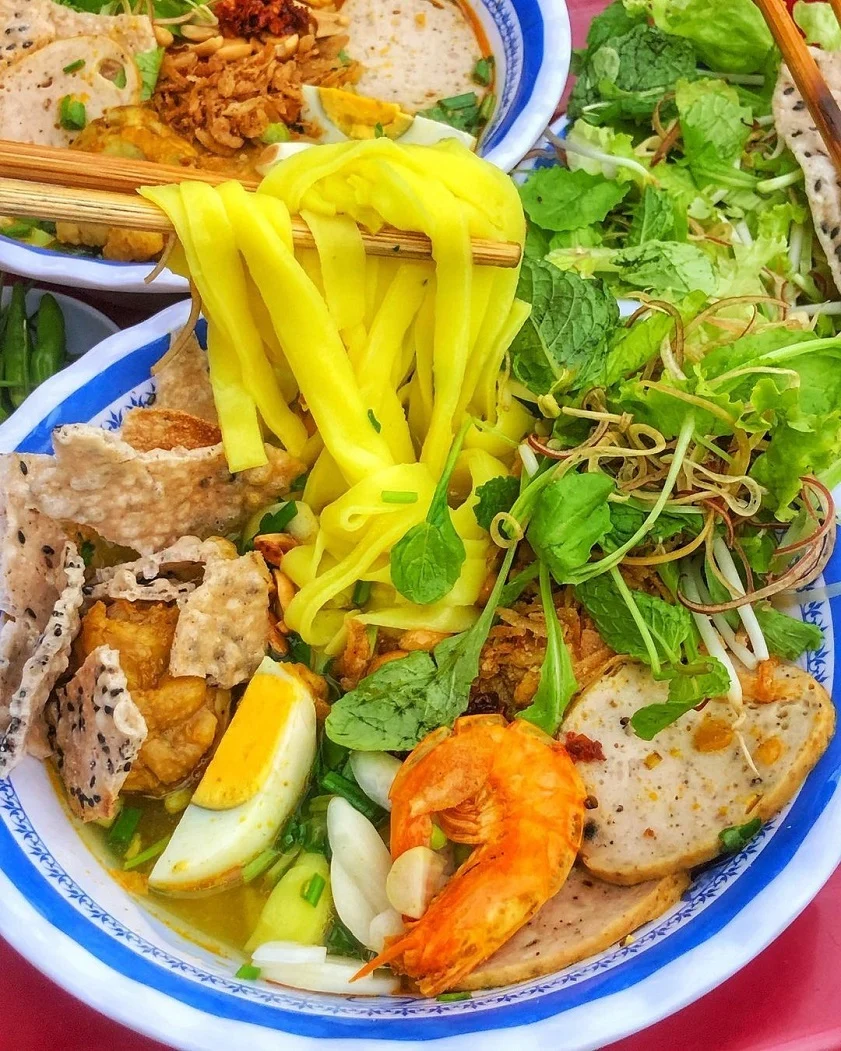
Somewhere between a noodle soup and a noodle salad sits Mi Quang: turmeric-stained rice noodles, a scattering of pork, shrimp, and quail egg, roasted peanuts and rice crackers for crunch, all of it moistened rather than drowned. 🥢
💡 Vani Tips
Mi Quang is technically a Quang Nam province dish that Da Nang has adopted as its own signature, not an exclusively Da Nang invention. It uses minimal broth, just enough to moisten the noodles, so do not expect a soup the way you might with pho. This distinction matters more than it sounds. Order it expecting a full bowl of liquid and you will be confused by what arrives: a shallow pool at the bottom of the bowl rather than anything you could properly slurp. That is not a lesser version of the dish. It is the entire point.
Why Less Broth Changes Everything
Stripping away the broth forces every other ingredient to work harder:
- The Noodles: Thick and slightly chewy, carrying turmeric’s earthy colour and flavour directly rather than having it diluted into a soup base.
- Textural Contrast: Roasted peanuts and a broken rice cracker add textural contrast that would simply drown in a fuller broth.
- Fresh Aromatics: Fresh herbs, mint and Vietnamese coriander among them, sit on top rather than wilting into hot liquid, staying crisp through the whole bowl.
The result eats faster and lighter than pho, less a meal you settle into and more one you move through with real momentum, which is exactly why it works as well for a quick lunch as it does for a leisurely breakfast.
Taste Central Vietnam Like a True Insider 🍲
Planning your culinary adventure across Da Nang, Hoi An, and Hue? Let our local travel designers create a handcrafted foodie itinerary tailored to your palate.
Sizzling Banh Xeo Down Hidden Alleys
Listen for it before you see it: a sharp, aggressive sizzle as rice batter hits a scorching hot pan, shrimp and pork tossed in seconds before the whole thing folds shut into a crescent. 🥞

💡 Vani Tips
Wrap it in rice paper with fresh herbs and dip it in the local peanut and pork liver sauce, not the lighter fish-sauce dip used in other regions. That sauce is specifically what makes the Da Nang version different. Thick, almost paste-like, built from ground peanuts, minced pork, and pork liver, it clings to the roll in a way thin fish sauce simply cannot, turning what could be a fairly plain rice pancake into something considerably richer. Ba Duong, a decades-old spot at the end of an unassuming alley, earned a Michelin recognition in 2025 (Source: Michelin Guide) for exactly this style, and the crowd waiting outside most evenings tells you the sauce is doing exactly what it should.
Reading the Regional Difference
Southern Vietnam’s banh xeo runs large and thin, folded generously and dipped in a light, sweet-sour fish sauce (Source: VietnamSpot). Da Nang’s version goes the opposite direction: smaller, thicker, fried until the edges genuinely shatter, the crepe itself almost secondary to that dark, savoury sauce built around it.
| Dish Specialty | Broth / Base Type | Signature Dipping Sauce | Key Textural Feature | Ideal Time of Day |
|---|---|---|---|---|
| Mi Quang | Shallow turmeric-pork broth | Fish sauce with crushed garlic & bird’s eye chili | Crunchy roasted peanuts & toasted rice cracker | Breakfast & Lunch |
| Banh Xeo Da Nang | Crispy pan-fried rice flour pancake | Warm, thick ground peanut & pork liver paste | Crispy crepe wrapped in pliable rice paper | Late Afternoon & Dinner |
| Bun Cha Ca | Clear broth simmered with tomato & pineapple | Mắm ruốc (fermented shrimp paste) on the side | Springy steamed & fried fish patties | Early Morning Breakfast |
| Banh Trang Cuon Thit Heo | Fresh table-wrapped platter | Pungent Mắm Nêm (fermented anchovy sauce) | Two-edge skin pork belly with fresh wild herbs | Lunch & Casual Dinner |
Table 1: Comparison of Signature Da Nang Dishes and Flavor Profiles
If you have already eaten banh xeo somewhere else in Vietnam and assumed you knew the dish, Da Nang’s take is worth resetting your expectations for entirely. Order it hot, eat it immediately, and do not let the pancake sit long enough to lose its crackle before you wrap the first piece. Every family-run stall guards its own version of the sauce closely, which is part of why regulars stay loyal to one specific vendor for years rather than treating banh xeo as interchangeable between shops.
The Helio Night Market Experience
Grilled skewers, live music drifting between food stalls, families claiming plastic tables three and four deep: Helio is where a genuinely large slice of Da Nang spends a weeknight rather than a tourist-only production staged for visitors. 🎪
💡 Vani Tips
Helio’s outdoor food stalls and live music have historically run daily from about 5:30 to 10:30pm and are free to enter. Some of the indoor attractions have gone through renovation closures recently (Source: Danang Fantasticity, Da Nang City Tourism Information Portal), so treat those as a bonus, not the main reason to go. The market underwent a significant closure starting in September 2025 for a comprehensive renovation, with an initial target of reopening by the end of that year. More recent activity around the site suggests it has returned to regular operation, but confirm current hours before building an entire evening around it rather than assuming the pre-2025 schedule still applies exactly as it once did.
What Actually Happens Once You’re Inside
- Grilled Seafood Zone: Smoke curls off charcoal grills faster than vendors can keep pace with orders of buttery scallops, cockles, and squid skewers.
- Central Delicacies: Mi Quang and banh xeo both show up here too, offering a fair, honest introduction if you have not tried them elsewhere yet.
- Entertainment Stage: A stage toward the back runs live music most evenings, covers and local pop mixed with the occasional acoustic set, loud enough to feel festive without drowning out conversation at the tables nearest the food stalls.

Arrive hungry and undecided rather than with a fixed plan. Half the appeal here is wandering between stalls, following whatever smells best in the moment rather than sticking to a predetermined list.
Navigating the Seafood Restaurants
Da Nang’s beachfront seafood strip delivers exactly what the postcards promise: live tanks, fresh catch, tables spilling out toward the sand as the sun goes down. 🦀 It is also where the single most common overcharging complaint in this city consistently originates. The seafood itself is rarely the problem. Crab, prawns, clams, and whole grilled fish here are genuinely fresh, often still moving in the tank minutes before they reach your table, and the cooking is usually excellent regardless of which specific restaurant you land at along the strip.
💡 Vani Tips
Before you order anything sold by weight, ask directly whether the listed price is per kilo or per 100 grams, and insist the item is weighed in front of you out of the tank. This single question prevents most of the overcharging complaints clustered around the beachfront strip. The trick is rarely a fake menu or a doctored scale. It is simply letting a customer assume a listed price is per kilo when the fine print, sometimes genuinely tiny, says per 100 grams instead, a five-fold difference that only becomes obvious once the bill lands on the table.
The Exact Script Worth Using
- Step 1: Point and Inquire: Point at what you want in the live tank and ask plainly: “Is this price per kilogram or per 100 grams?”
- Step 2: Watch the Scale: Watch the item get weighed before it leaves the counter for the kitchen, and ask to see the number on the scale display yourself.
- Step 3: Confirm Final Inclusions: Clarify cooking style charges and whether VAT or service charges are added to the final receipt.

Step-by-Step Case Study: How Sarah & Mark Avoided a $150 Seafood Trap
While strolling along Vo Nguyen Giap street, Sarah and Mark stopped by a bustling seafood restaurant with lively tanks. They selected two medium-sized mud crabs. The board listed “Crab: 180k”. Instead of assuming the price was 180,000 VND per kilogram, Mark followed our exact script:
- Action Taken: He asked the server directly, “Is this 180k per kilo or per 100 grams?” The staff clarified it was per 100 grams (making it 1,800,000 VND/kg).
- The Result: Instead of an unexpected $120 surprise on their bill, they switched to steamed lemongrass clams and grilled tiger prawns with clear per-kilogram rates, watched the basket placed openly on the digital scale (850 grams of prawns), and enjoyed an exceptional feast for under $25 total.
Reputable spots handle the question without a flicker of irritation, since honest operators answer it a dozen times a night anyway. Restaurants that dodge the question directly, or seem annoyed you asked at all, are worth walking away from before you order rather than after the bill arrives. A restaurant with a clear, printed price list per kilogram, weighed openly at a visible scale, is almost always the safer bet over one relying on a verbal quote from a server hovering near your table.
Frequently Asked Questions
Here are concise answers to the most common questions travelers ask when planning their food adventures across Da Nang:
What is the most famous food to eat in Da Nang?
Quick Answer: Mi Quang noodles and crispy Banh Xeo pancakes.
Mi Quang and banh xeo top most lists, though bun cha ca (fish cake noodle soup) and fresh grilled beachfront seafood are equally central to how locals actually eat day to day.
What is the difference between Mi Quang and pho?
Quick Answer: Mi Quang uses a shallow broth coating, while pho is a full noodle soup.
Mi Quang uses minimal broth, just enough to coat the turmeric noodles and intensify flavors, while pho is a full, brothy soup. The two are closer to different categories of dish than variations on the same idea.
Is seafood expensive in Da Nang?
Quick Answer: Seafood is reasonably priced if you verify per-kilo versus per-100-gram rates.
It can be reasonable or genuinely overpriced depending entirely on how carefully you confirm the per-unit price before ordering, since per-kilo versus per-100-gram confusion is the main driver of inflated bills here.
What time does Helio Night Market open?
Quick Answer: Daily from roughly 5:30pm to 10:30pm.
Historically open around 5:30pm and running through roughly 10:30pm. The market underwent a major renovation closure starting in September 2025, so confirm current operational hours before your visit.
What is the best street food area in Da Nang?
Quick Answer: Han Market by day, beachfront strip and Helio Night Market by night.
Han Market for daytime eating, the beachfront strip for seafood, and Helio Night Market for an evening mix of both food and lively social atmosphere together.
Final Word From Vani
Eat the dishes everyone already knows, but do not stop there. Order bun cha ca one morning and banh trang cuon thit heo one evening, both dishes that rarely make it onto a shortlist but genuinely define how this city eats day to day. ✨
Then, before your first seafood dinner on the beachfront strip, ask the per-kilo-or-per-100-gram question out loud, every single time, no exceptions. That one habit will save you more money and more frustration than any other single piece of advice in this guide.
Come hungry, come curious, and let the smell drifting out of whichever alley you happen to be walking down decide your next stop more often than any list, including this one, ever could.
For more local culinary stories and destination guides, explore our full travel blog. If you’d like to learn more About Truly Voyage and how we craft authentic journeys, or need tailored travel assistance, feel free to contact our team.

Ready to Experience Da Nang’s Culinary Magic? ✈️
From street-side noodle stalls to private sunset seafood banquets, let Truly Voyage design your seamless Central Vietnam journey with expert local guides.
Further Reading & Resources
- Bánh Tráng Cuốn Thịt Heo or Pork rice paper roll, Danang Fantasticity, Da Nang City Tourism Information Portal: Direct Link
- Helio Center (temporarily suspended), Danang Fantasticity, Da Nang City Tourism Information Portal: Direct Link
- Banh Xeo Ba Duong, Michelin Guide: Direct Link
- Bun Cha Ca (Fish Cake Noodle Soup), Jewel Tours: Direct Link
- Banh Xeo: Vietnam’s Sizzling Pancake, VietnamSpot: Direct Link

Vani is the Founder and Lead Travel Designer at Truly Voyage. With over a decade of experience and a deep passion for her Vietnamese heritage, she specializes in crafting bespoke, unhurried itineraries. Vani is dedicated to helping travellers experience the authentic soul of Southeast Asia with absolute financial security and 24/7 on-ground support.
0 Comment