


 By Vani
How to get to Hoi An: fly into Da Nang International Airport (DAD), about 30 km away, then take a Grab or taxi for 45 to 60 minutes, because Hoi An has no airport of its own. Vietnam Tourism lists a Grab 4-seater at 250,000–350,000 VND (about $10–14) and an airport taxi at 300,000–400,000 VND.
Your plane touches down, the seatbelt sign clicks off, and within twenty minutes you are standing at arrivals with a suitcase and no reference point for what happens next ✈️. A driver may already be offering to carry your bag before you have finished reading the exit signs, quoting a number with high confidence, and you have no way of knowing whether that number is fair.
Knowing the route into this town starts with one key fact: almost everyone arrives through the same airport first. What you decide in the first few minutes after you walk out of that terminal shapes whether your trip starts calmly.
The Closest Airport: Da Nang (DAD)
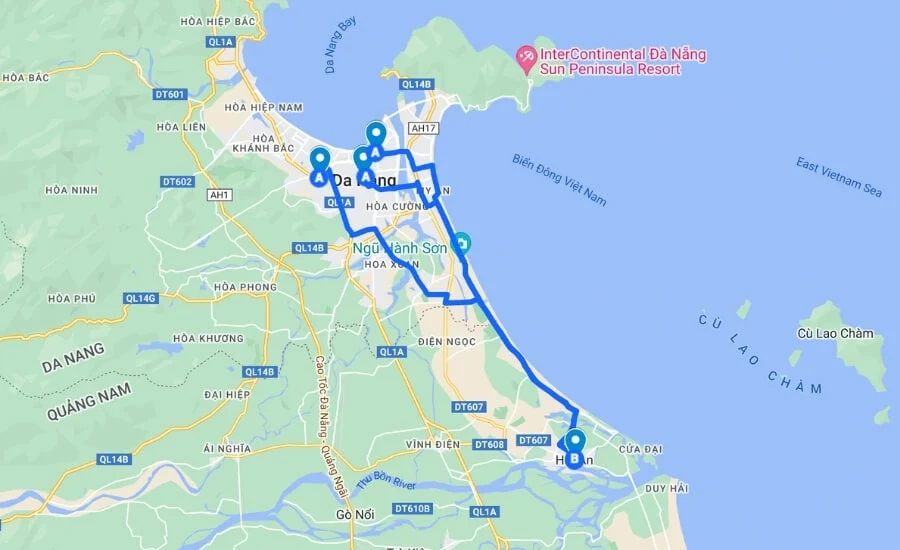
There is no airport in Hoi An itself, and Da Nang International Airport (DAD) is the gateway for arrivals, whether you are flying in from within Vietnam or connecting internationally. Plan the rest of your transport around that fact.
Da Nang airport has two separate terminals, one for international and one for domestic passengers (Source: Wikipedia), so check which one your airline uses before you land. It is about 30 km from Hoi An (Source: Vietnam Tourism).
If you are connecting through Hanoi or Ho Chi Minh City, there are plenty of flights to Da Nang. Vietnam Airlines, Vietjet Air and Bamboo Airways all operate multiple daily flights from both cities (Source: Vietnam Tourism), so a same-day connection is usually easy to build without an overnight layover.
What a Realistic Connection Actually Looks Like
The flight takes about 1 hour 15 minutes from Hanoi and 1 hour 20 minutes from Ho Chi Minh City (Source: Vietnam Tourism). Wikipedia lists Hanoi–Da Nang with 319 weekly flights and Ho Chi Minh City–Da Nang with 250, the second and third busiest routes in Vietnam (Source: Wikipedia); schedules change, so check the airlines for current times. With multiple flights each day, international arrivals at either hub have a realistic same-day option.

Build in at least a two to three hour buffer between landing at Hanoi or Ho Chi Minh City and your connecting flight’s departure ⏱️, particularly if your international arrival requires clearing immigration, collecting checked baggage, and moving between terminals at either hub. That buffer absorbs the ordinary friction of a first arrival into an unfamiliar airport without turning a tight connection into a stressful sprint through unfamiliar signage.
Da Nang to Hoi An (Grab, Taxi, Private Car)
Vietnam Tourism lists the Da Nang airport to Hoi An transfer at 250,000–350,000 VND (about $10–14) by Grab 4-seater and 300,000–400,000 VND (about $12–16) by airport taxi. Knowing these figures before you land makes it easier to judge any quote you are given.
At any airport, someone who has just landed, is tired, and has no reference point for what a transfer should cost is the easiest person to quote a high price to. Knowing the usual range now, before you board your flight to Da Nang, is the simplest protection. Grab shows the fare upfront, so there is no haggling (Source: Vietnam Tourism).
How Do You Book a Grab for the Da Nang Airport to Hoi An Transfer?
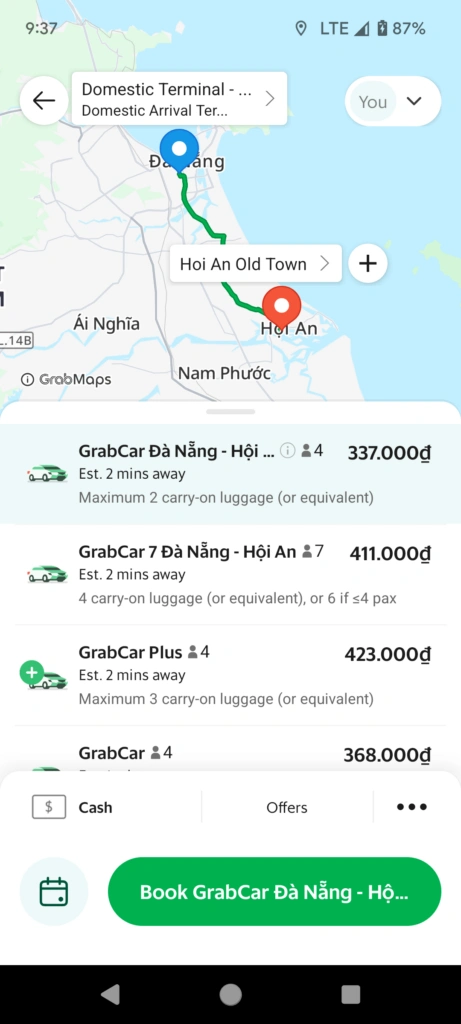
Open the Grab app while you are still inside the terminal, set the pickup and your hotel in Hoi An, and check the fare it shows before you walk outside.
Before you go
- Install Grab and add a payment method before you fly, while you still have reliable wifi.
- Compare the fare in the app with the 250,000–350,000 VND range for a 4-seater.
- Allow 45 to 60 minutes for the ride before you plan a hotel check-in or dinner.
Who it suits
- Travellers with a smartphone and a data or wifi connection who want a price shown upfront.
Who may prefer something else
- Travellers without a smartphone, who may prefer an airport taxi (Mai Linh, Vinasun) at fixed rates (Source: Vietnam Tourism), or a private car pre-booked through their hotel.
Book your Grab from inside the terminal, before you walk out to the curb. Opening the app while you are still inside, and walking toward the exit with a price already on your screen, removes most of the guesswork about what a fair fare looks like. If a driver outside quotes a figure far above the range in this guide, you can simply decline.
Why the Ride Takes as Long as It Does
The distance is about 30 km, and private car transfers take 45 to 60 minutes (Source: Vietnam Tourism). Time of day, road conditions and your exact drop-off point within Hoi An all shift the total slightly, so a quote that assumes a short 15-minute hop does not fit the distance.
| Transfer Method | Price | Time |
|---|---|---|
| Grab (4-seat, booked inside terminal) | 250,000-350,000 VND (about $10-14) | 45-60 minutes |
| Taxi (Mai Linh, Vinasun) | 300,000-400,000 VND (about $12-16) | 45-60 minutes |
| Unofficial curbside driver | Agree the price before you get in | Same |
| Private car (pre-booked) | Varies by operator | 45-60 minutes |

A JOURNEY SHAPED AROUND YOU
Start with what matters.
We can plan from there.
Tell us what you enjoy, how you like to travel and where you would like more time. We can discuss a private itinerary around your interests and preferred pace.
Arriving from Hanoi or Ho Chi Minh City
If your Vietnam itinerary starts elsewhere and Hoi An is a later stop, a domestic flight into Da Nang remains the fastest, most practical route regardless of which city you are departing from.
Both major domestic hubs connect to Da Nang across multiple airlines throughout the day, and neither route demands the kind of advance planning that international long-haul connections often require.
The Ho Chi Minh City and Hanoi routes to Da Nang are among the busiest in Vietnam (Source: Wikipedia), which makes last-minute or flexible booking realistic if your plans shift. Either way, the flight itself takes roughly an hour and a quarter, short enough that this leg of the journey barely registers against whatever international flight brought you into the country in the first place.
Is There a Train to Hoi An?
Not directly, and this catches some travellers off guard 🚂. Hoi An has no train station of its own. Trains arrive at Da Nang Railway Station in the city centre (Source: Vietnam Tourism), so a train journey from Hanoi or Ho Chi Minh City still requires the same road transfer from Da Nang that a flight would, just after a considerably longer journey by rail first. For most itineraries, flying into Da Nang and transferring by Grab or taxi remains the faster, simpler option unless the train journey itself is part of what you are travelling for.

The scenic argument for the train is real, particularly the stretch along the coast approaching Da Nang, but the time cost is substantial. On the SE1 timetable listed on Wikipedia, the train leaves Hanoi at 22:20 and reaches Da Nang at 13:25 the next day, around 15 hours (Source: Wikipedia), which makes it a deliberate choice for the journey itself rather than a practical option for anyone working with limited holiday time.
Getting Around Hoi An Town
Rent a bicycle for about 30,000 to 50,000 VND a day (roughly $1.20–2) from most hotels, or use a GrabBike for longer distances. Once you have arrived, getting around Hoi An itself costs far less than the airport transfer that got you here.
A bicycle remains an excellent way to reach the countryside 🚲, Tra Que village, the coconut forest, An Bang beach, without depending on a driver’s schedule or availability. GrabBike offers a faster alternative for longer distances or hotter afternoons when cycling feels like too much effort.
Between the two, most visitors end up using both across a multi-day stay, cycling for the unhurried countryside mornings and GrabBike for a quick, sweat-free trip when time or heat makes pedalling less appealing.

Bicycle rental is about 30,000 to 50,000 VND a day from most hotels (Source: Vietnam Tourism). Neither a bicycle nor a GrabBike needs advance booking, so decide day to day based on the weather and how far you are actually going that particular morning.
Walking the Old Town Itself

Vietnam Tourism lists a motorbike ban in the old town from 9:00 to 11:00 and from 15:00 to 21:00 daily, and its English guide says cars and motorbikes are restricted during daylight hours, so walking is the default (Source: Vietnam Tourism). Hours can change, so confirm current vehicle access with your hotel. Outside the pedestrian core, cycling and GrabBike both remain practical for reaching anywhere the old town’s narrow lanes do not comfortably cover on foot.
Once inside the restricted core, distances shrink enough that a car or motorbike would barely save time anyway, and most of the old town’s key sights sit within a comfortable walk of each other 🚶♂️. Save the bicycle and GrabBike for the trips that actually justify them, reaching the beach, the countryside, or a destination outside the pedestrian zone entirely.
Before You Go
Download the Grab app now, while you still have reliable wifi, not at the arrivals curb. Know the usual fare range before you land, and remember that the ride takes 45 to 60 minutes regardless of what a curbside quote implies about the distance.
Once you have arrived, a rented bicycle handles most of what you will actually want to reach, and our Cycling in Hoi An guide maps out the countryside route worth taking once you have settled in.
For everything to actually do once you arrive, our guides to the old town and the beaches show how the town, the coast and the countryside fit together across however many days you have.
FAQ: How to Get to Hoi An
How much does a taxi from Da Nang airport to Hoi An cost?
Vietnam Tourism lists 250,000 to 350,000 VND for a 4-seat Grab and 300,000 to 400,000 VND for an airport taxi.
Grab shows the fare upfront; with any other driver, agree the price before you get in.
How far is Hoi An from Da Nang airport?
About 30 kilometres.
It is a 45 to 60 minute drive depending on traffic and your exact drop-off point.
Is there a train to Hoi An?
Not directly.
Trains run to Da Nang station, so a road transfer to Hoi An is still required regardless of how you arrive.
How do I get around Hoi An without a car?
Bicycle rental, GrabBike, and walking cover nearly everything.
The old town restricts motorbikes and cars at set times anyway.
How do I get from Hanoi to Hoi An?
Fly Hanoi to Da Nang.
Several airlines fly the route every day and the flight takes about 1 hour 15 minutes, then transfer by Grab or taxi, 45 to 60 minutes, to reach Hoi An itself.
Can I book a private car in advance for the Da Nang airport transfer?
Yes, many local operators and hotels offer this service.
Many local operators and hotels offer pre-booked private car transfers with a driver waiting with a name sign; ask for the price in advance and compare it with the Grab fare in the app.
Further Reading & Resources
Where the figures in this guide come from, plus related guides for planning your trip.
Sources
- Getting to Hoi An: from Da Nang airport and beyond (updated 7 October 2026) Vietnam Tourism
- Things to do in Hoi An besides the lanterns (updated 29 August 2026) Vietnam Tourism · in Vietnamese
- Da Nang International Airport Wikipedia
- Vietnam Railways SE1/2 train Wikipedia
Related guides
A JOURNEY SHAPED AROUND YOU
Start with what matters.
We can plan from there.
Tell us what you enjoy, how you like to travel and where you would like more time. We can discuss a private itinerary around your interests and preferred pace.

Vani is the Founder and Lead Travel Designer at Truly Voyage. With over a decade of experience and a deep passion for her Vietnamese heritage, she specializes in crafting bespoke, unhurried itineraries. Vani is dedicated to helping travellers experience the authentic soul of Southeast Asia with absolute financial security and 24/7 on-ground support.
0 Comment