Incense Village Hanoi (Quang Phu Cau) is remarkably stunning, but poorly timed visits often lead to crowded courtyards and flat-looking photos. Don’t waste your morning guessing! This guide reveals the precise travel distance, current photography fees, ideal shooting hours, and respectful etiquette to help you capture vibrant, authentic moments seamlessly.
Incense village Hanoi is the nickname most travellers use for Quang Phu Cau, a craft hamlet about 35 kilometres south of the Old Quarter that has quietly become a highly photographed place in Northern Vietnam 📸. I am Vani, founder of Truly Voyage, and I still remember the first photo one of our guides sent back from Quang Phu Cau: hundreds of incense bundles fanned out across a courtyard like a field of red flowers, glowing under low morning light 🌅. That single image is a major reason people search for this village in the first place, and it is also the reason so many visits feel rushed or badly timed, since the internet rarely explains when to go, how far it really is, or what a fair price looks like. This guide fixes that 💡.
Below, you will find the real distance and travel time from Hanoi, current photography fees, the specific hours and season that give you ideal light, respectful etiquette for a genuine working village, and how our half-day photo tour brings all of this together. For more of my personal travel experiences, tips, and dedicated advice, you can explore our blog. If you are planning your wider journey, be sure to browse our full collection of Vietnam holidays and our comprehensive Hanoi travel tips.
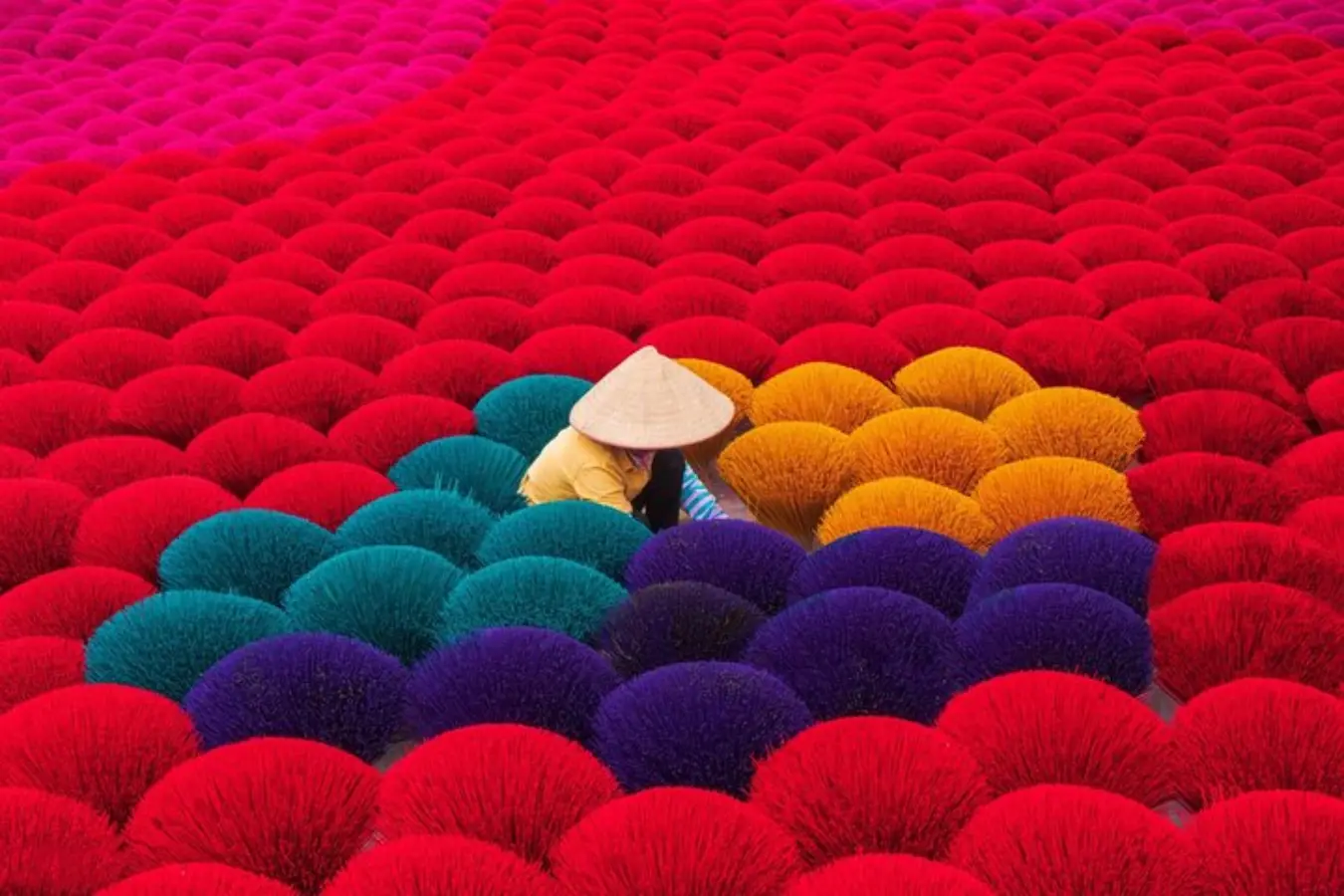
Breathtaking morning sunlight hits the vibrant red bundles at Incense Village Hanoi.
What Is the Hanoi Incense Village and Why Did It Go Viral?
The Hanoi incense village of Quang Phu Cau (Quảng Phú Cầu) is a cluster of six hamlets, Xa Cau, Quang Nguyen, Phu Luong Thuong, Phu Luong Ha, Cau Bau and Dao Tu, that have made incense sticks and their bamboo cores for more than a century *(Source: local commune profile, Dandautu.vn)*. Local records trace the craft back to Le Xuan Vinh of Phu Luong Thuong hamlet, who began splitting bamboo into incense cores before the trade spread across the neighbouring hamlets, and production modernised significantly after 2010, when artisan Nguyen Huu Chuyen brought back manufacturing techniques learned on trips to India, allowing households to move from fully hand-rolled sticks to machine-assisted production *(Source: Vietnam Tour guide, vietnamtour.in)*. Today, several hundred households across the six hamlets still take part in some stage of the work, from bamboo splitting to dyeing, even as large-scale manufacturing has consolidated into a smaller number of bigger workshops, and in the old commune of roughly 13,000 residents, more than 75 percent of household income came from incense production and related trade *(Source: Dandautu.vn commune profile)*.
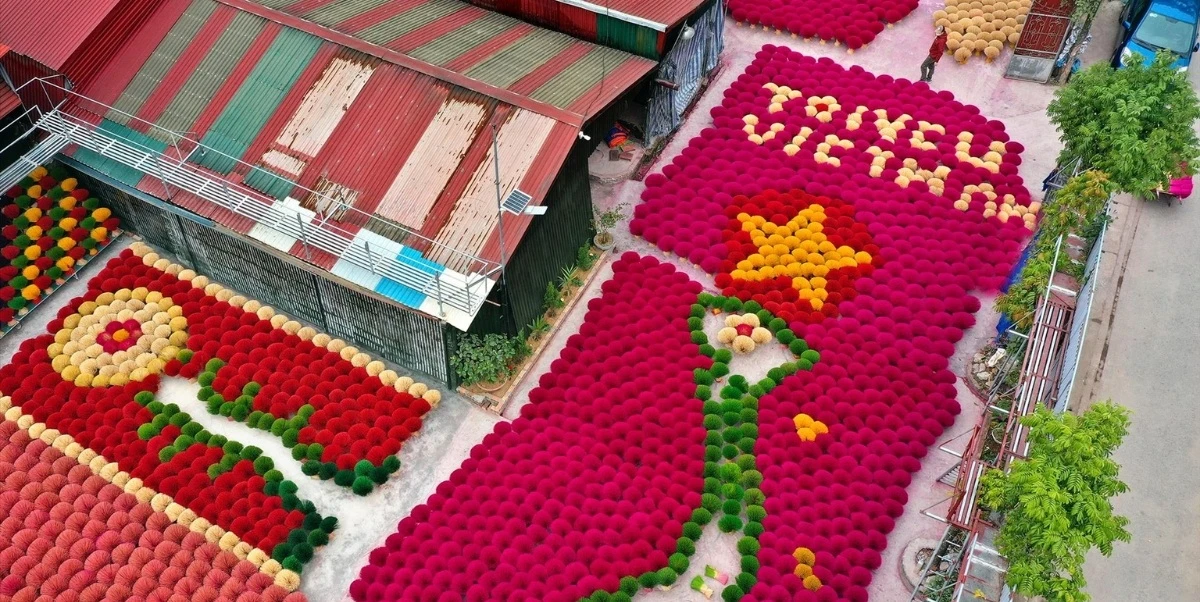
Artisans arrange colourful bundles into creative patterns ahead of the busy Tet festival season.
The colours you now see online have an economic story behind them 📊. Until 2019, the village exported an estimated 300 tonnes of incense to India each year; a partial Indian import ban that year pushed many households to diversify into brighter colours, longer sticks and more decorative arrangements aimed at domestic buyers and, increasingly, visitors with cameras *(Source: Business Insider documentary, cited via Erin Henderson Media)*. That pivot is very likely why the fan-shaped, flower-like patterns became so common in the first place. In January 2024, international wire agency AFP photographed the village ahead of Tet, and its images, republished by outlets including Malay Mail, showed workers arranging incense bundles into the shape of the Vietnamese map and national flag *(Source: AFP, via Malay Mail, 26 January 2024)*. Short clips of similar scenes, including one shared by Matador Network, have circulated widely on TikTok under hashtags such as incensevillage and visitvietnam *(Source: Matador Network, TikTok)*.
This kind of visual-first travel decision is not unique to Vietnam. A 2025 peer-reviewed study published in the journal Tourism & Management Studies found that a destination’s photogenic quality, sometimes called its Instagrammability, can influence visit intention as strongly as, or more strongly than, traditional motivations like sightseeing or local food *(Source: Soares et al., 2025, Tourism & Management Studies)*. A separate UK-based survey of 1,000 millennials, cited by tourism research outlet ICEF Monitor, found that more than 40 percent ranked a destination’s photo potential as their top travel motivation, ahead of personal development, sightseeing and cuisine *(Source: ICEF Monitor, 2020)*. Quang Phu Cau fits this pattern closely: a genuine working village that also happens to be extraordinarily photogenic, which is exactly why it keeps resurfacing on Google Discovery feeds and travel wish lists years after those first viral photos.
One more update matters for planning your visit. Following Vietnam’s nationwide administrative reform, the district level of government, which included Ung Hoa district, was formally dissolved on 1 July 2025, and on 16 June 2025 the National Assembly Standing Committee’s Resolution No. 1656/NQ-UBTVQH15 merged the former Quang Phu Cau commune with three neighbouring communes into a new, larger commune called Ung Thien, spanning 38.5 square kilometres with a population of roughly 53,885 *(Source: Vietnamese Wikipedia entry for Quang Phu Cau, citing Resolution 1656/NQ-UBTVQH15; Hanoimoi.vn)*. The incense-making hamlets have not moved, and Quang Phu Cau remains the name every map, driver and guide will recognise, though you may see the wider area referred to as Ung Thien in newer official documents.
Truly Voyage planning tip
How Do You Get From Hanoi to Incense Village Quang Phu Cau?
Quang Phu Cau sits roughly 35 kilometres south of Hanoi’s Old Quarter, and the trip most people mean by Hanoi to incense village typically takes between 1 and 1.5 hours by car, depending on traffic through Ha Dong *(Source: cross-checked across multiple independent travel guides and Google Maps routing)*. There are four realistic ways to get there, each with a great balance of cost, comfort and effort.
Private Car or Guided Tour From Hanoi to Incense Village
A private car with a driver is what we recommend highly at Truly Voyage, and it is also a common suggestion across independent travel blogs, because Quang Phu Cau has limited phone signal and very few Grab drivers waiting to bring you back to the city afterward *(Source: The World Travel Guy; Local Vietnam)*. The standard route runs along National Highway 21B onto Provincial Road 429, and a private car or guided tour handles this without you needing to navigate rural roads shared with incense delivery trucks 🚚. A good guide adds real value here too: several operators note that guides can gain access to production areas closed to walk-in visitors and can translate questions for the artisans directly *(Source: Chasing Gambozinos travel guide)*. This removes a major risk of visiting solo, which is arriving at a quiet courtyard with nobody able to explain what you are looking at. This ease of travel makes it an excellent choice for day trips from Hanoi to include alongside your broader Hanoi tours.
Booking a private car or guided tour ensures a smooth, comfortable trip from Hanoi to Quang Phu Cau.
Grab, Taxi, or Motorbike From Hanoi
If you are travelling independently, a taxi or Grab round trip from the Old Quarter typically costs between 700,000 and 1,100,000 VND, roughly £22 to £35 or 28 to 45 USD, based on fares reported by several recent visitors *(Source: The Sensible Fay; The Vietnam Journey)*. Motorbike rental in central Hanoi runs around 120,000 VND per day, and the ride itself is manageable for experienced riders, though Hanoi’s inner-city traffic is genuinely demanding for anyone unfamiliar with Vietnamese roads *(Source: SVietnam Travel)*. Grab and GoJek coverage becomes patchy once you reach the village, so if you ride or drive yourself, arrange your return trip before you arrive rather than after.
Exact Google Maps Location and Public Bus Route
For scooter riders and independent travellers, an extremely useful tip is to search Lang Lam Huong Do directly on Google Maps, since this pin leads straight to a photogenic, walk-in-friendly courtyard in the village *(Source: The World Travel Guy; Chasing Gambozinos)*. If you prefer public transport, take the Cat Linh to Ha Dong elevated railway or a taxi to Yen Nghia Bus Station, then board bus number 91, which runs directly to Quang Phu Cau in about 1.5 hours for a fare of roughly 12,000 VND 🚌 *(Source: The Sensible Fay)*. Buses back to Hanoi are less predictable and English signage is limited, so we generally only recommend this route to confident, flexible travellers.
In short, reaching the incense village Hanoi trip breaks down into four steps:
Choose your method: private car or guided tour, Grab or taxi, motorbike, or public bus route 91.
If self-driving, follow National Highway 21B to Provincial Road 429, or simply search Lang Lam Huong Do on Google Maps.
Arrange your return transport before you arrive, since signal and ride-hailing coverage are limited on site.
Budget 3 to 4 hours round trip in total, including 1 to 2 hours in the village itself.
Option
Typical Travel Time
Approx. Round-Trip Cost
Ideal For
Private car or guided tour
1h to 1.5h each way
From 69 USD per person (Truly Voyage, 2 travellers)
First-time visitors, photographers, families
Grab or taxi (self-arranged)
1h to 1.5h each way
700,000 to 1,100,000 VND (approx. 28 to 45 USD)
Independent travellers comfortable without a guide
Motorbike (self-drive)
1h to 1.5h each way
Approx. 120,000 VND per day rental, plus fuel
Experienced riders
Public bus (route 91)
Up to 2 hours each way
Approx. 12,000 to 24,000 VND
Budget travellers with flexible schedules
Table 1: Comparison of realistic transport options from Hanoi to Quang Phu Cau.
Vani with Truly Voyage guests.
A JOURNEY SHAPED AROUND YOU
Your Vietnam journey. At your own pace.
Tell us what you enjoy, how you like to travel and where you would like more time. We can discuss a private itinerary around your interests and preferred pace.
How Much Does a Hanoi Incense Village Tour Photo Yard Cost?
There is no official entrance fee for Quang Phu Cau itself, since it is a residential village rather than a ticketed attraction, but the specific courtyards that arrange incense into the fan and flower patterns you have seen online are private property, and most charge a small photography fee, typically between 50,000 and 100,000 VND per person, roughly £1.60 to £3.20 or 2 to 4 USD, payable in cash directly to the household *(Source: Erin Henderson Media; Local Vietnam; The Sensible Fay)*. A Hanoi incense village tour booked in advance usually has this fee built into the price, so you will not need cash on the day.
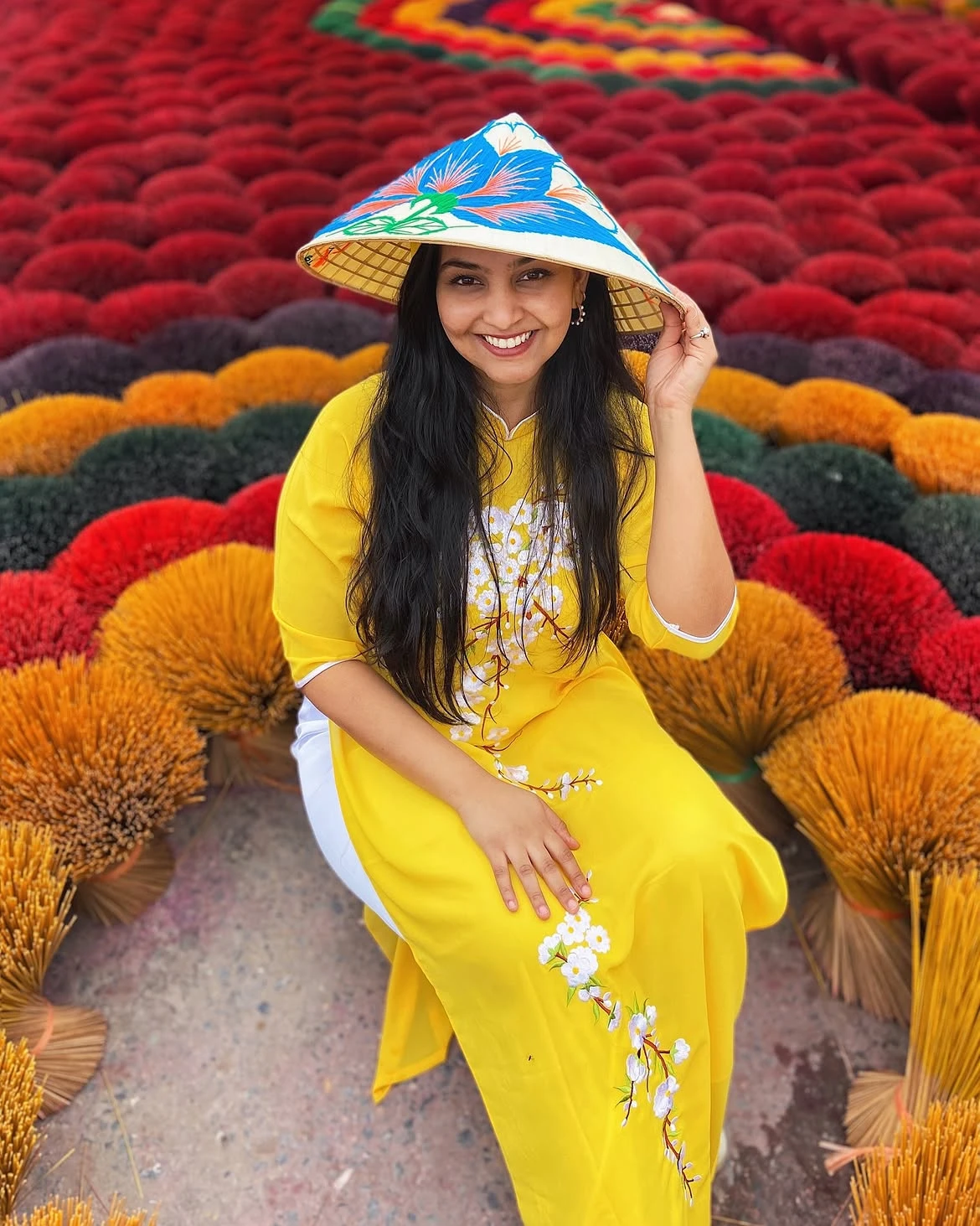
A white Ao Dai creates beautiful contrast against the rich red background in the village courtyards.
Not every courtyard offers the same experience, and a little local knowledge saves you a wasted trip. A few households near the main courtyards also offer traditional Ao Dai rental for an additional fee, for travellers who want their photos to include traditional Vietnamese dress 👘 *(Source: Local Vietnam)*.
Truly Voyage planning tip
Courtyard or Yard
What Makes It Distinctive
Typical Photo Fee
Elevated Platform
Lang Lam Huong Do
A well-known walk-in yard, with large fan patterns sometimes shaped like the Vietnamese flag or map
Approx. 50,000 to 100,000 VND
Yes
Neighbouring household yards (Xa Cau hamlet)
Smaller, quieter courtyards, great for fewer crowds and closer artisan interaction
Approx. 50,000 VND or by donation
Sometimes
Indoor production workshops
Bamboo-chopping and dyeing process on view, less colourful but more educational
Often included in guided tours
No
Table 2: Distinctive features and typical photography fees for village courtyards.
When Is an Ideal Time for an Incense Village Hanoi Tour?
The short answer: aim to arrive by 8 to 8.30 in the morning, and if you can, time your trip within about six weeks before Tet, since that is when the village is at its most colourful and its busiest. An incense village Hanoi tour timed well is the difference between an empty courtyard and the scene that made you search for this place.
Light matters more than most visitors expect. During the first hour or two after sunrise, sunlight travels through ten to forty times more atmosphere than it does at midday, and this longer path scatters away blue wavelengths through a process called Rayleigh scattering, leaving a warm colour temperature of roughly 3,000 to 4,000 Kelvin, compared with 5,500 to 6,500 Kelvin at noon *(Source: universaltimedate.com, What Is Golden Hour)*. In practical terms, that early light is what makes red incense bundles glow rather than flatten out under harsh, high-contrast midday sun, which is why photographers consistently prefer the first part of the morning here. Understanding the best time to visit Hanoi overall will also help you plan this specific excursion, as the cooler, drier months provide the clearest morning light.
The soft golden light between 8 and 9 AM provides the ideal conditions for stunning photography.
Timing also depends on what the artisans are actually doing. Several recent visitor accounts note that households usually begin laying bundles out from around 8 to 9 in the morning, with the fullest, most photogenic arrangements typically visible between roughly 9.30 and noon *(Source: Nomad eSIM; Laure Wanders travel guide)*. Arriving by 8.30 gives you the overlap of soft light and freshly arranged bundles, before the midday sun both hardens the light and, on hot days, prompts some households to begin covering the incense to protect it.
Season adds a second layer. Production visibly ramps up in the four to six weeks before Tet, as households race to meet festival demand, and this is consistently described as a lively, colour-saturated period to visit *(Source: Vinpearl travel guide; The Sensible Fay)*. For concrete planning, Tet 2027 falls on Saturday, 6 February 2027, so the village’s busiest production weeks will run from roughly late December 2026 through the first days of February 2027 *(Source: National Today, Tet Holiday 2027)*.
On rainy days, households typically cover the drying bundles to protect them, so outdoor courtyards will look far less colourful. If rain is forecast, ask your guide about the indoor production areas as a backup, since the bamboo-chopping, dyeing and rolling process is genuinely worth watching regardless of the weather 🌧️.
Truly Voyage planning tip
Truly Voyage planning tip
Vani with Truly Voyage guests.
A JOURNEY SHAPED AROUND YOU
Your Vietnam journey. At your own pace.
Tell us what you enjoy, how you like to travel and where you would like more time. We can discuss a private itinerary around your interests and preferred pace.
What Etiquette Should You Follow at Hanoi Incense Village?
Treat the Hanoi incense village as a working village first and a photo backdrop second, because that is exactly what it is. Several long-time visitors make the same observation: this is somebody’s actual job, not a set built for tourists, even in the courtyards designed for photography *(Source: The Vietnam Journey travel guide)*. A visit that respects that reality tends to be a better one anyway, since artisans who feel respected are far more willing to explain their craft or pose for a genuine portrait.
A few practical points make a real difference on the ground:
Ask before entering a private courtyard that is not one of the designated public photo yards, since incense bundles and drying racks are the household’s livelihood, not props.
Avoid stepping on or brushing against drying incense, particularly the sharpened bamboo tips, which can be genuinely hazardous underfoot *(Source: Vietnam Tour guide, vietnamtour.in)*.
If a worker poses for your photo or lets you photograph them closely, a small tip is appreciated and is standard practice among visiting photographers *(Source: Erin Henderson Media)*.
Dress in dark or white clothing rather than red or orange, since red and orange outfits tend to blend into the incense and reduce the contrast that makes these photos striking in the first place.
Check with your guide or the household before flying a drone, since many properties are private residences and airspace etiquette varies household by household.
Truly Voyage planning tip
Can You Combine a Hanoi Incense Village Tour With Huong Pagoda?
Yes, and many travellers do exactly this, since a Hanoi incense village tour pairs naturally with either the spiritual pilgrimage route at Huong Pagoda or the craft-village hop to Chuong conical hat village, both within a similar radius south of Hanoi. We cover that full combination, including timing, boat routes and what to skip if you only have one day, in our separate Chuong Conical Hat Village and Huong Pagoda guide, which is worth reading in full if you are planning more than a single stop.
What’s Included in Our Incense Village Hanoi Tour?
Our half-day Incense Village Hanoi Tour with Truly Voyage was built directly around the timing and etiquette points above, because we would rather you leave with photos you are proud of than a rushed stop bolted onto a bigger group itinerary.
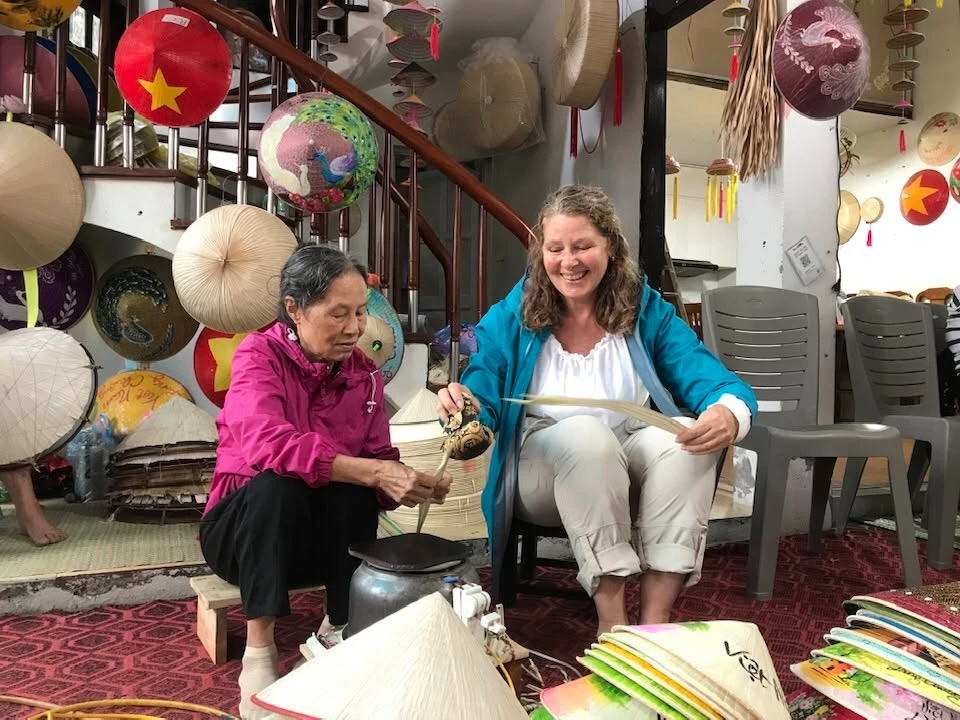
Travelling with a knowledgeable guide opens doors to authentic conversations with local artisans.
Case Study: Sarah’s Step-by-Step Morning at Quang Phu Cau
To give you a realistic picture of how smoothly this flows, here is a breakdown of a recent trip with Sarah, a solo traveller from the UK:
Step 1 (6:30 AM): Sarah’s guide picked her up directly at her Old Quarter hotel. Leaving this early meant entirely skipping the heavy outbound commuter traffic 🚗.
Step 2 (8:00 AM): Arriving at the village, the artisans had just finished setting out the first colourful bundles. The courtyard was peaceful, allowing Sarah to casually chat with a local worker (translated by our guide) and watch how the bamboo cores were carefully dyed.
Step 3 (8:30 AM): Moving into the photo yard, the slanted golden morning light was absolutely perfect ☀️. Because she wore a crisp white dress as suggested in our pre-tour advice, her photos popped beautifully against the sea of red incense.
Step 4 (10:00 AM): After purchasing a small incense bundle as a meaningful, aromatic souvenir, they departed.
Step 5 (11:30 AM): Sarah was safely back in central Hanoi with plenty of time for a local lunch and an entire afternoon free for exploring.
The tour departs central Hanoi at 6.30am, reaching Quang Phu Cau by around 8am, right in the window of soft morning light and freshly arranged incense bundles. You get a private, air-conditioned car, an English-speaking guide who works directly with two or three specific households, entrance and photography fees covered at Lang Lam Huong Do and one additional courtyard, bottled water, and a small gift-sized bundle of incense to take home. We return to central Hanoi by around 12.30pm, leaving your afternoon free. This gives you plenty of time to explore the Temple of Literature Hanoi, catch a water puppet show Hanoi, or visit the famous Train Street Hanoi in the evening.
Pricing starts from 69 USD per person for two travellers sharing a private car, drops to 58 USD per person for a group of four, and a private solo departure is available from 145 USD. Each of these rates already includes the photography fees discussed earlier in this guide, so there is nothing extra to negotiate in cash once you arrive.
Vani with Truly Voyage guests.
A JOURNEY SHAPED AROUND YOU
Your Vietnam journey. At your own pace.
Tell us what you enjoy, how you like to travel and where you would like more time. We can discuss a private itinerary around your interests and preferred pace.
The most reliable options are a private car/tour, taxi, or public bus route 91.
The most reliable options are a private car or guided tour (1 to 1.5 hours each way), a Grab or taxi (similar travel time, 700,000 to 1,100,000 VND round trip), or public bus route 91 from Yen Nghia Bus Station (up to 2 hours, roughly 12,000 VND).
Is there an entrance fee at Quang Phu Cau?
There is no general fee, but photogenic private yards charge 50,000 to 100,000 VND.
There is no general village entrance fee, but the photogenic courtyards, including Lang Lam Huong Do, charge a photography fee of roughly 50,000 to 100,000 VND per person, payable in cash.
What is an ideal time to visit for photos?
Arrive by 8:00 – 8:30 AM, particularly within the 4-6 weeks before Tet.
Arrive by 8 to 8.30am for soft, warm light and freshly arranged bundles, and plan your trip within the four to six weeks before Tet for the busiest, most colourful production season.
Is Quang Phu Cau worth visiting?
Absolutely, especially for photographers and lovers of traditional heritage crafts.
Yes, particularly if you enjoy photography or want a first-hand look at a genuine, century-old craft. It is highly appreciated with realistic expectations and, ideally, a guide who understands the working rhythm of the village.
Can I combine it with other villages?
Yes, most easily paired with Huong Pagoda or Chuong conical hat village.
Yes. Quang Phu Cau is commonly paired with Huong Pagoda or Chuong conical hat village on a half-day or full-day itinerary.
What happens if it rains during my visit?
Sticks are covered up outdoors, but indoor production processes remain fully active.
Households cover the incense to protect it, so outdoor courtyards will be far less colourful. Indoor production steps such as bamboo chopping and dyeing remain visible regardless of the weather.
Is it okay to fly a drone there?
Always check with local owners as drone rules are not standardized.
Ask first. Many courtyards are private residences, and drone etiquette is not standardised across the village.
Conclusion
Incense village Hanoi trips go well when three things line up: the right time of day, the right season, and a little respect for the fact that you are visiting someone’s workplace. Get those three right, whether independently or with a guide, and Quang Phu Cau delivers the kind of photograph that made you search for it in the first place, backed by a genuinely interesting craft tradition stretching back more than a century.
At Truly Voyage, we built our half-day photo tour around exactly these details, because we have watched too many good mornings get wasted on the wrong timing. If you would rather not gamble your one shot at this on guesswork, we would love to show you the village the way we know it. Please contact us to customize your itinerary and secure your spot.
A visit to Quang Phu Cau is a wonderful opportunity to support a genuine century-old craft tradition.
Further Reading & Resources
Where the figures in this guide come from, plus related guides for planning your trip.
Vani is the Founder and Lead Travel Designer at Truly Voyage. With over a decade of experience and a deep passion for her Vietnamese heritage, she specializes in crafting bespoke, unhurried itineraries. Vani is dedicated to helping travellers experience the authentic soul of Southeast Asia with absolute financial security and 24/7 on-ground support.


 By Vani






0 Comment