


Independence Palace Saigon can be confusing to navigate due to mixed historical accounts and hidden rooms. Are you wondering which tank actually broke the gate in 1975, or worried about the new 2026 camera fee? This guide clears up the tank breach facts, explains the rooftop bomb marks, and shows you exactly how to find the historical basement bunker.

Independence Palace sits at 135 Nam Ky Khoi Nghia Street, a fifteen-minute walk from the War Remnants Museum. Almost every English-language account of what happened here on 30 April 1975 gets one detail wrong 🏛️. I am Vani, founder of Truly Voyage. Most guides say tank 843 crashed through the gates first. The palace’s own website now says otherwise. This guide sorts out which tank actually broke through, why two circular scars still sit on the rooftop helipad, and what that new camera fee everyone is asking about actually means for you 📸.
Table of Contents
ToggleWhich Tank Actually Broke Through the Gate on April 30 1975?
Tank 390 broke through the main gate first. Tank 843’s commander was the one who ran to the roof and raised the flag 🇻🇳. For twenty years, Vietnam’s own official history credited the wrong tank with the first job.
Two Tanks, Two Different Jobs, One Merged Story
Just before midday on 30 April 1975, two Vietnamese People’s Army tanks reached the palace within moments of each other. Tank 843, a Soviet-made T-54 commanded by Lieutenant Bui Quang Than, tried a side gate on Le Duan Street and got stuck. Tank 390, a Chinese-made Type 59 commanded by Lieutenant Vu Dang Toan, adjusted course and crashed through the main iron gate first, at roughly 10:45am to 11:00am ⏱️.
Than did not wait around. He jumped down from tank 843, ran up to the roof, tore down the flag of the old Republic of Vietnam, and raised the flag of the National Liberation Front at 11:30am (Source: dinhdoclap.gov.vn). That single act made him famous. For two decades, it also got credited to the wrong vehicle.

Official Vietnamese and international accounts named tank 843 as the gate-breaker for roughly twenty years after the war ended. The record only changed after French photojournalist Francoise Demulder produced images clearly showing tank 390 physically breaching the gate while 843 sat stuck behind the side columns (Source: Wikipedia). She was 25 years old at the time, and a prominent photographer on the scene at that exact moment. Wikipedia dates the correction to 1995. The palace’s own website has since adopted it outright, stating plainly that tank 390 was first through the gate.
One more detail rarely makes it into English guides. Australian cameraman Neil Davis filmed the actual gate-crash live, since the official Vietnamese army film crew missed the moment entirely 🎥. He is remembered for greeting the lead soldier with a line that has since become part of Vietnamese War lore, translated roughly as: welcome to Saigon, comrade, I have been waiting for you (Source: Helene Chung).
Not every source has caught up with the correction. Grokipedia, an AI-generated reference site, still credits tank 843 with initiating the breach, repeating the older, superseded version. Both tanks were declared national treasures in 2012, and neither sits on the palace grounds today. Tank 390 is preserved at the Armoured Forces Museum in Hanoi. Tank 843 is displayed separately, also in Hanoi (Source: Malay Mail).
Vani Tips: ask your guide, if you have one, which tank they credit with breaking the gate. It is a quietly useful test 💡. A guide who still says 843 crashed the gate is working from a decades-old script, and it is worth listening a little more critically to whatever else they tell you that day.
Why Are There Bomb Marks on the Roof?
Two circular marks on the rooftop helipad are genuine bomb scars, but not from the incident most articles reference. They date to 8 April 1975, a separate and far less famous attack than the 1962 coup bombing 💥.
The Second, Lesser-Known Bombing

On 8 April 1975, three weeks before Saigon fell, South Vietnamese Air Force lieutenant Nguyen Thanh Trung peeled his Northrop F-5E away from a combat formation, claiming a mechanical fault. He then flew back over the city and dropped four 550-pound bombs on the palace itself, before strafing a fuel depot and defecting to North Vietnamese-held territory ✈️.
Trung had been a communist agent since 1969, recruited after South Vietnamese forces killed his father and arrested his mother in 1963 on suspicion of communist sympathies (Source: The Aviationist). Two of his bombs hit the garden. Two hit the rooftop helicopter pad. The physical damage was minor, but the two circular scars from that second pair are the marks visitors photograph today (Source: dinhdoclap.gov.vn).
Most generic content skips this event entirely, or folds it into the much better-known 27 February 1962 coup bombing. That earlier attack is a different story with a different outcome. Two dissident Republic of Vietnam Air Force pilots, flying Douglas A-1 Skyraiders against President Ngo Dinh Diem, destroyed the previous building on this site so thoroughly that Diem ordered it demolished rather than repaired. The roof you are looking at when you see the bomb scars belongs to the building constructed afterwards. It is the one still standing today, hit only by Trung’s later, quieter attack.
Vani Tips: look for the marks on the helipad itself, not the main roofline 👀. They are easy to miss unless you already know that two separate bombings happened here, thirteen years apart, on two completely different buildings.
What Is Actually Worth Seeing Inside?
The basement command bunker is the single most interesting room in the building, not the ornate reception floors most photographs focus on.
Case Study: A Real Visitor’s Step-by-Step Route
Let me share a recent experience from Sarah, a traveler from the UK who visited last month. She was worried about missing the historical context among the grand architecture. Here is how she successfully navigated the grounds:
- Step 1: She started at the front garden to observe the replica tanks, gaining a sense of the scale before heading indoors 🚶♀️.
- Step 2: Instead of lingering in the lobby, she walked straight to the stairwell leading down to the basement command bunker, avoiding the mid-morning crowd.
- Step 3: After exploring the communication rooms, she moved up through the ceremonial floors, spending a few minutes at the vintage games room 🎲.
- Step 4: She ended her tour on the rooftop, easily spotting the two bomb marks on the helipad 🚁.
- Step 5: She captured photos freely with her personal mirrorless camera—nobody asked her for the commercial photography fee 📸.
The Basement Command Bunker

Below the ceremonial floors sits a genuine 1960s-era command bunker, still fitted with period rotary telephones, radio transmitters and operational maps marking South Vietnam’s military zones 🗺️. A reinforced tunnel network runs beneath it, though only the upper level is open to visitors. Most people walk straight past the stairwell that leads down to it, since nothing on the ground floor signals what waits below, and the room rewards the ones who go looking for it. Published dimensions for the lower levels vary enough between sources that I would not repeat a single figure here with confidence. Treat any exact metre count you read elsewhere with some caution, and let the room speak for itself instead.
The Tank at the Gate Is Not 390 or 843
A T-54 tank sits in the palace’s front garden near the entrance, and it is easy to assume this is one of the two famous tanks from the gate story above. It is not 🚫. Both tank 390 and tank 843 were declared national treasures in 2012 and moved to museums roughly 1,700 kilometres north in Hanoi. What sits on the palace grounds today is a separate vehicle entirely.
Beyond the bunker and the garden tank, the upper floors hold a formal banquet hall with tiered glass chandeliers, a red-velvet private cinema, and a games room with poker and domino tables. The president’s private living quarters sit apart from all of it, comparatively modest and centred on a rooftop-adjacent courtyard.
Vani Tips: budget your time for the bunker specifically. Most self-guided visitors spend their allotted hour upstairs among the chandeliers and miss the basement almost entirely, and it is a fascinating part of the building that photographs cannot really prepare you for.
Planning Your Historical Walk in Ho Chi Minh City?
Let our local experts guide you through the hidden stories of Independence Palace and beyond.
Do You Need to Pay Extra to Take Photos?
No, not for your own photos. The 500,000 VND fee that caused a wave of confusion in August 2026 targets commercial and professional photography, not ordinary visitors carrying a camera.
| Detail | Current information |
|---|---|
| Street address | 135 Nam Ky Khoi Nghia Street |
| Ward, since 1 July 2025 | Ben Thanh Ward, Ho Chi Minh City |
| Opening hours | 7:00am to 6:00pm, daily |
| Palace + Exhibition admission | 80,000 VND, adult |
| Palace-only admission | 40,000 VND, adult |
| Children, ages 6 to 15 | 20,000 VND |
| Personal photography | Free |
| Realistic visit time | 30 minutes to 1.5 hours |
Table 1: Current visitor information and admission pricing for Independence Palace

The palace’s street address has not moved, and its ward, Ben Thanh, kept its familiar name after the July 2025 reform, unlike the War Remnants Museum’s Xuan Hoa Ward nearby 📍. District 1, like every district nationwide, no longer exists as an administrative level.
What the New Camera Fee Actually Covers
On 1 August 2026, Independence Palace introduced a new photography price list. One line in it worried a lot of visitors: a 500,000 VND charge listed against anyone carrying a proper camera or equivalent recording device.
Within days, palace director Bui Huu Toan was clarifying the policy directly to local press 📰. He confirmed that visitors carrying a personal camera to photograph themselves, their family or friends are not who the fee targets (Source: Tien Phong). The fee is really aimed at organised, professional photography: pre-wedding shoots, fashion sets and paid photo sessions that tend to occupy a spot for a while and crowd out other visitors.
The numbers back him up convincingly. In the first twelve days after the new price list took effect, the palace welcomed over 60,700 visitors. Only 89 of them bought a photography service ticket (Source: Tien Phong). That works out to roughly one visitor in seven hundred. Bring your own camera or phone, take your souvenir photos, and move on. Nobody is going to stop you at the door.
Current Admission Prices, and Why So Many Blogs Still Quote 40,000 VND
General admission covering both the palace and its exhibition rose to 80,000 VND on 1 August 2025. That is roughly double the 40,000 VND figure that was standard before, and it is the number a lot of English-language blogs still quote without checking. Seniors aged 60 and over, along with Vietnamese university students, pay 40,000 VND, and children aged 6 to 15 pay 20,000 VND 🎟️.
A cheaper, palace-only ticket also exists, and this is likely where some of the blog confusion actually comes from. Adults pay 40,000 VND for palace access alone, without the exhibition, the exact figure that used to cover full general admission before the price rose. Combo packages bundling the palace, the exhibition and an electric-car ride run up to 105,000 VND for adults. For a self-guided visit, budget 30 minutes to 1.5 hours, with an hour cited most often as the comfortable minimum, and note that air conditioning inside is limited, which affects comfort on longer visits (Source: Independence Palace official site).
Vani Tips: if your one goal is the basement bunker and the tank-story context above, the palace-only ticket at 40,000 VND covers it. Save the extra 40,000 VND for the exhibition wing only if the aircraft and military displays specifically interest you.
Who Designed Independence Palace, and What Happened to the Building It Replaced?
Architect Ngo Viet Thu designed the current building to spell out good fortune in Chinese characters when viewed from above. It replaced an earlier French palace, destroyed by an entirely different bombing, in 1962.
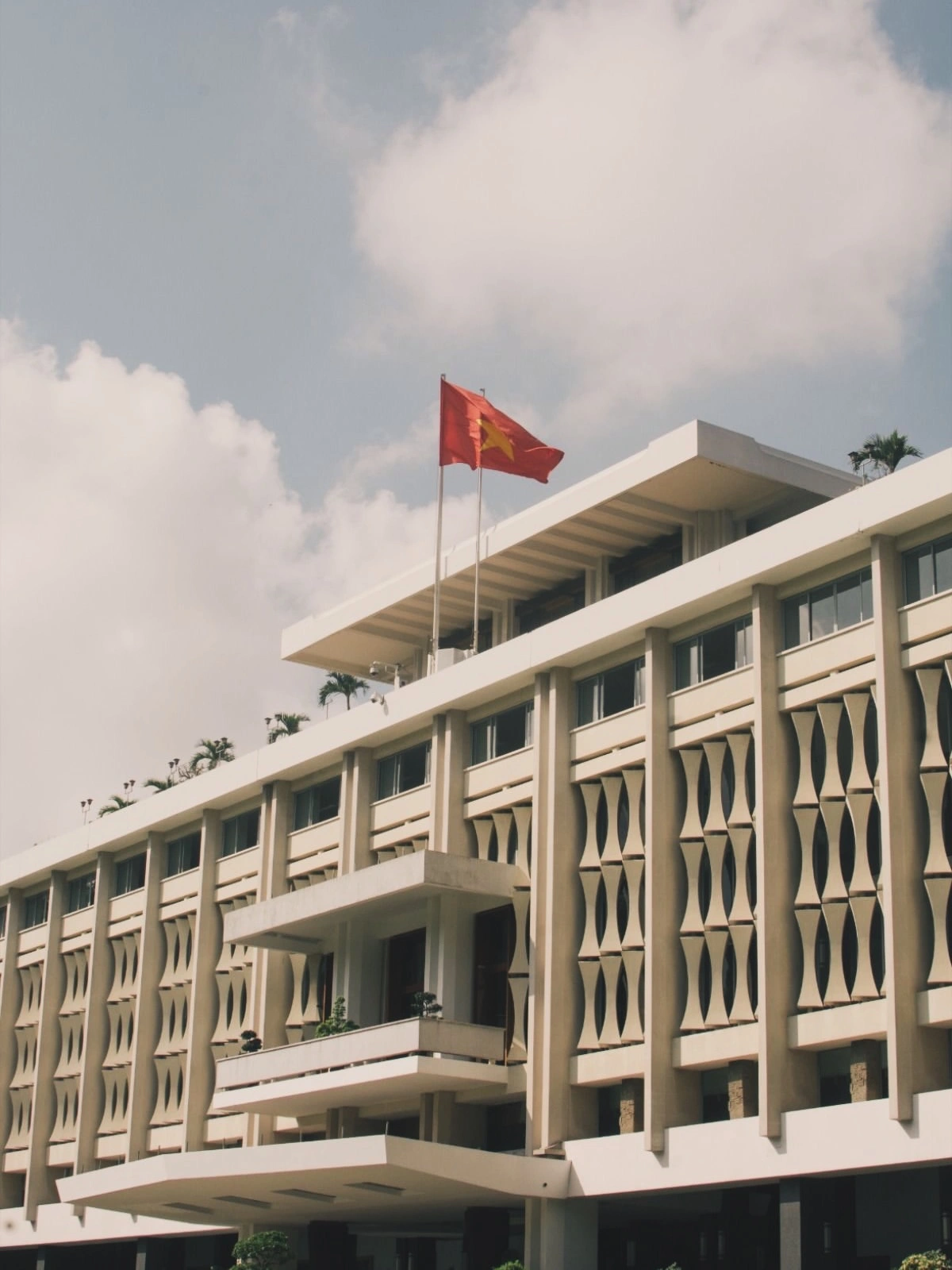
An Architect’s Hidden Symbolism, and the Coup That Made Room For It
The French colonial government built the original Norodom Palace between 1868 and 1873. It stood for nearly ninety years until 27 February 1962. Two dissident Republic of Vietnam Air Force pilots, Lieutenant Nguyen Van Cu and Second Lieutenant Pham Phu Quoc, bombed it that day in a failed coup attempt against President Ngo Dinh Diem. Diem survived by reaching an underground shelter in time. His palace did not. The damage was severe enough that he ordered the whole building demolished rather than repaired 🏗️.
Construction of a replacement began on 1 July 1962. Architect Ngo Viet Thu, Vietnam’s first winner of the Grand Prix de Rome, took the commission and designed something considerably more deliberate than a standard government building. Viewed from above, the layout forms the Chinese character for good fortune. Individual facade elements are arranged to be read as characters representing prosperity, sovereignty, leadership and the classical virtues (Source: Independence Palace official site). Diem never saw it finished. He was assassinated in a 1963 coup, and the building was inaugurated in 1966 under his successor, Nguyen Van Thieu.
Experience the Best of Vietnam
From the vibrant streets of Ho Chi Minh City to the historic charm of Hanoi, discover it all.
Is Independence Palace Worth Pairing With the War Remnants Museum?
Yes, and I would visit the palace first if you are doing both in one day. It gives you the war’s political ending before the museum gives you its human cost.
My Recommended Order, and Why It Matters
Independence Palace and the War Remnants Museum sit roughly fifteen minutes apart on foot. That is close enough that a commercial walking tour already bundles the two with a shared guide, allocating about an hour at each site. I would visit in that order for a reason. The palace gives you the war’s formal, political ending: the tanks, the flag, the surrender. The museum gives you what that ending actually cost, in photographs and physical evidence that are considerably harder to look at ⚖️.
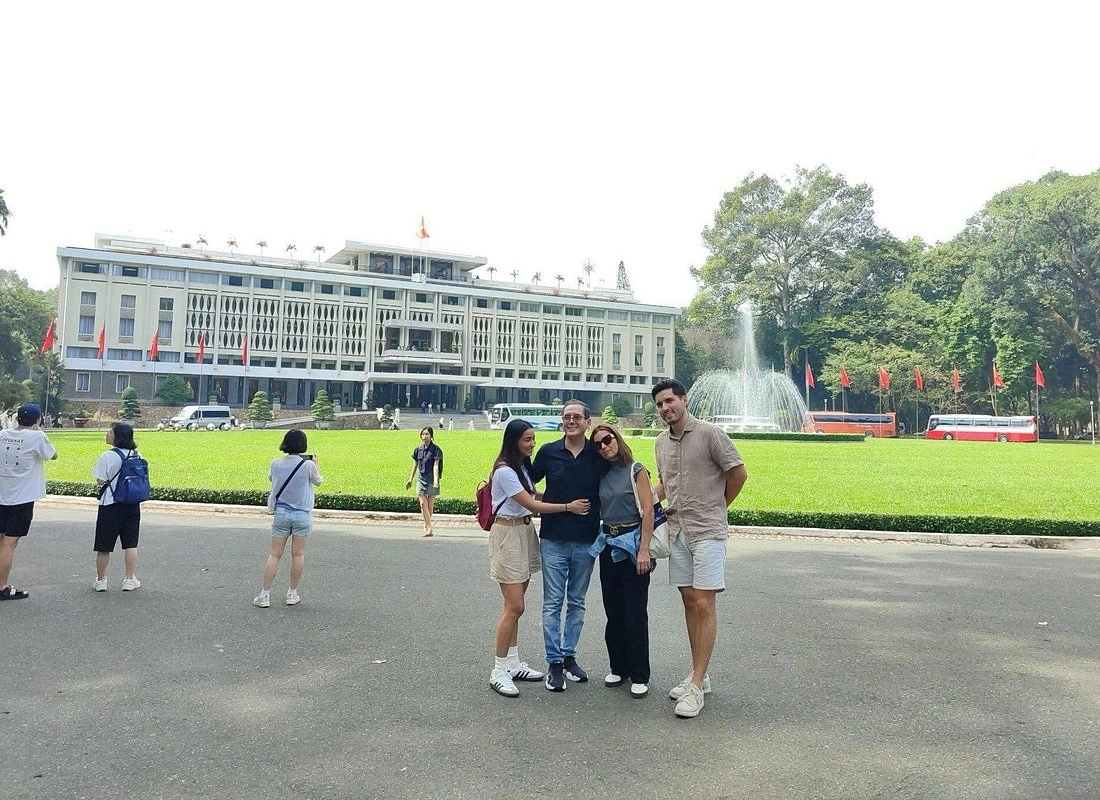
Doing the palace first gives you the narrative framework before the museum fills in the human weight of it. Reversing the order works too. I have simply watched enough guests arrive at the palace still visibly shaken from the museum to notice a pattern. The palace’s lighter, more architectural tone can feel oddly abrupt straight afterwards, even though nothing about that reaction is wrong.
Vani Tips: if you only have energy for one stop today and history is not your main interest, the palace is the easier visit. Thirty minutes covers the essentials, most rooms are air-conditioned, and nothing here is as viscerally difficult as the Agent Orange gallery next door. Come back for the museum on a day when you have more to give it.
Frequently Asked Questions About Independence Palace
Which tank really broke through the gate at Independence Palace?
Quick Answer: Tank 390, a Chinese-made Type 59, crashed through the main gate first, at around 10:45am to 11:00am on 30 April 1975. Tank 843 tried a side gate and got stuck.
Who raised the flag on the roof of Independence Palace?
Quick Answer: Lieutenant Bui Quang Than, commander of tank 843, ran to the roof and raised the flag at 11:30am, even though his own tank did not break the gate first.
What caused the bomb marks on the roof?
Quick Answer: A second, later bombing on 8 April 1975, when defecting pilot Nguyen Thanh Trung dropped bombs on the palace. It is a separate event from the better-known 1962 coup bombing, which destroyed the earlier building entirely.
Do I have to pay extra to take photos inside?
Quick Answer: No, not for personal photos. The 500,000 VND fee introduced in August 2026 targets commercial and professional photography, such as pre-wedding shoots, not ordinary visitors with a camera or phone.
How much does it cost to visit Independence Palace?
Quick Answer: General admission covering the palace and exhibition is 80,000 VND for adults, since 1 August 2025. A cheaper palace-only ticket costs 40,000 VND, and children aged 6 to 15 pay 20,000 VND on the combined ticket.
How long should I spend at Independence Palace?
Quick Answer: Budget 30 minutes to 1.5 hours for a self-guided visit, with an hour cited most often as a comfortable minimum to see the bunker and the main floors properly.
Is the tank at the entrance one of the famous tanks from 1975?
Quick Answer: No. The genuine tanks 390 and 843 are both preserved in Hanoi. The tank displayed on the palace grounds today is a separate vehicle.
Should I visit Independence Palace or the War Remnants Museum first?
Quick Answer: Either order works, but visiting the palace first gives you the political and military framework before the War Remnants Museum shows you the human cost, which some visitors find an easier emotional sequence.
Conclusion
Skip straight to the basement bunker. Most self-guided visitors spend their whole hour upstairs among the chandeliers and the games room, then leave without seeing the one space that actually explains what this building was for. Bring your own camera without a second thought about the new fee, since the numbers prove almost nobody actually pays it. And if you want a quick, honest test of any guide you hire here, ask them which tank broke the gate. Their answer tells you how current the rest of their tour is going to be 🧭.
Ready to Explore Saigon?
Let us craft a personalized itinerary that matches your travel style perfectly.
Further Reading & Resources
- (Source: dinhdoclap.gov.vn) — the palace’s own official account crediting tank 390 as first through the gate. Direct Link
- (Source: Wikipedia) — the 1995 correction of the tank 390/843 historical record. Direct Link
- (Source: Malay Mail) — 50th-anniversary retrospective on the tank crews and where both tanks are preserved today. Direct Link
- (Source: Helene Chung) — the Neil Davis gate-crash filming account. Direct Link
- (Source: The Aviationist) — background on Nguyen Thanh Trung and the 8 April 1975 bombing. Direct Link
- (Source: dinhdoclap.gov.vn) — the palace’s own record of the rooftop bomb strike. Direct Link
- (Source: Tien Phong) — director Bui Huu Toan’s on-record clarification of the photography fee. Direct Link
- (Source: Tien Phong) — visitor and ticket-sales figures for the first twelve days of the new fee. Direct Link
- (Source: Independence Palace official site) — current admission and combo-package pricing. Direct Link
- (Source: Independence Palace official site) — architect Ngo Viet Thu’s symbolic design. Direct Link

Vani is the Founder and Lead Travel Designer at Truly Voyage. With over a decade of experience and a deep passion for her Vietnamese heritage, she specializes in crafting bespoke, unhurried itineraries. Vani is dedicated to helping travellers experience the authentic soul of Southeast Asia with absolute financial security and 24/7 on-ground support.
1 Comment