

 By Vani
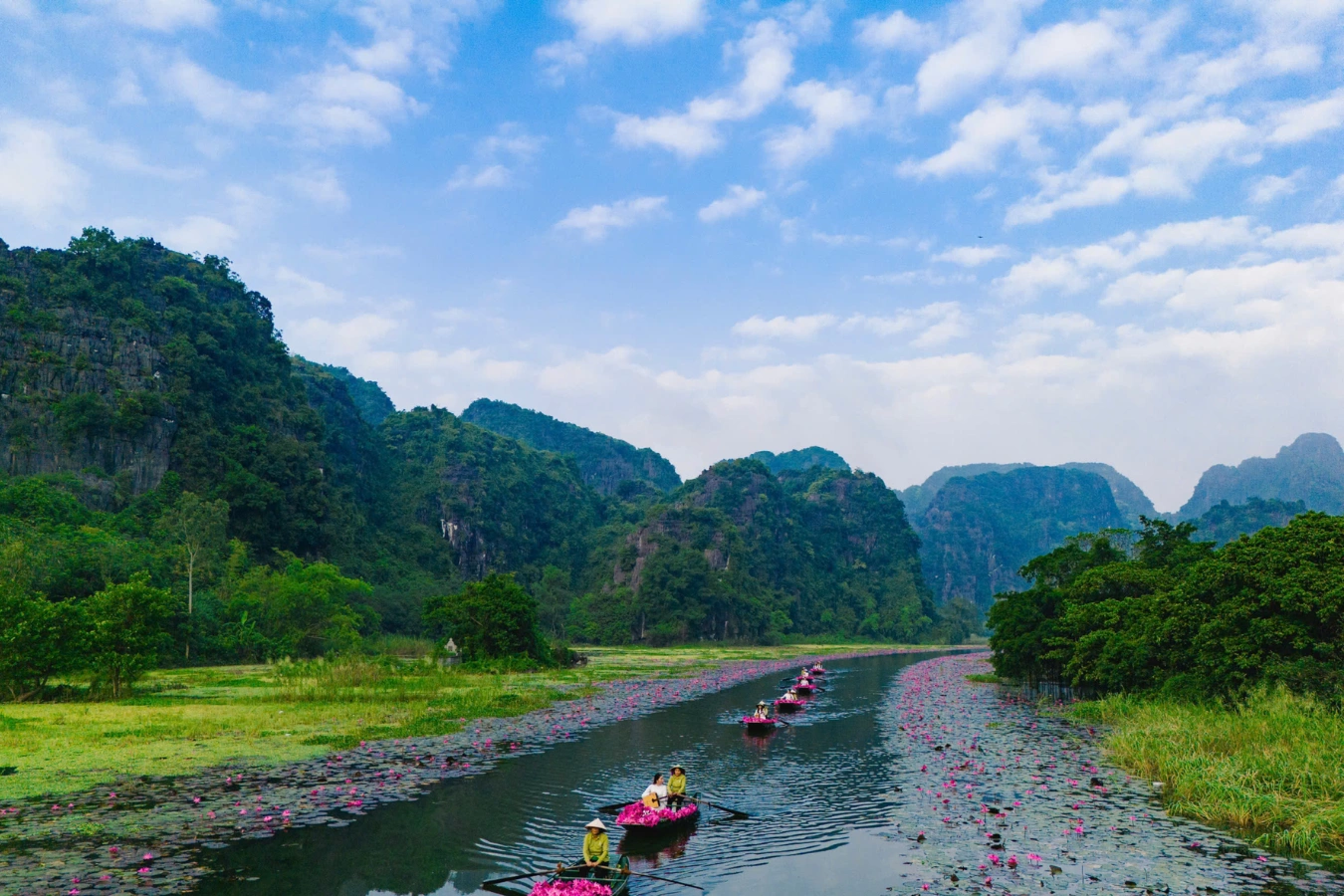
Tam Coc is a roughly two-hour sampan boat ride in Ninh Binh, passing rice fields and three limestone caves along the Ngo Dong River. Plan for late May to early June if golden rice is your priority. The open boats and low cave ceilings deserve consideration when choosing your day trip.

Tam Coc is a sampan outing along the Ngo Dong River, between rice paddies and limestone hills. The practical questions are straightforward: how to board, what the ticket includes, how enclosed the caves feel and whether the fields will be green or gold. The team at Truly Voyage can help describe the route and local transfers when you plan a day in Ninh Binh. Leave time around the boat ride rather than treating its duration as the whole visit.
What Is the Tam Coc Boat Tour and What Does It Actually Involve?
The Tam Coc boat tour departs from Van Lam Pier, follows the river between paddies and passes through cave tunnels before returning. Confirm ticket inclusions and your group’s seating arrangements at the pier.
A Two-Hour Sampan Ride Along the Ngo Dong River
The round trip is often described as roughly four to five kilometres; treat this as a route estimate, not an exact distance for every departure. Boats leave Van Lam Pier, close to the ticket office. Vietnam Tourism advises asking whether two or four people can share a boat and notes that foot rowing occurs at both Tam Coc and Trang An (Source: Vietnam Tourism). Ask how an odd-numbered group will be seated before boarding. The ride alternates between open river light and cool, darker cave passages, with little shade between caves.
For admission, the Ninh Binh Tourism Promotion Centre’s 2026 list, updated 27 February 2026, quotes the Tam Coc–Thai Vi Temple–Dong Tien–Bich Dong route at approximately US$10 (250,000 VND) per adult without the inter-site electric shuttle, or US$14 (350,000 VND) with it. Children 1–1.3m are listed at 120,000 VND without the shuttle or 190,000 VND with it (Source: Ninh Binh Tourism Promotion Centre). The USD amounts use an illustrative 25,000 VND per US$1, not a live exchange rate.
Ask the ticket office which route and boat services the displayed ticket includes, where the electric shuttle goes and what applies to your group. The published list labels these as route admission options, so do not add an assumed separate boat fee or treat the shuttle option as a different length of river ride. Confirm the current offer before paying and keep the ticket until the visit is over.
Bring small-denomination Vietnamese dong if you choose to tip your rower. A planning allowance of approximately USD 2–4 (50,000–100,000 VND) per boat uses USD 1 = 25,000 VND. Decide what you wish to give rather than treating this as a fixed fee.
Is a Tam Coc Sampan Ride Right for Your Day Trip?
A Tam Coc sampan ride suits a day focused on rice fields and caves. Consider the open boat, boarding arrangements and low ceilings before buying your ticket.
Before you go
- Arrival and ticketing: Buy at Van Lam Pier and confirm the current ticket inclusions before paying.
- Boarding: Ask staff how your group will be seated and wear your life jacket throughout the ride.
- Cave passages: Stay seated, watch the ceiling and follow the rower’s instructions when passing beneath low rock.
- Returning: Keep small-denomination dong handy if you choose to give your rower a tip.
Who it suits
Travellers seeking rice-field photographs and a shorter boat outing than the longer Trang An routes.
Who may prefer something else
Travellers uncomfortable sitting in an open boat or bending under low ceilings may prefer exploring the countryside on land. Those seeking temple stops may prefer Trang An.

What Are the Three Caves on the Tam Coc Bich Dong Boat Ride?
The three caves are Hang Ca, Hang Hai and Hang Ba, natural limestone tunnels of decreasing length carved by the Ngo Dong River, with low ceilings that may require passengers to duck. 🦇
Hang Ca, Hang Hai and Hang Ba, Cave by Cave
Tam Coc means three caves: Hang Ca, Hang Hai and Hang Ba, the river tunnels through limestone. The wider valley has the same layered landscape of water, paddy and vertical stone that visitors associate with nearby Trang An. Hang Ca is 127 metres long, with an entrance over 20 metres wide; that is not the width of the entire cave. Hang Hai is 60 metres long, while Hang Ba is 50 metres long with a lower ceiling than the other two (Source: Vietnam National Authority of Tourism). Stalactites hang above the water, and the passages can feel darker and more enclosed than the open river.
The name Tam Coc Bich Dong also refers to nearby Bich Dong pagoda, built across Lower, Middle and Upper levels into the mountainside (Source: Ninh Binh Department of Tourism). The boat ride and pagoda are distinct visits: check the route, transfer arrangements and time ashore rather than assuming the river trip delivers you to every part of the pagoda.
Stay seated and watch ahead in the caves. Follow the rower’s instructions about lowering your head rather than judging clearance from another passenger’s position.
When Do the Tam Coc Golden Fields Actually Turn Golden?
The Tam Coc golden fields follow a short agricultural window. Check harvest progress close to your visit; a photograph from another season does not tell you which fields will still be standing.
The Real Rice Cycle, Not Just a Postcard Season
The photographed version of Tam Coc, golden fields beside a rowed sampan, exists for a limited window rather than year-round. Knowing the cycle avoids disappointment when choosing a date for Vietnam rural rice fields. Late May into early June is the usual focus for golden rice (Source: Vietnam Tourism). Before ripening, the paddies are green; after cutting, the scene changes again. At other times you may see green, flooded or fallow fields, depending on farm work and water levels. Ask locally about the fields close to your date rather than assuming every month has a fixed colour. For a broader seasonal view, read our Best Time to Visit Ninh Binh guide, especially if the rice fields are your main reason for coming.

If golden fields are your priority, check recent photographs and local harvest progress before fixing your date. A seasonal window cannot promise that every field will be uncut.

A JOURNEY SHAPED AROUND YOU
A day in Vietnam.
Planned around you.
Already in Vietnam? Explore day-tour options and tell us where you are staying, your dates and your preferred pace.
Which Is Better, Trang An or Tam Coc, for a First Visit?
Trang An and Tam Coc get compared constantly, and searchers asking which is better usually assume the two are mutually exclusive, when in practice a longer Ninh Binh stay can comfortably fit both. The core difference comes down to length and focus rather than one site simply being nicer than the other.
| Feature | Tam Coc Boat Tour | Trang An Boat Tour |
|---|---|---|
| Duration | ~ 2 hours | 2–4 hours, depending on route |
| Main Scenery | Natural open rice fields, 3 low tunnel caves | Karst cliffs, cave routes and temple stops |
| Best Suited For | Short day trips, classic agricultural photography | Longer exploration, rich historical & natural variety |
Choose Tam Coc for a rice-field focus and a shorter outing; consider Trang An when temple stops and a longer route matter more. Neither is a promise of uncrowded water or easy boarding. Tam Coc–Bich Dong also lies within the wider Trang An World Heritage property, so the distinction between the boat tours is not “UNESCO versus non-UNESCO” (Source: UNESCO). Compare practical differences in Which Is Better Trang An or Tam Coc, then decide whether one ride leaves enough time for your other plans.

Choose Tam Coc over Trang An specifically if you are short on time, since its shorter round trip fits more easily into a tight day-trip schedule from Hanoi.
Should You Stay in Ninh Binh City or in Tam Coc Itself?
For accommodation planning, Tam Coc is the riverside visitor area roughly seven kilometres from central Ninh Binh, with homestays, bungalows and resorts near the boat wharf. Staying close to the pier can simplify an early departure. If you are deciding whether to stay in Ninh Binh or Tam Coc, compare the actual walking distance and transfer arrangements of each property rather than relying on its destination label.
Homestays, Bungalows and Resort-Style Stays Near the Wharf
Compare guesthouses, homestays, bungalows and larger resorts for your actual dates. A countryside address may offer a quieter setting while adding a transfer to the pier; a central room may make meals and departure simpler. Ask for a quote stating room type, private bathroom, breakfast and any patio or rice-field view. A photograph of green paddies is not a promise of the view at harvest time or after cutting.
Facilities vary between properties and the village. If a pool, gym or spa matters to your stay, ask where it is and whether access is included. A garden restaurant attached to a homestay or resort can be convenient for dinner, but check advance ordering and whether non-resident guests can eat there. Confirm the walking route to Van Lam Pier rather than relying on a listing’s broad “Tam Coc” location.

How Do You Get to Tam Coc from Hanoi or Ninh Binh?
Vietnam Tourism describes Hanoi to Ninh Binh as about two hours by train or road (Source: Vietnam Tourism). Allow for the onward journey to Tam Coc and confirm whether a booked vehicle stops at the pier, your hotel or a city drop-off point. Ask about a pre-arranged transfer if needed.
From Hanoi, From Ninh Binh City, and On to the Tam Coc Boat Station
Arrange the longer trip from Hanoi first, then check the final local leg. If arriving at Ninh Binh station, allow for an onward taxi or other booked transfer to Tam Coc. The often-used estimate of about seven kilometres from central Ninh Binh is a planning guide; the distance depends on your actual starting point. Do not apply a fixed transfer time to every hotel or traffic condition.
The Tam Coc boat station, or Van Lam Pier, has ticketing and access down to the sampans. Agree where your driver will wait and how to contact them after the ride. Travellers adding Mua Cave should plan a separate land visit and transfer; it is not another boat wharf. Include boarding, ticket queues, a meal and the return drive when deciding how many sights fit into the day.
What Is the Weather Like in Tam Coc and When Should You Visit?
Ninh Binh, including Tam Coc weather, has hot, humid summers and cool, drizzly winters (Source: Vietnam Tourism). Golden rice in late May and early June comes with summer conditions, so prepare for heat and rain rather than choosing dates by field colour alone.
Seasonal Conditions and How They Shape Your Boat Ride
Tam Coc follows Ninh Binh’s seasonal pattern: hot, humid summers and cool, drizzly winters (Source: Vietnam Tourism). Late May and early June may suit rice-field photography, but a summer visit also calls for water, sun protection and a rain layer. Check the local forecast before leaving for the pier; a morning booking cannot promise clear skies.
Visiting outside the golden-rice season changes the scene: you may see green paddies or fields between crops. Winter drizzle can still affect an open-air ride, so keep weather expectations separate from the rice calendar. An early departure may help avoid midday heat and busy tour arrivals, but there is little shade once you are on the open river between caves.

Where Can You Eat Near Tam Coc?
Compare your accommodation’s kitchen, garden restaurants and places along Tam Coc Road. Local dishes include goat meat and com chay, the crispy rice speciality. Choose a meal ashore before or after the boat ride.
A Tam Coc garden restaurant setting, shaded by fruit trees or set beside a small pond, can be found among local homestays and bungalows. Ask your accommodation about dining arrangements and whether dinner is included in your particular package rate.
On a day trip from Hanoi, agree the meal stop with your driver or guide. Allow time to order and eat without rushing the departure, and explain dietary requirements before choosing dishes. Do not rely on an unplanned food stop during the river ride.

Frequently Asked Questions
How long is the Tam Coc boat ride?
Around two hours for the full round trip (Source: Vietnam Tourism), covering roughly four to five kilometres along the Ngo Dong River and back.
When do the Tam Coc rice fields turn golden?
Aim for late May into early June for golden rice; local harvest timing varies (Source: Vietnam Tourism).
Are the Tam Coc boats safe?
Wear a life jacket and follow staff instructions throughout the ride (Source: Vietnam Tourism). Consider whether you are comfortable sitting in a low-sided boat and bending beneath low cave ceilings. Ask staff about boarding assistance if needed.
What should I expect from the three caves?
Expect the boat to travel directly through each of the three natural tunnels, Hang Ca, Hang Hai and Hang Ba, ducking beneath low ceilings rather than simply viewing the caves from outside.
Which is better, Trang An or Tam Coc?
Neither suits every visitor. Tam Coc suits a shorter visit and stronger rice-field focus, while Trang An suits travellers wanting a longer route with more history and taller caves.
Should I stay in Ninh Binh City or in Tam Coc?
Choose by the actual property and route. A room close to Van Lam Pier can simplify departure, but not every Tam Coc address is within walking distance. A city stay may suit your rail arrival or other plans; compare transfers to the pier and other Ninh Binh sights.
Sit still and keep your hands inside the boat while passing through the caves, since the tunnel walls sit close enough to the sampan that reaching out is both a safety risk and a reason to secure loose belongings. 💡
Conclusion
Tam Coc combines open rice-field scenery with enclosed cave passages. Choose it for the outing itself, then fit the season, transport and accommodation around your priorities. Check the ticket inclusions, boarding arrangements and local forecast before setting out. Truly Voyage can help you plan a Vietnam itinerary with time for the ride, a separate land visit or an overnight stay. Keep the day manageable rather than adding sights simply because they appear nearby on a map.
Further Reading & Resources
Where the figures in this guide come from, plus related guides for planning your trip.
Sources
- A guide to the boat tours of Ninh Binh Vietnam Tourism
- Ninh Binh: A journey through golden valleys Vietnam Tourism
- Tam Coc – Bich Dong Vietnam National Authority of Tourism · in Vietnamese
- Tam Coc – Bich Dong – The second most beautiful cave in northern Vietnam (2016) Ninh Binh Department of Tourism
- Ninh Binh Vietnam Tourism
- Ninh Binh attraction ticket prices for 2026, updated 27 February Ninh Binh Tourism Promotion Centre · in Vietnamese
- Trang An World Heritage property and its component landscapes UNESCO
Related guides
A JOURNEY SHAPED AROUND YOU
A day in Vietnam.
Planned around you.
Already in Vietnam? Explore day-tour options and tell us where you are staying, your dates and your preferred pace.

Vani is the Founder and Lead Travel Designer at Truly Voyage. With over a decade of experience and a deep passion for her Vietnamese heritage, she specializes in crafting bespoke, unhurried itineraries. Vani is dedicated to helping travellers experience the authentic soul of Southeast Asia with absolute financial security and 24/7 on-ground support.
0 Comment