


Marble mountain cave Da Nang system drops you directly into a stunning but demanding underground world. Struggling to plan your exploration without missing the best spots? This guide breaks down the real history, hidden altars, and exact steps to navigate Am Phu, Huyen Khong, and Van Thong safely. Get ready for an unforgettable subterranean adventure!
The air changed first, cool and faintly mineral 🌬️, before my eyes had adjusted enough to see what was waiting in the dark. Then the shapes resolved. A demon mid-strike. A soul kneeling before a judge carved from the same pale stone as the ceiling above him. Somewhere ahead, water dripped in a rhythm that had clearly been going on long before any tourist stood where I was standing, and the marble underfoot, cool through the sole of my shoe, felt older than the carved figures it was supporting. The cave system here does not ease you in. It drops you straight into a Buddhist vision of the afterlife carved into limestone, and knowing which parts of that vision are genuine history and which have simply been repeated online until they sounded true changes how you experience every step of it.
I went in wanting both, the goosebumps and the facts. Here is what actually held up.
| Cave Name | Key Feature | Accessibility Level |
|---|---|---|
| Am Phu Cave | Judgment & Underworld Morality | Moderate (Stairs & Dim lighting) |
| Huyen Khong Cave | Natural Skylights & Shrines | Easy |
| Van Thong Cave | Heaven’s Gate Viewpoint | Challenging (Narrow squeeze) |

Table of Contents
ToggleThe Eerie Descent into Am Phu (Hell Cave)
A stone bridge crosses a small symbolic river at the entrance, twelve carved zodiac pillars lining the way, and from that first step the cave commits fully to its concept 👹. This is not a natural grotto with a few statues added for atmosphere. It is a complete narrative, carved and arranged specifically to walk you through Buddhist and folk teachings on what happens after death. Local legend holds that Emperor Minh Mang himself sent soldiers with torches to explore the cave’s full depth in the nineteenth century, and that even after burning through a dozen torches in succession, they never found its bottom, a detail that says less about the cave’s actual dimensions than about how thoroughly this place has always resisted being fully mapped, physically or spiritually.
Vani Tips: Budget a separate 20,000 VND for Am Phu Cave, it is not automatically covered by the general Marble Mountains ticket. The walkthrough depicts the Ten Kings of Hell judging the dead, a real Buddhist and folk concept, not something invented for tourists (Source: Expat.com forum). This tribunal structure, ten judges presiding over ten courts of the underworld, appears across multiple Buddhist traditions throughout Asia, and the sculptures here render that shared belief in vivid, unmissable detail rather than softening it for a foreign audience.
Walking the Judgment Path
Past the entrance, the path splits, one route climbing toward light, the other descending into shadow, and the descent is where the cave earns its name. Sculpted demons loom over reconstructed punishment scenes, carved specifically to illustrate consequences for particular sins, a kind of three-dimensional morality lesson lit by strings of red and amber light 🏮.
A marble scale sits at one judgment station, meant to weigh a soul’s good deeds against its bad ⚖️. It is genuinely unsettling in places, deliberately so, and that discomfort is the point rather than a side effect. Bring a torch or use your phone’s light for the darker stretches, since some sections rely on minimal artificial lighting that leaves real shadow between the fixtures.
The Heavenly Light of Huyen Khong Cave
Climb back into daylight, walk the connecting trail, and descend again into what feels like an entirely different cave system, because in every meaningful sense it is.
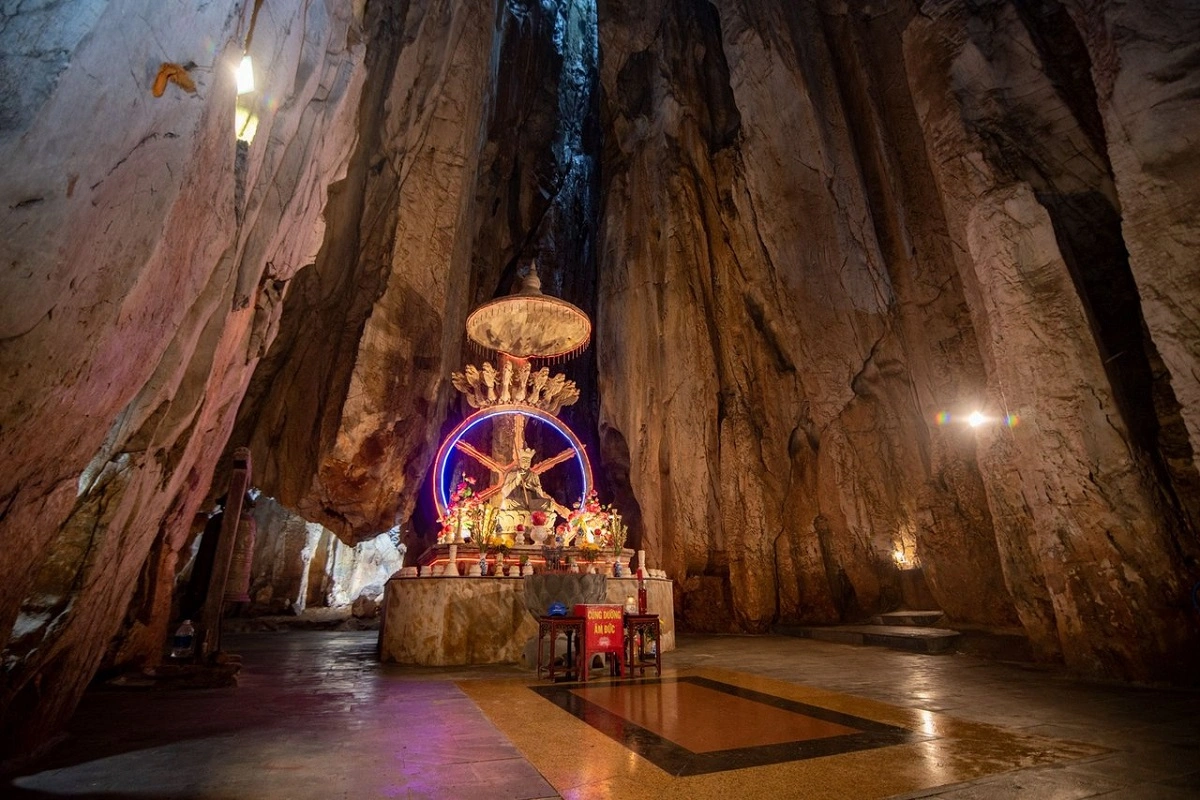
Huyen Khong opens into a vast, bell-shaped chamber, its ceiling rising sixteen metres overhead, punctured by five natural openings that locals read as the five fingers of Buddha’s hand or the five classical elements. On a clear day, the effect those openings produce is one of the highly photographed moments in the entire Marble Mountains complex.
Vani Tips: The skylight beams are natural, sunlight through openings in the cave ceiling (Source: VinWonders), not a wartime bomb crater as one or two sources claim. Time your visit for late morning, around 11am to 1pm, when the light shaft lines up most dramatically (Source: english.nguhanhson.org). Outside that window the chamber is still beautiful, cool and cavernous with genuine limestone formations worth studying on their own, but the specific spectacle of solid-looking beams cutting through drifting incense smoke belongs to that narrow midday hour, and missing it means missing the reason a lot of people specifically plan their visit around this cave.
What the Light Actually Reveals
Stand beneath the openings at the right hour and the beams do not simply illuminate the space, they become visible as distinct shafts, incense smoke from the altars below catching the light and giving it physical form the way dust does in a projector’s beam ☀️. A large seated Buddha statue faces the entrance from an elevated ledge, and smaller shrines dedicated to other figures in Vietnamese folk religion occupy side chambers, still actively used for prayer rather than preserved purely as a museum piece. The stone itself carries fantastical shapes if you look for them, formations locals point out as resembling an old man’s profile or a pair of elephant heads, the kind of pareidolia that turns a ten-minute stop into a genuine half hour of looking.

Ready for an Unforgettable Adventure?
Let us guide you through the mystical Marble Mountains and discover Vietnam’s hidden treasures.
Explore Vietnam Holiday Packages
Consult Our Local Travel Experts
Squeezing Through Van Thong Cave
Not every cave here rewards patience over exertion. Somewhere past Tam Thai Pagoda, a narrow stone mouth opens in the cliff face (Source: HoiAnDayTrip), and getting through it asks considerably more of your body than anything else in the complex.
The passage climbs roughly forty metres through a genuinely tight crevice, steep enough and narrow enough that only one person fits through at a time, both hands needed to find grip on smooth, worn marble 🧗.
It empties out, eventually, near a viewpoint locals call Heaven’s Gate, an incredibly rewarding outlook across the surrounding mountains and coastline.

Vani Tips: If tight, dark spaces are not for you, look for the alternate staircase built specifically because some visitors could not handle the original narrow squeeze. Nobody will judge you for taking it. To be precise about what I could confirm and what I could not, multiple visitors describe simply turning back the way they came rather than a dedicated bypass staircase reaching the identical endpoint, so treat any specific claim of a purpose-built alternate route with a note of caution, and ask a staff member on-site for the current easiest path if the squeeze does not appeal to you. Either way, skipping it costs you nothing essential. The complex offers several other routes to comparable viewpoints without requiring a crawl through solid rock.
Deciding Whether to Attempt It
The honest test is simple. If you can comfortably use both hands to climb, are not claustrophobic in tight, dim spaces, and are not carrying a bulky bag, the passage is manageable rather than genuinely dangerous, closer to a brief scramble than technical climbing. If any of those conditions gives you pause, this is not the spot to push through anyway, since the payoff, however striking the summit view, is not worth genuine panic in a space where turning around mid-crawl is awkward at best. Watch a few other visitors attempt it first if you are unsure. Their body language tends to tell you more honestly than any guidebook description whether this particular squeeze suits you.
Case Study: A Step-by-Step Cave Exploration
To make sense of the complex, it helps to see how a real itinerary flows. Consider the route taken by Sarah, a recent traveler seeking both history and photography, which perfectly balanced the caves’ varying demands:
- Step 1: Early Descent (8:30 AM): Sarah started with Am Phu Cave at the mountain’s base. Arriving early meant fewer crowds, allowing her to take in the eerie Judgment stations without feeling rushed.
- Step 2: The Physical Challenge (10:00 AM): Making her way up Thuy Son, she tackled Van Thong Cave. Wearing proper hiking grips, the scramble took her about 10 minutes to safely navigate the steep, dark crevice to Heaven’s Gate.
- Step 3: Catching the Light (11:30 AM): Finally, she descended into Huyen Khong just as the midday sun aligned with the ceiling cracks, securing breathtaking photos of the light beams piercing the incense smoke.
This structured approach avoids doubling back and capitalizes on the best lighting and crowd conditions.

The History Hidden in the Rock
Beyond the carved demons and the natural light shows, these caves carry real, documented history, layered across centuries and, more recently, across a war that reshaped how locals talk about this mountain entirely.
Vani Tips: This cave saw a real battle on August 23, 1968 (Source: MACV-SOG), and served afterward as a field hospital for wounded soldiers. Treat any specific claim about bullet holes or a secret hidden entrance with skepticism, since I could not confirm those particular details beyond repeated blog copy. What multiple independent sources do agree on, consistently, is the broader shape of events: Vietnamese liberation forces retook the Marble Mountains from American and South Vietnamese positions that year, and Huyen Khong Cave subsequently became a hidden shelter where wounded fighters were treated, its natural chambers offering both concealment and a rough kind of protection from the fighting outside.
Reading the Site With Care
I want to be direct about something a travel guide does not always say plainly. This mountain was a real battlefield, and the events of that period are remembered very differently depending on which side of the conflict tells the story, a genuine divergence documented independently by sources on both sides rather than a simple case of one account being right and another wrong.
What belongs in a travel guide is the part that is not in dispute, that fighting happened here, that the caves served a genuine medical and shelter function afterward, and that the plaques and memorials you will see inside reflect how the site is remembered locally today 🕊️. Walk through with that context rather than expecting a neutral museum plaque to settle a question that, honestly, is bigger than any single cave.

Want to Explore Da Nang Like a Local?
Avoid the tourist traps and experience authentic history and landscapes with our expertly crafted tours.
Tips for Exploring the Dark
Everything above assumes you arrive prepared for what the terrain and lighting actually demand, and getting the practical details wrong causes more disappointment here than any historical uncertainty ever does.
Vani Tips: Wear real shoes with grip, not sandals 🥾. The marble steps are worn smooth by decades of foot traffic and get genuinely slippery, especially if it has rained, and the caves can close entirely during heavy downpours since the roof is partly open to the sky. This is a remarkably common mistake I see visitors make here, arriving in flip-flops because the day feels hot and casual, then white-knuckling their way down a polished marble staircase they had no idea would be this slick.
Building the Rest of Your Kit
Beyond footwear, bring a phone light or small torch for the darker interior sections 🔦, since not every chamber benefits from Huyen Khong’s dramatic natural illumination, and some passages in Am Phu rely on minimal fixed lighting that leaves real shadow between fixtures. Carry water, since the combined stair climbing between caves adds up faster than the modest distances suggest on a map.
Check the weather before you commit to a full loop through every cave, since a sudden downpour 🌧️ can close the open-roofed sections without much warning, and arriving to find Am Phu shut for safety after a wet morning is a genuinely common disappointment worth avoiding with a quick forecast check first.
Frequently Asked Questions
Is Am Phu Cave included in the Marble Mountains ticket?
Quick Answer: No.
It requires a separate 20,000 VND ticket in addition to the main Marble Mountains entrance fee.
Is Am Phu Cave in Marble Mountain?
Quick Answer: Yes.
It sits within Thuy Son, the main developed peak of the Marble Mountains complex, near the base of the mountain rather than at the summit.
What is Huyen Khong Cave known for?
Quick Answer: Its natural skylight.
It has five openings in a sixteen-metre ceiling that produce dramatic beams of sunlight, best seen between roughly 11am and 1pm on a clear day.
Is Van Thong Cave difficult to visit?
Quick Answer: The squeeze through its narrow upper passage is genuinely physically demanding and not suited to everyone.
Though the cave’s lower chamber remains accessible without attempting the full climb.
Do the caves close in bad weather?
Quick Answer: Yes.
Several, including Am Phu, have partially open roofs and can close during heavy rain due to flooding and slippery conditions on the stone steps.
Final Word From Vani
Wear proper shoes before anything else on this list matters. The marble catches more people off guard than any of the darkness or the history ever does, and a single slip on worn, wet stone will end your visit faster than any decision about which caves to prioritise.
Beyond that, give Huyen Khong the specific midday hour it needs for its light show, treat the wartime history with the weight it deserves rather than skimming past the plaques, and let Van Thong’s squeeze be optional rather than a challenge you feel obligated to prove yourself against. None of this requires an entire day. A focused two to three hours, moving deliberately rather than rushing between checklist items, is enough to leave with both the photographs and the actual understanding of what you walked through.
Further Reading & Resources
- Huyen Khong Cave: A mystical cave in Marble Mountains, VinWonders – Direct Link
- Am Phu Cave, a mysterious trip to hell, Expat.com forum – Direct Link
- Van Thong Cave, HoiAnDayTrip – Direct Link
- 23, August 1968 FOB-4 CCN, MACV-SOG – Direct Link
- Huyen Khong Cave, english.nguhanhson.org – Direct Link

Vani is the Founder and Lead Travel Designer at Truly Voyage. With over a decade of experience and a deep passion for her Vietnamese heritage, she specializes in crafting bespoke, unhurried itineraries. Vani is dedicated to helping travellers experience the authentic soul of Southeast Asia with absolute financial security and 24/7 on-ground support.
0 Comment