


Are you dreaming of conquering the Da Nang Hai Van Pass but feeling unsure about road conditions, traffic, or motorbike choices? While this coastal route isn’t deserted anymore, it remains incredibly rewarding. Discover practical preparation tips, historical insights, and real-life step-by-step experiences to ride these hairpin turns safely.

Somewhere around the fifth hairpin, a tour bus rolled past in the opposite lane, horn barely tapping, gone again before I had fully processed it 🚌. A minute later, a family on a rented scooter waved from a coffee stop cut into the cliffside, steam rising off their cups into air already noticeably cooler than the coast below ☕. This was not the empty road I had psyched myself up for. The da nang hai van pass everyone quotes to you before you arrive, the one described as a deserted stretch of tarmac with nothing but you and the ocean, has not actually existed for two decades, and riding up expecting it sets you up for a version of disappointment that has nothing to do with the road itself. (Source: Danang Fantasticity)
What you get instead is better in almost every practical way, and I want to walk you through exactly what that means before you decide what bike to rent.
Table of Contents
ToggleFollowing the Top Gear Route
Everyone who has heard of this road heard of it the same way. A British motoring show, three grown men on scooters, and a line that has been quoted in nearly every travel article about this pass since it first aired 📺. (Source: Wikipedia)
Vani Tips: The famous line comes from Jeremy Clarkson’s December 2008 Vietnam special, calling it a deserted ribbon of perfection, one of the best coast roads in the world. The road today carries far less truck and bus traffic than it did before 2005, when the Hai Van Tunnel opened and diverted most of the heavy vehicles. That framing matters enormously for what you should actually expect. Clarkson filmed on a genuinely different road, one still absorbing the majority of Vietnam’s north-south freight traffic. The tunnel changed that permanently, and the pass you ride today inherited the quiet without inheriting the emptiness the quote implies.
What the Quote Gets Wrong Today
Light traffic is not the same as no traffic, and confusing the two is where most first-time riders’ expectations go sideways. You will share this road with tour buses running between Hue and Hoi An, scooters loaded down with day-trippers from Da Nang, and the occasional local truck making a genuinely necessary delivery run rather than a through-freight haul 🚚. None of this ruins the ride. It simply means treating every blind curve as though something is coming around it, because on a weekend morning, something usually is. The romance of a single empty road belongs to 2008. The reality of 2026 is a well-paved, moderately busy mountain route that still delivers on every visual promise the quote makes, just with more company along the way.

Renting the Right Motorbike
Before any of the views or the history, one decision shapes your entire day, and rental shops do not always give you neutral advice about it 🛵. (Source: Vietnam Story)
Vani Tips: A standard automatic scooter around 110 to 125cc is genuinely fine for this pass. Independent riders and long-time Vietnam motorbike guides consistently say so, take manual-only advice from a rental shop with a grain of salt, since they often rent the pricier manual bikes too. The pass road is well-paved and maintained, a meaningfully different proposition from Son Tra’s steeper, rougher switchbacks across town, where the manual-only advice actually carries real technical weight.
Reading Past the Rental Counter’s Incentive

A shop that stocks both automatic and manual bikes has an obvious reason to steer nervous first-timers toward the pricier option, and safety framing is an effective way to do that regardless of whether the underlying road actually demands it. Ask a few independent riders, check a handful of long-running Vietnam motorbike blogs rather than a single shop’s recommendation, and the consensus holds steady: this specific pass, unlike some of the country’s steeper mountain routes, does not require a clutch and manual gearing to ride safely. What it does require is a bike in good mechanical condition, confidence with basic mountain-road cornering, and the same caution you would bring to any unfamiliar road with real elevation change. If you are already nervous about riding generally, that hesitation matters more than the transmission type, and a private car or guided tour remains the better call regardless of which bike you would otherwise choose.
| Motorbike Type | Suitability for Hai Van Pass | Riding Difficulty | Average Cost |
|---|---|---|---|
| Automatic Scooter (110-125cc) | Excellent (smooth, well-paved roads) | Low (easy for most riders) | Very affordable |
| Manual/Semi-Manual Bike | Good (great for engine braking) | Moderate to High | Slightly pricier |
Table 1: Quick comparison of motorbike types for riding the Hai Van Pass safely.
Planning Your Coastal Vietnam Journey?
Whether it’s navigating hairpin turns or finding the best spots to relax, a well-curated trip makes all the difference.
The Ascent: Hairpins and Ocean Views
Leave central Da Nang heading north and the road climbs gradually at first, coastline still visible to your right, before the real switchbacks begin in earnest a few kilometres in 🌊. The pavement itself stays consistently good throughout, a detail worth appreciating given how rough some of Vietnam’s other famous mountain routes can get, and the road surface alone removes one entire category of worry from what would otherwise be a genuinely demanding ride.
Vani Tips: Budget roughly 30 kilometres and 45 to 60 minutes from central Da Nang to the summit, longer if you stop often, and you should, since the ocean viewpoints are the entire point of choosing the pass over the tunnel. The tunnel gets you through in a fraction of that time, which is exactly why it exists, but it also gets you nothing, a dark six-kilometre bore with no view at all. The extra hour above ground is the whole transaction.
Where the Views Actually Peak
Each hairpin opens a slightly different angle on the water below, Da Nang Bay curving away to the south, the coastline growing more distant and abstract with every metre of elevation gained ⛰️. Pull off wherever the shoulder widens enough to do so safely, kill the engine, and just look for a minute before reaching for your phone. The wind carries salt and something faintly resinous from the pine growing along the upper slopes, and the temperature drops noticeably as you climb, cool enough by the upper switchbacks that the jacket you shed in Da Nang’s heat starts making sense again. Morning rides, ideally underway before ten, generally deliver the clearest visibility, since afternoon cloud and the region’s frequent mist tend to thicken as the day goes on, particularly through the cooler months from October to February.

The Brick Gates and War Bunkers
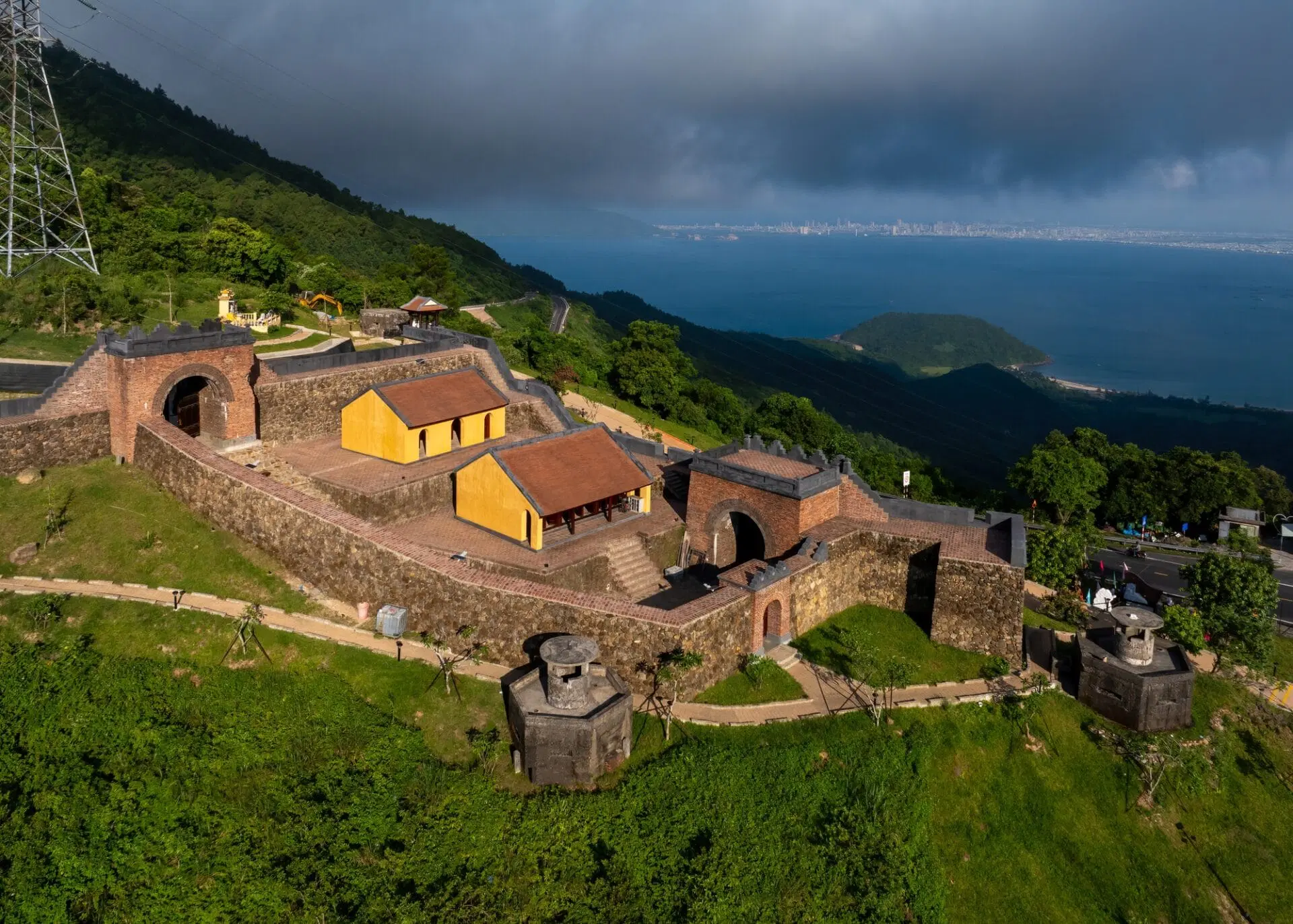
The summit itself is not just a viewpoint. It is a genuine historical site, layered with roughly two centuries of use that most riders blow straight past on their way to the next photograph. (Source: Vinpearl)
Vani Tips: Hai Van Quan gate dates to 1826, built under Emperor Minh Mang, with genuine French and Vietnam War-era gun towers still standing nearby 🏰. It was fully restored in 2024, so what you see today is in noticeably better condition than photos from even a few years ago. Before that restoration, the structure had spent decades eroding under weather and war damage, walls crumbling, watchtowers reduced to moss-covered stubs. What stands now reflects a genuine two-year, joint restoration project between the two neighbouring provinces, not a hastily patched ruin.
Reading the Layers of History in One Small Space
Walk through the arched gateway slowly and you can trace the site’s whole timeline in the architecture itself. The original fortification began under the Tran dynasty, expanded into its current form under Minh Mang in 1826 specifically to guard the approach to Hue, the imperial capital lying just beyond the mountains to the north. French colonial forces later fortified the position further, and American and South Vietnamese troops reinforced it again during the war years that followed, each era leaving behind its own additions, a bunker here, a gun emplacement there, layered onto the original Nguyen-era stonework. Two inscriptions still mark the gate, one facing Hue, one facing Da Nang, and standing beneath either one, wind cutting across the exposed summit, gives you a clearer sense of why an emperor thought this exact point in the mountains was worth defending than any museum plaque could.
Descending into Lang Co Bay
Past the summit, the road begins its long drop toward the water on the other side, and the whole character of the ride shifts as Lang Co’s lagoon comes into view below.
Vani Tips: The Cay Thong Co Don, the lonely pine tree spot, sits on the Da Nang side and was for decades a genuinely popular photo stop, but I have to be honest about its current state 🌲. The tree, planted back in 1979, died from termite damage that set in during 2024 and finished it off by early 2025, and as of my last check it had not yet been replaced, though locals have been actively trying to source a replacement. (Source: Dân Trí) Treat any mountain-road pull-off with the same caution regardless, check your mirrors before stepping off the bike, since trucks do still use this route.
What Remains Worth the Stop
Even without its namesake tree standing green, the pull-off itself still delivers the view that made it famous in the first place, a genuinely striking angle over Da Nang Bay with a large rock formation nearby that visitors still climb for photographs. I would not build a special stop around the tree specifically anymore, but if you are already passing through, the wider viewpoint remains worth the two minutes it costs you. Continue past it and the descent delivers you to Lang Co itself, a narrow spit of land wedged between the open sea and a shallow, turquoise lagoon, oyster farms visible in patches across the water and a scatter of floating seafood restaurants worth returning to for lunch once you have parked the bike for good 🦪.
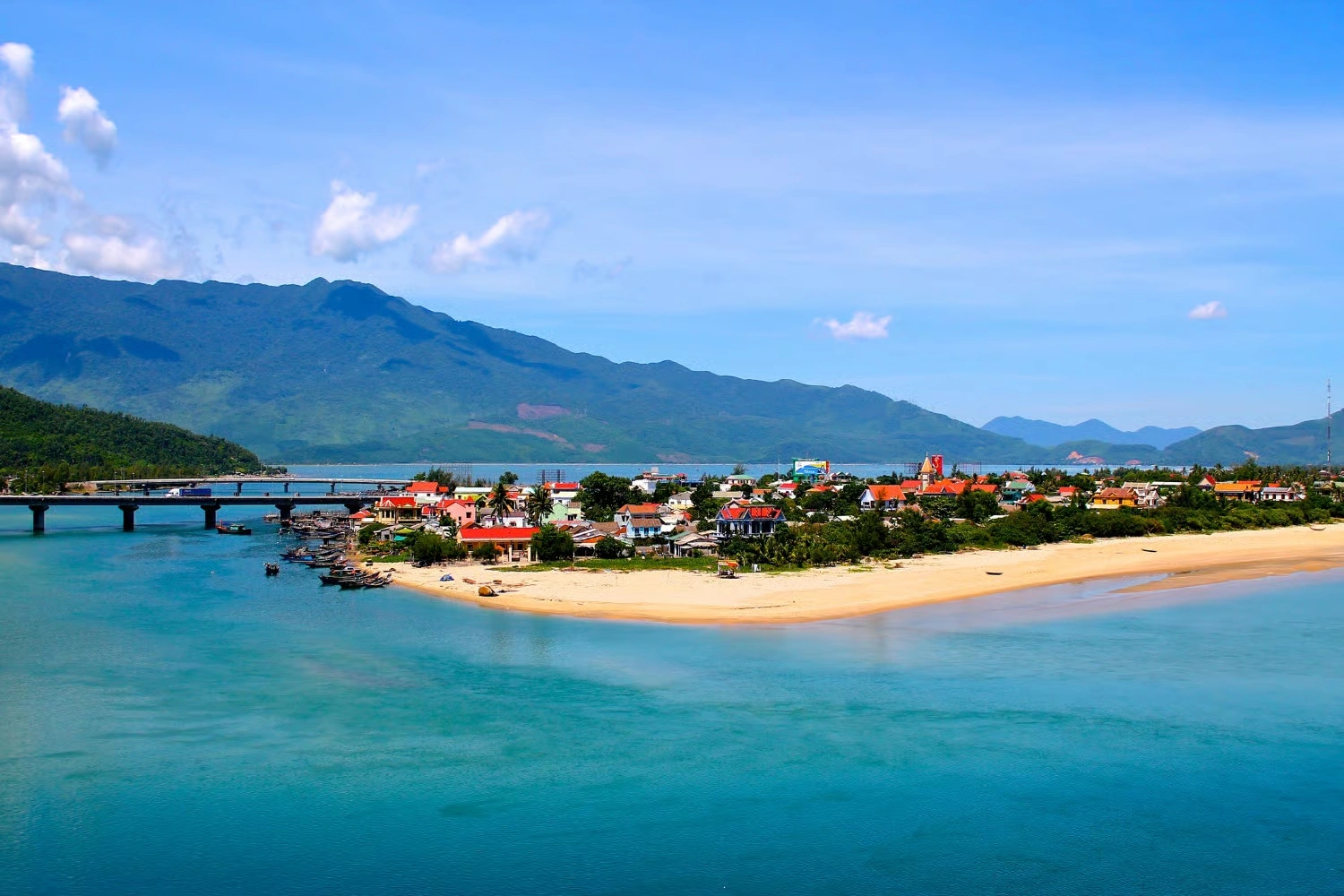
The lagoon side rewards a slower look than most riders give it on their way through. Fishing boats sit anchored close to shore in the calm water, nets drying across their bows, while the mountains you just descended rise sharply behind the whole scene, still catching mist in patches even as the coast below sits in full sun 🌤️. Stop at one of the roadside restaurants overlooking the water rather than pushing straight on, and order whatever the day’s oysters happen to be, since the lagoon’s shallow, brackish conditions produce a genuinely different flavour from the deep-water seafood more common along Da Nang’s own coast. Twenty minutes here, plate in front of you and the pass now behind rather than ahead, makes a natural close to the ride before you either loop back or continue on toward Hue.
Case Study: Sarah & Mark’s Step-by-Step Hai Van Journey
To give you a clearer perspective, here is a real-life step-by-step experience from Sarah and Mark, a couple who recently explored the pass independently:
- Step 1: Early Departure: They rented a well-maintained 125cc automatic scooter and left central Da Nang at 7:30 AM to catch the cool breeze and avoid afternoon mist.
- Step 2: The Steady Ascent: Maintaining a comfortable speed of 30-40 km/h, they treated every blind corner with caution, sounding the horn lightly before turning.
- Step 3: Historical Exploration: Arriving at the summit by 8:45 AM, they spent 30 minutes walking through the newly restored Hai Van Quan gate, taking photos of the layered architecture.
- Step 4: A Lagoon Lunch: Coasting down the northern side, they reached Lang Co by 10:15 AM, rewarding their ride with a plate of fresh lagoon oysters at a floating restaurant before heading back.
Need Help Organizing Your Adventure?
Drop us a message for personalized itineraries, reliable local tips, and dedicated support for your entire trip.
Frequently Asked Questions
How long does it take to ride the Hai Van Pass from Da Nang?
Quick Answer: Roughly 45 to 60 minutes each way to the summit without stops, though a proper ride with photo stops and a coffee break easily fills three to four hours round trip.
Is the Hai Van Pass dangerous to ride?
Quick Answer: Not inherently, given a well-maintained bike, daylight riding, and reasonable caution on blind curves, though the winding terrain and shared traffic mean it rewards focus over speed.
Do you need a manual motorbike for the Hai Van Pass?
Quick Answer: No. A standard automatic scooter in good condition handles this specific road fine, unlike some of the region’s steeper, rougher mountain routes where manual transmission genuinely matters.
Is the Hai Van Pass worth it if you have already done the tunnel?
Quick Answer: Yes. The tunnel is transport, a fast, viewless six-kilometre bore. The pass is the experience, delivering the coastal views, the historic gate, and the descent into Lang Co that the tunnel simply skips entirely.
Can you ride the Hai Van Pass without a guide or tour?
Quick Answer: Yes, easily. The road is well-signed, well-paved, and straightforward to navigate solo on a rented bike, though a guide adds local knowledge of the stops and can be worthwhile for less confident riders.
Final Word From Vani
Rent whatever bike you already feel comfortable on, an automatic scooter genuinely does the job here, and set aside a real morning rather than just the ride time itself. The pass rewards stopping, at the viewpoints, at the gate, at Lang Co for lunch, far more than it rewards getting to Hue quickly. Go expecting company on the road rather than the empty ribbon of a fifteen-year-old TV episode, and the ride still earns every bit of its reputation.
Further Reading & Resources
- Hai Van Pass, Danang Fantasticity, Da Nang City Tourism Information Portal. Direct Link
- Top Gear: Vietnam Special, Wikipedia. Direct Link
- Hai Van Gate (Da Nang): A full guide for first-time visitors, Vinpearl. Direct Link
- Cây thông cô đơn nổi tiếng trên đèo Hải Vân đã chết khô, Dân Trí. Direct Link
- Hai Van Pass by motorbike: A local’s guide to Vietnam’s most famous road, Vietnam Story. Direct Link

Vani is the Founder and Lead Travel Designer at Truly Voyage. With over a decade of experience and a deep passion for her Vietnamese heritage, she specializes in crafting bespoke, unhurried itineraries. Vani is dedicated to helping travellers experience the authentic soul of Southeast Asia with absolute financial security and 24/7 on-ground support.
0 Comment