


Red Sand Dunes Mui Ne is frequently grouped with the distant White Dunes, confusing travelers and wasting their time. Don’t let generic itineraries ruin your schedule! This guide reveals the short 10-minute ride from town, the reality of cheap plastic sledding, and practical sunset tips. Learn how to perfectly slide this vibrant landscape into your quick pre-dinner plans. 💡

Ask five different listings about Red Sand Dunes Mui Ne and four of them will fold it into the same generic sand-dunes paragraph as the White Sand Dunes, as though the two were a single stop on the same short outing. 🏜️
They are not. Not even close.
I am Vani, founder of Truly Voyage, and I keep these two sites firmly separate for a reason: one is a roughly 90-minute round trip you plan a whole morning or afternoon around, the other is a five-minute detour you can slot in on the way to dinner. This guide covers the second one properly, on its own terms: the real distance, the colour, the highly affordable sled rental, and the sunset crowd worth knowing about before you go.
Table of Contents
ToggleMinutes From Town, Not the Half Day the White Dunes Need
The Red Sand Dunes, also known locally as Doi Cat Hong or Doi Cat Do, sit about 3 to 15 kilometres from Mui Ne town, a 5 to 15 minute ride, roughly a tenth of the distance to the White Dunes. 🛵
| Feature | Red Sand Dunes | White Sand Dunes |
|---|---|---|
| Distance from Mui Ne | 3–15 km, 5–15 min | ~40 km, 45–60 min |
| Scale | Smaller, compact | Sweeping, desert-scale |
| Entry fee | Free | 10,000–15,000 VND |
| Signature activity | Sled rental, 10,000–20,000 VND | Sledding, ATV, jeep, boat |
| Best suited to | A quick sunset add-on | A dedicated half day |
Table 1: Quick comparison between Red and White Sand Dunes in Mui Ne
Sources disagree on the exact distance figure, which is worth being upfront about rather than picking one number and quietly dropping the rest. The Culture Trip describes the site as sitting directly next to the main coastal road running out of Mui Ne (Source: The Culture Trip), while GuidesAndStories puts it at 10 to 15 minutes by motorbike or taxi, roughly 10 to 15 km (Source: GuidesAndStories.com). A third figure, 25 km, shows up across Vinpearl and VinWonders (Source: Vinpearl), but that number is measured from Phan Thiet city, not from Mui Ne town itself. 🗺️
Reconciling the Numbers
Subtract the roughly 22 km that separates Phan Thiet from Mui Ne town, and that 25 km figure lands at about 3 km beyond Mui Ne itself, which lines up neatly with the coastal-road and 10 to 15-minute descriptions everyone else gives. Whichever exact number you settle on, multiple sources agree on the shape of the picture: this sits an order of magnitude closer to town than the White Dunes’ roughly 40 km, and nobody needs to plan a dedicated half day around it the way they do for the White Dunes. Close enough, in fact, that a decent hotel bike or a short taxi hop covers it, rather than the private-driver booking a White Dunes trip warrants.

Getting There Without Booking a Driver
The short distance changes how you get here, compared with the White Dunes. A hotel-rented scooter covers this in under fifteen minutes along a flat coastal road, no mountain bends or long open-highway stretches involved, and a metered taxi or ride-hailing app handles it just as easily for travellers who would rather not ride themselves. 🚕
Most Mui Ne jeep tours also fold this stop into a longer loop alongside Fairy Stream and the fishing village, so if you are already booking one of those, check whether the Red Dunes are included before arranging a separate trip here on top of it. Self-driving out to the White Dunes, by contrast, is a different undertaking once you factor in the distance and the earlier start.
Looking to Craft the Perfect Vietnam Itinerary?
Let us help you seamlessly combine Mui Ne’s hidden gems with the rest of Vietnam.
Why the Sand Is Actually Red
The reddish colour here comes from a different mineral composition than the White Dunes, and the shade itself visibly shifts through the day as the angle of light changes. 🌅
Every source I checked agrees on the underlying mechanism: iron-oxide content in the sand, distinct from the pale, quartz-toned White Dunes further up the coast. What nobody has published is a precise mineral percentage, so treat the iron-oxide explanation as the correct qualitative mechanism, not a number you can cite with false precision. The two sites differ sharply in scale as much as in colour. GuidesAndStories describes the White Dunes as tall, pale dunes that stretch to the horizon, a sweeping desert landscape, while The Culture Trip calls the Red Dunes plainly the smaller of the two (Source: The Culture Trip).
Two Real Dune Fields, Not One Marketed Off the Other
I get asked this more often than you would expect: whether one of these two sites is somehow the fake or dyed version of the other. Neither is. Both are real, naturally occurring dune fields with different mineral makeups, not a single dune field photographed under different filters or marketed twice under two names.
The confusion is understandable given how often the two appear stacked in the same three-photo carousel online, but they are separate formations with separate geology, roughly 40 km apart by road, each earning its place on a Mui Ne itinerary for different reasons rather than as interchangeable versions of the same stop. 🧭

What the Cheap Sled Rental Really Involves
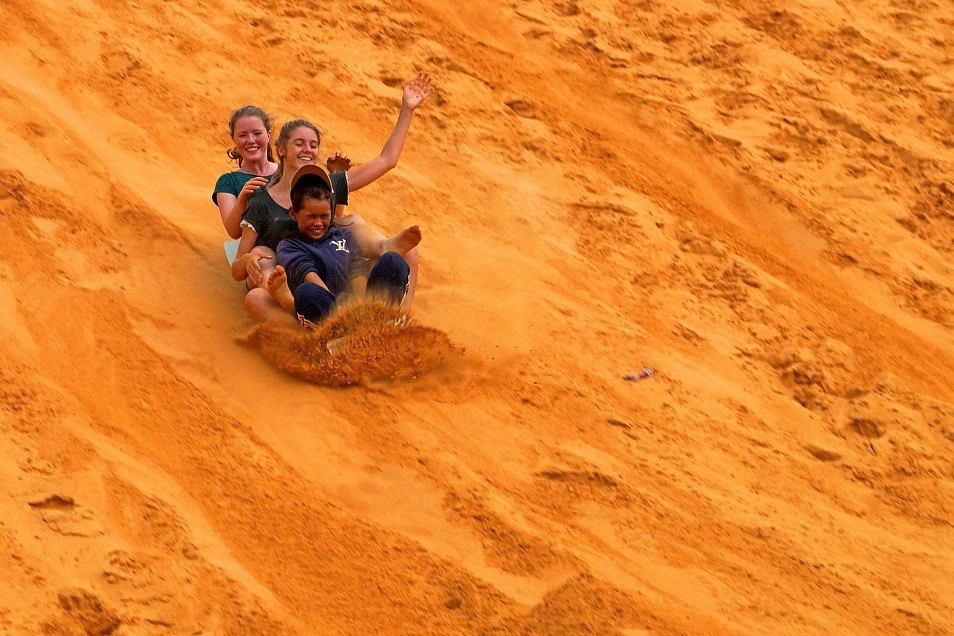
Plastic sled rental runs an affordable 10,000 to 20,000 VND, and this is sledding, sitting or lying on a flat plastic board, not standing sandboarding the way snow sports work. 🏂

Sitting or Lying, Not Standing
Set this expectation before you rent one, because the marketing photography here does you no favours. A lot of promotional images crop tightly enough to imply a snowboard-style stand-up run down the dune face, and that is simply not what is on offer.
What you actually get is a flat plastic sled, ridden seated or lying face-first, for a short, fast slide down the slope, walked back up, and done again. It is fun. It is just not the sport the photos suggest, and I would rather you know that walking in than find out disappointed at the bottom of the dune. If the full breakdown on technique and whether it suits younger kids specifically is what you are after, I cover that in more depth in my dedicated Mui Ne sandboarding guide.
The Quoted-Low-Charged-High Pattern
Rental cost is tightly convergent across independent sources, an affordable activity in this cluster of sights, at 10,000 to 20,000 VND per sled. The catch worth knowing about upfront: the quoted-low-charged-high complaint pattern documented around Mui Ne’s dune vehicles does show up here too, on a smaller scale. GuidesAndStories states plainly that some visitors report being asked for significantly more money after the ride than was initially suggested (Source: GuidesAndStories.com). It is a known pattern, but a low-stakes one here, typically a dispute over a few thousand dong rather than the far more heavily documented pricing complaints around the ATV and buggy rentals at the White Dunes, which I cover separately in my Mui Ne Jeep Tour guide. 💸
Case Study: A Step-by-Step Sunset Detour Experience
To show how effortlessly this fits into a casual afternoon, here is a step-by-step breakdown of how a recent client, Sarah, tackled this trip without dedicating a full day to it:
- Step 1: The 4:30 PM Departure: Sarah booked a metered taxi from her resort on the main strip. The ride took exactly 12 minutes along the flat coastal road. 🚕
- Step 2: Upfront Negotiation: Arriving near the entrance at 4:45 PM, she approached a local vendor and immediately agreed on a 20,000 VND fee for a plastic board before walking up the slope. 🤝
- Step 3: The 30-Minute Slide: She spent half an hour hiking up and sliding down face-first. It was a fast, dusty thrill. 🏃♀️
- Step 4: Dinner Bound: By 5:30 PM, after snapping a few golden-hour photos, she hopped back into a Grab car and was seated at a seafood restaurant by 5:45 PM. 🦞
Want a Hassle-Free Trip in Vietnam?
Let us handle the planning, transfers, and insider tips so you can just enjoy the ride.
When to Go for the Best Light
Sunset gives the richest colour on the red sand and the most comfortable temperature underfoot, but it is also, honestly, the most crowded window of the day at this specific spot.

The golden, low-angle light in the 4 to 6pm window intensifies the natural orange and deep red tones far beyond what the same sand looks like at midday, and the sand itself cools to a pleasant temperature rather than the scorching heat of early afternoon (Source: Viet-Go.com). ☀️ GuidesAndStories is direct about the trade-off involved, calling sunset by far the busiest period at the site, meaning the best photographs and the biggest crowd arrive at exactly the same time, sled vendors included.
Early morning is the honest alternative if crowds matter more to you than colour. The light is flatter and the reds noticeably less intense, but you will likely have long stretches of the dune face to yourself, and the sand stays cool well past the hour it starts baking at the White Dunes. Neither window is wrong. It comes down to whether you are optimising for the photograph or for the experience of having the place mostly to yourself.
Frequently Asked Questions About the Red Sand Dunes Mui Ne
How far are the Red Sand Dunes from Mui Ne?
Quick Answer: About 3 to 15 km, a 5 to 15 minute ride from central Mui Ne.
This makes it roughly a tenth of the distance to the White Sand Dunes.
Are the Red Sand Dunes free to enter?
Quick Answer: Yes.
There is no ticket office or admission charge here, unlike some other stops on a typical Mui Ne day tour. 🎟️
What is the difference between the Red and White Sand Dunes in Mui Ne?
Quick Answer: Distance and scale, mainly.
The Red Dunes sit minutes from town and are smaller and more compact; the White Dunes sit roughly 40 km out and form a sweeping desert landscape. The colour difference comes from a different mineral composition in the sand itself, not from one site being a dyed or marketed version of the other.
Is sledding at the Red Dunes worth it?
Quick Answer: For 10,000 to 20,000 VND and five minutes of your time, yes.
It serves as a fun add-on rather than a planned activity. Go in expecting seated or lying sledding, not standing sandboarding.
When is the best time to visit the Red Sand Dunes?
Quick Answer: Sunset, for the richest colour and most comfortable sand.
Though it is also the busiest window. Go slightly earlier than peak sunset, or come in the early morning instead, if you would rather avoid the crowds.
Can I combine the Red Dunes with the White Dunes in one trip?
Quick Answer: Yes, most jeep tours do exactly this.
But budget the time honestly: the White Dunes alone add close to 90 minutes of driving, while the Red Dunes add a short detour on the way past. 🚙
Do I need to book a tour to visit the Red Sand Dunes?
Quick Answer: No.
The short distance from town makes this one of the sights in the area that works well as a self-arranged taxi or motorbike trip, rather than something that requires a booked driver the way the White Dunes do.
Conclusion
Treat this as the quick, cheap sunset add-on it actually is, not a planned excursion that deserves its own half day.

Agree the sled price before you sit down. Go slightly ahead of peak sunset if the crowd matters more to you than the very last of the colour. Do that, and this remains exactly what it should be: five fun minutes on the way to somewhere else, not a trip you build an entire afternoon around. ✨
Further Reading & Resources
- The Culture Trip — distance framing and scale comparison with the White Dunes. Direct Link
- GuidesAndStories.com — distance detail, sled pricing, and the pricing-complaint pattern. Direct Link
- VietGo — sunset light and timing detail. Direct Link
- Vinpearl — distance from Phan Thiet used to reconcile the Mui Ne figure. Direct Link
- VinWonders — sled rental pricing corroboration. Direct Link
- Edenseekega — sled rental pricing corroboration. Direct Link
Your Adventure in Vietnam Starts Here!
Discover the real Vietnam with our carefully curated tours, or let us tailor one just for you.

Vani is the Founder and Lead Travel Designer at Truly Voyage. With over a decade of experience and a deep passion for her Vietnamese heritage, she specializes in crafting bespoke, unhurried itineraries. Vani is dedicated to helping travellers experience the authentic soul of Southeast Asia with absolute financial security and 24/7 on-ground support.
0 Comment