

 By Vani
Son Doong Cave is a demanding, guided expedition in Phong Nha–Ke Bang. Oxalis lists a six-day, five-night package with four trekking days, priced at US$3,000 per person. Check availability and eligibility before arranging flights: the operator’s page lists 2027 and 2028 as fully booked as of 10 November 2026.
In early December 1990, local forest forager Ho Khanh found the entrance to Son Doong while sheltering from a storm. He heard a river and felt air coming from the opening, but did not explore the passage. Years later, his account helped lead the British-Vietnamese caving team to the cave. (Source: Oxalis Adventure)
This guide combines the discovery story with the practical decisions before a Son Doong expedition: availability, eligibility, the current route, what the price includes and how to prepare. For the surrounding journey, start with our Phong Nha–Ke Bang guide. A confirmed cave place should come before the rest of the itinerary.
Who First Found Son Doong Cave?
Oxalis dates Ho Khanh’s first finding of the entrance to December 1990; the British-Vietnamese survey followed in 2009.

After Ho Khanh described the entrance to cavers, relocating it took repeated searching. Oxalis records that he found the way again in 2008 and led the survey group there in 2009. The distinction is useful: finding an entrance and scientifically surveying a cave were separate events. (Source: Oxalis Adventure)
Peter MacNab entered on 7 April 2009 as part of the British-Vietnamese expedition working with Hanoi University of Science. The team announced the discovery on 14 April 2009. In 2010, further exploration crossed the barrier known as the Great Wall of Vietnam. The name Son Doong is commonly translated as Mountain River Cave. (Source: Oxalis Adventure)
How Big Is Son Doong, Really?
Son Doong holds the largest single cave passage distinction. Its size record is different from the longest cave-system record held by Mammoth Cave in the United States.
Guinness World Records describes Son Doong as the world’s largest single cave passage by overall dimensions, around 200 metres high and 150 metres wide, with a length of at least 6.5 kilometres in its 2009 record. Oxalis describes the subsequently explored cave as nearly 9 kilometres long. These figures refer to different survey descriptions; they are not measurements of a walking day on the tour. (Sources: Guinness World Records; Oxalis Adventure)
Oxalis gives a volume of 38.5 million cubic metres for Son Doong. Separately, the U.S. National Park Service describes Mammoth Cave as the world’s longest known cave system, mapped at 426 miles, or 686 kilometres. Use largest passage for Son Doong and longest system for Mammoth Cave; do not turn the two into a length ranking. (Sources: Oxalis Adventure; U.S. National Park Service)
| Feature | Son Doong Cave | Mammoth Cave |
|---|---|---|
| Record | Largest passage | Longest system |
| Measure | 38.5 million m³ | 686 km |
| Location | Phong Nha, Vietnam | Kentucky, USA |
| Geological Type | Karst river cave | Limestone system |

use largest for Son Doong and longest for Mammoth Cave if you want to describe both places accurately, rather than repeating the common mix-up that treats the two records as interchangeable.
What Is Actually Inside This Cave?
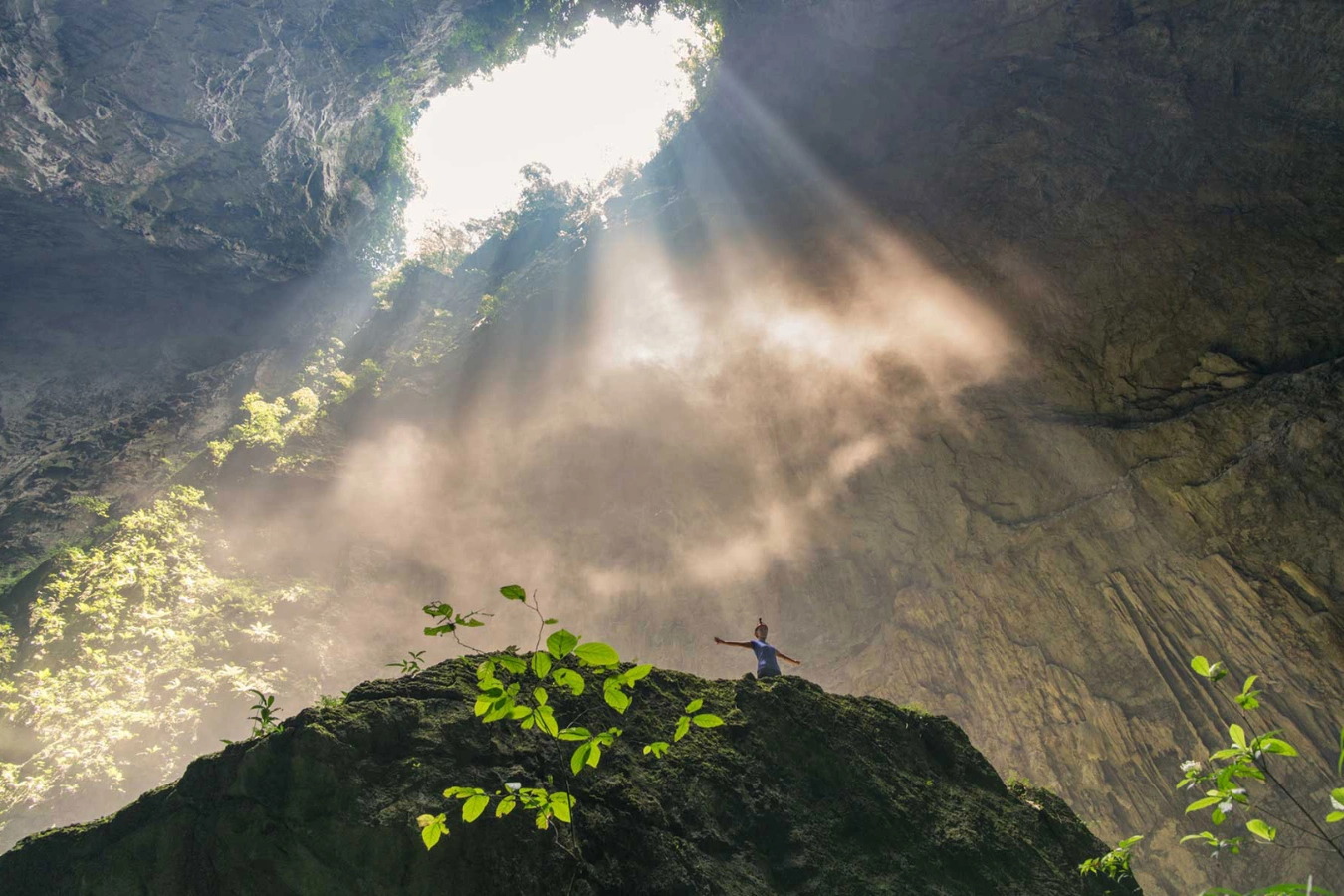
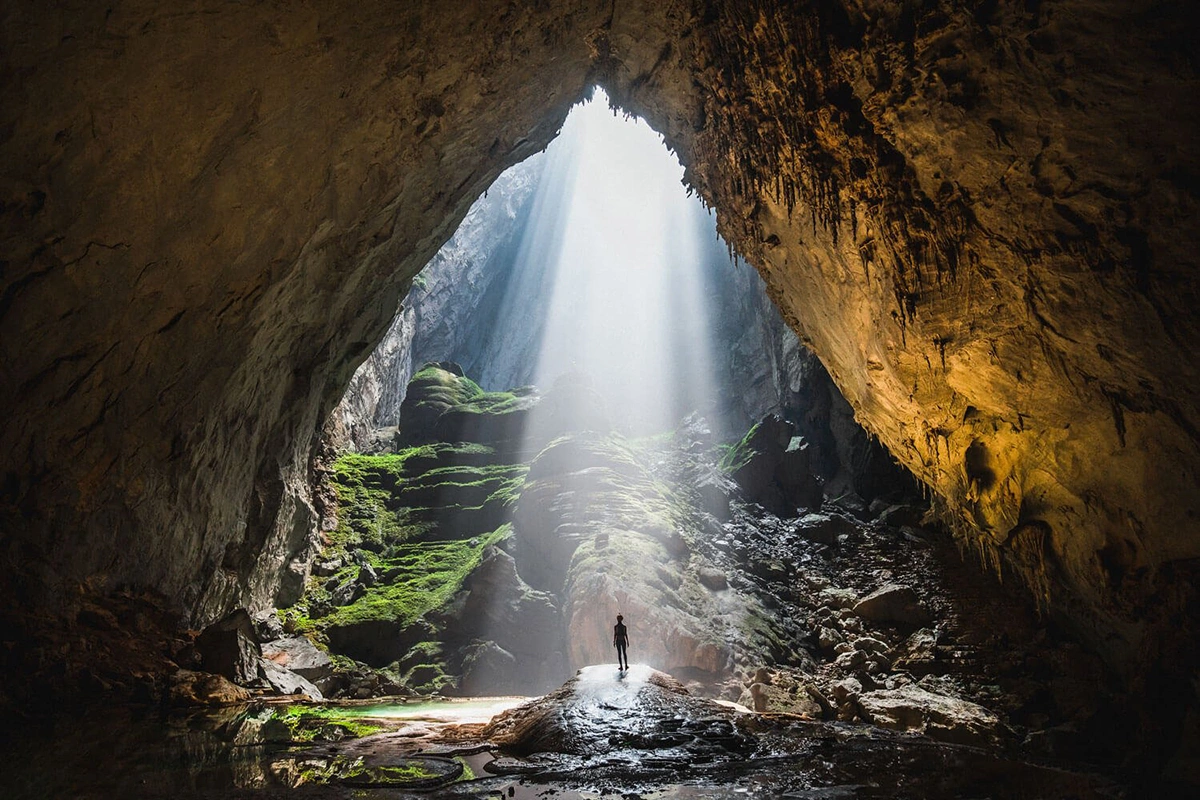
Two collapsed roof openings, or dolines, allow daylight into parts of Son Doong. They are landmarks within the cave, not separate caves or ordinary roadside viewpoints.
These openings allow plants to grow in places where light reaches the cave floor. The river, formations, dark passages and naturally lit sections are all part of a wilderness route involving uneven ground. The scenery does not remove the physical demands of reaching it. (Source: Oxalis Adventure)
Doline 1: Watch Out for Dinosaurs
Doline 1 is known as Watch Out for Dinosaurs, with the Wedding Cake formation among its landmarks. The view and any sunbeams depend on the weather and light; do not choose dates on a promise of a particular photograph. (Source: Oxalis Adventure)

Doline 2: The Garden of Edam
Doline 2 is the Garden of Edam, a forested section sustained by light entering through the collapsed ceiling. It is distinct from Doline 1 and is part of the expedition’s deeper route. Expect rough ground and follow the safety team rather than treating it as a garden walk. (Source: Oxalis Adventure)


A JOURNEY SHAPED AROUND YOU
Start with what matters.
We can plan from there.
Tell us what you enjoy, how you like to travel and where you would like more time. We can discuss a private itinerary around your interests and preferred pace.
What does the current six-day itinerary involve?
The current package has an arrival and briefing day, four trekking days and a departure day. The first expedition overnight is a forest camp near Son Doong’s entrance, rather than the Hang En overnight described in older itineraries. (Source: Oxalis Adventure)
Read package days and trekking days separately
- Day 1 — arrival: reach Phong Nha, attend the safety briefing and stay at Commander Lodge.
- Day 2 — first trekking day: travel via Ban Doong’s Bru-Van Kieu community and Hang En, then continue to the forest camp near Son Doong’s entrance.
- Day 3 — enter Son Doong: explore the high-level passage and descend to the main cave, continuing to Doline 1 camp.
- Day 4 — deeper into the cave: travel through Doline 1 and the Garden of Edam to Doline 2 camp.
- Day 5 — exit: ascend the Great Wall of Vietnam, exit the cave and return to Chay Lap Farmstay.
- Day 6 — onward travel: leave according to the agreed Dong Hoi transfer arrangements.
The Great Wall ascent is listed at 90 metres overall, including an 18-metre ladder section and a 72-metre sloping ascent with safety equipment. It is not a 72-metre vertical rope ladder. Treat this as a route description, not climbing instruction; the safety team directs the actual ascent. (Source: Oxalis Adventure)

Who Runs the Trek, and Why a Dedicated Operator?
Oxalis Adventure is the operator currently authorised to take visitors into Son Doong. Access is through its expedition, with booking and participation requirements.
Son Doong lies within Phong Nha–Ke Bang National Park. Oxalis states that it is currently the only licensed operator for this expedition; do not plan an independent cave entry or assume another itinerary seller operates the route. Tourism began in 2013. Confirm the actual expedition booking with Oxalis, even if another company helps arrange your wider holiday. (Source: Oxalis Adventure)
How Much Does the Son Doong Tour Cost?
Oxalis lists US$3,000 per person for a six-day, five-night package with four expedition days. It also publishes VND80,000,000; these are the operator’s quoted prices, not a currency conversion made for this guide.

The published package includes the specified Dong Hoi transfers, pre- and post-trek accommodation, expedition support, meals, camping and safety equipment, and park fees. Groups are listed at 10 guests, with an age range of 18–70 subject to the operator’s fitness and health requirements. Eligibility by age still requires the operator’s fitness and health assessment. (Source: Oxalis Adventure)
When Can You Actually Go?
The operator’s published season is January to August. Availability is a separate question from whether a month is within that season.
Oxalis describes a January-to-August operating window and limited annual access. As of 10 November 2026, its tour page marks the 2027 and 2028 expeditions as fully booked. Use the current Son Doong expedition page and speak to the operator before making non-refundable travel arrangements. Do not infer a place from a general enquiry or a quoted holiday price. (Source: Oxalis Adventure)
How should you prepare before booking Son Doong?
Start with availability and suitability, then build the rest of your Vietnam trip around a confirmed expedition. Do not buy non-refundable flights on the assumption that paying for a holiday package will secure a Son Doong place. Truly Voyage can discuss the surrounding itinerary; the cave expedition, screening and operating decisions belong to Oxalis.

A practical order of decisions
- Before paying: ask about actual places, the booking conditions, eligibility and the current itinerary.
- Before booking connections: agree the briefing location, arrival deadline and pickup arrangements with Oxalis.
- Before departure: discuss your trek with a travel-health clinician, arrange suitable insurance and follow the operator’s personal packing list.
- After the trek: allow time to rest before another demanding outing, and leave space for changes to transport plans.
Fitness: what experience does the operator require?
Oxalis describes this as a challenging expedition for regular trekkers. Its current requirements include an overnight forest or mountain camping trek within the previous 12 months, covering at least 8 km per day on steep, rocky terrain and at least 1,000 m of total elevation gain across that trip. It also lists a 5 km outdoor run within 45 minutes and five flights of stairs continuously as baseline checks. These are the operator’s screening criteria, not a training prescription or a guarantee of acceptance. (Source: Oxalis Adventure)

For the expedition itself, the current tour page lists 28 km of jungle and mountain trekking, 9 km of cave exploration, repeated river crossings and rope-assisted sections. Porters carry specified camp items, but you carry your personal backpack. Compare these demands with your recent experience honestly before asking the operator to assess your application. (Source: Oxalis Adventure)
If you need a way to build up experience, discuss a suitable progression with qualified professionals and the operator. Do not treat a month of gym sessions, your age alone or a single fitness test as proof that this particular trek will suit you. Use the current Oxalis fitness guidance alongside the requirements on the actual tour page.
Health, insurance and communication before departure
Arrange a travel-health consultation at least a month before departure. Explain that the itinerary includes remote jungle trekking, caves, river crossings and camping, and discuss your medical history, medicines, vaccinations and insect-bite prevention. CDC advice is destination guidance; a clinician should apply it to your health and actual route. (Source: CDC)

Tell the operator about relevant conditions: request its current health restrictions and disclose the information it asks for accurately. A clinician’s advice and the operator’s participation decision serve different purposes; neither should be replaced by a general travel article.
Read the insurance wording: Oxalis includes limited tour insurance and recommends your own comprehensive cover. Ask an insurer to confirm guided caving, trekking, medical treatment, evacuation, trip cancellation and any pre-existing-condition terms for your circumstances. Keep the written confirmation and emergency contact details. Do not assume that an included policy covers every cost. (Source: Oxalis Adventure)
Plan to be out of contact: agree the expedition’s emergency contact procedure with Oxalis and tell family when you expect to be reachable again. Ask how staff communicate and respond if someone cannot continue; a personal SIM or a presumed helicopter pickup is not an emergency plan.
On the route: follow the safety team’s instructions on equipment, movement, water and camp hygiene. Carry personal medication as advised by your clinician and tell the guide promptly if you feel unwell. Let the team manage difficult sections rather than trying to reproduce rope techniques from a written guide.
Budget for the whole journey, not only the cave price

The quoted expedition includes specified accommodation, support, meals, safety equipment and Dong Hoi transfers. Budget separately for international and domestic travel to Dong Hoi, entry documents if required, personal insurance, personal gear, extra nights and activities outside the expedition. Ask about any supplements and the payment and cancellation conditions before paying. (Source: Oxalis Adventure)
Compare the total journey cost, and confirm whether any quoted discount applies to your booking. If traveling with a companion who will not trek, ask for a separate Phong Nha plan and accommodation quote. Do not assume their stay is included in the expedition price.
Getting to Phong Nha and the expedition briefing
Plan to reach Dong Hoi or Phong Nha according to the operator’s confirmed instructions. The current package starts with an arrival and safety-briefing day in Phong Nha; it is not a group briefing in Hanoi or Ho Chi Minh City followed by an included domestic flight. Oxalis lists pickup and drop-off in Dong Hoi as part of the package. (Source: Oxalis Adventure)

For route choices, use the Phong Nha transport guide, then agree the pickup point and timing with Oxalis. A scheduled flight or train arrival is different from reaching the briefing venue. Leave room for a delayed arrival when choosing your connection.
Check Vietnam entry requirements for your passport and travel dates before buying tickets. Keep the documents the operator requests, and ask how documents and spare luggage are stored during the trek. Visa fees, exemptions and document requirements should match your nationality and route.
A local SIM can help with arrival arrangements, but buy according to current coverage and plan terms rather than an old price list. Save booking details and maps offline, carry accessible emergency information, and agree a contact plan before leaving the town.
Packing: your daypack, the porter bag and stored luggage
Keep three categories separate: luggage that stays in town, the personal backpack you carry on the trail, and the bag of permitted camp items carried by porters. Oxalis states a 7 kg limit for porter-carried luggage; that is not an allowance to load your daypack to 7 kg. Its preparation guidance describes a personal pack of about 20–30 litres. (Source: Oxalis Adventure)

Pack by when you need an item
- Personal daypack: keep the water and essentials agreed with the operator, medication you may need, sun and insect protection, a weather layer and protected camera or phone accessible.
- Porter bag: pack the permitted spare clothes, camp items and toiletries within the current weight limit. Confirm when that bag will be accessible; do not put an essential medicine in a bag you cannot reach during the day.
- Stored luggage: leave items that are not needed on the expedition according to the operator’s storage arrangements. Confirm document and valuables handling rather than assuming a passport is collected or carried at a particular time.
Use the latest operator list for quantities and provided equipment. The practical priorities are quick-drying trekking clothes, suitable footwear already used on walks, spare socks, comfortable camp clothing and protection for electronics. Confirm how footwear handles river crossings and what cold-weather layers your departure needs. Avoid adding bulky equipment simply because a generic packing list recommends it.
Oxalis provides specialist safety equipment and camping arrangements. Ask before bringing an alternative harness, headlamp, sleeping setup or bulky photography kit; staff need to know what will be used and carried. Follow the team’s conservation instructions for toiletries, waste, water and movement around cave formations.

Choose the season with realistic expectations
The operator’s published season is January through August. Early departures can need warmer layers, while jungle approaches later in the season can feel hot and humid. Ask about conditions for your actual dates and follow updated instructions; a seasonal label does not promise dry trails, a particular sunbeam or unchanged river levels. (Source: Oxalis Adventure)

For the wider area, see when to visit Phong Nha. If your trip falls outside the Son Doong operating season, compare other places and check their own calendars. Another cave is not automatically open or suitable just because Son Doong is unavailable.
Practical details to confirm for the current itinerary

Hang En and camping: the current tour passes through Hang En but lists the first expedition overnight in the forest near Son Doong’s entrance. Do not use photographs of a Hang En campsite as proof of where your departure will sleep. The itinerary you receive at booking takes precedence. (Source: Oxalis Adventure)

Bathing and swimming: ask about the facilities at each overnight stop. Oxalis says swimming is not required for Son Doong, although river crossings still mean wet conditions. Do not confuse an optional swim with a mandatory swim section, or assume a campsite has a hotel-style shower. (Source: Oxalis Adventure)
Food and room arrangements: discuss dietary requirements when booking, along with tent sharing, camp facilities and the exact pre- and post-trek rooms. A vegetarian option does not by itself confirm every ingredient or preparation requirement.
Photography: protect gear from moisture, keep your hands available on demanding sections, and accept that a desired photograph may depend on conditions and the guide’s decision. Ask before bringing a large tripod or extra batteries that add weight.

What if Son Doong does not suit your dates or fitness?
Who it suits
Experienced, fit trekkers who meet the operator’s requirements, can manage the current terrain and camp routine, and have a confirmed departure.
Who may prefer something else
Travelers seeking a short cave visit, easier access, hotel nights throughout, or a trip that can be booked around fixed flights without expedition availability.
Compare Paradise Cave, Dark Cave and the wider Phong Nha attractions by their own access and activity requirements. Dark Cave can involve active outings, so it is not automatically an easier substitute. Let your actual priorities determine the alternative rather than trying to recreate Son Doong with a different cave name.
Frequently Asked Questions About Son Doong Cave
Who discovered Son Doong Cave?
Oxalis dates Ho Khanh’s finding of the entrance to December 1990. The British-Vietnamese survey followed in 2009, with the discovery announced that April.
Is Son Doong the longest cave in the world?
No. Son Doong holds the largest single cave passage distinction. Mammoth Cave in Kentucky, USA, holds the longest cave-system distinction.
How much does the Son Doong tour cost?
Oxalis lists US$3,000 per person, also published as VND80,000,000, for the six-day, five-night package with four trekking days. Check the current inclusions and conditions directly with the operator.
Can I book a Son Doong departure for 2027 or 2028?
As of 10 November 2026, the Oxalis tour page marks both years as fully booked. Ask the operator about current availability before buying non-refundable flights; an enquiry is not a confirmed place.
Can you visit Son Doong Cave without a tour?
No independent visit is offered. Access is through the authorised Oxalis expedition, subject to its booking and participation requirements.
What formed Son Doong Cave?
River water dissolved and eroded limestone along a geological fault. Oxalis describes the limestone as older than 400 million years and cave formation as about 2–3 million years ago; these are different geological ages.
How do you get to the expedition?
Plan your arrival in Dong Hoi or Phong Nha with the operator so you reach the Phong Nha safety briefing on time. The published package includes specified Dong Hoi transfers; domestic flights are separate travel arrangements.
Does the current itinerary camp overnight in Hang En?
The current tour passes through Hang En and lists the first expedition overnight at a forest camp near Son Doong’s entrance, followed by two cave camps. Confirm the itinerary supplied with your booking.
Is Son Doong suitable for someone without trekking experience?
The operator requires recent overnight trekking experience and specific fitness and health screening. Age eligibility, a gym routine or the ability to pay does not replace those requirements. Discuss your experience honestly with Oxalis before booking.
Do I have to carry all my luggage or swim?
You carry your personal trail backpack; the operator permits specified camp items in a porter-carried bag with a 7 kg limit. Oxalis says swimming is not required for Son Doong, although river crossings mean you should expect wet conditions.
Conclusion
Son Doong is both a major cave discovery and a demanding expedition. Understanding the difference between its size record, the current route and the booking requirements helps you decide whether it belongs in your Vietnam journey.
Confirm availability and suitability first, then plan arrival, the briefing, your own preparation and the days around the trek. If the departure or terrain does not fit, choose a different Phong Nha visit on its own merits. There is no need to turn a shorter cave outing into a promise of the Son Doong experience.
Further Reading & Resources
Sources
- Son Doong Cave Expedition Oxalis Adventure
- FAQs: Son Doong packing and swimming Oxalis Adventure
- How to make sure that you are fit for Son Doong Cave Tour Oxalis Adventure
- Son Doong Cave: discovery and exploration Oxalis Adventure
- Largest cave Guinness World Records
- Son Doong Cave: largest cave in the world Oxalis Adventure
- Exploring the World’s Longest Known Cave U.S. National Park Service
- Vietnam: Traveler view CDC
Related guides
A JOURNEY SHAPED AROUND YOU
Start with what matters.
We can plan from there.
Tell us what you enjoy, how you like to travel and where you would like more time. We can discuss a private itinerary around your interests and preferred pace.

Vani is the Founder and Lead Travel Designer at Truly Voyage. With over a decade of experience and a deep passion for her Vietnamese heritage, she specializes in crafting bespoke, unhurried itineraries. Vani is dedicated to helping travellers experience the authentic soul of Southeast Asia with absolute financial security and 24/7 on-ground support.
0 Comment