
A three-week Vietnam itinerary usually runs from Hanoi and Ha Long Bay to Hue and Hoi An, then the southern beaches, Ho Chi Minh City and the Mekong Delta. Domestic flights replace the longest train days. Our 21-day route starts from US$1,850 per person. Check the season first: Hue and Hoi An are rainy from about September to January.
Three weeks is enough time to see the north, the centre and the south of Vietnam without rushing, as long as the route follows the geography. The country is a long S-shape of about 1,650 kilometres from the northern mountains to the southern delta 🗺️, with very different weather at each end, so the order of your stops matters as much as the list.
This guide uses our 21-day route as a worked example: where you stay each night, how you move between regions, what the weather is like along the way and what a trip of this length costs. If you have less time, start with our Vietnam 10 day itinerary, the 2 weeks in Vietnam itinerary, our 14-day Vietnam holiday planning guide, or the 2026 Vietnam travel plan. To compare finished routes of every length, browse our Vietnam holidays ✈️.
Truly Voyage is a travel company registered in Hanoi; you can read who we are on our About Truly Voyage page.

Why is a meticulously planned Vietnam travel route essential for your holiday success?
Distances are long and the weather changes by region, so a good Vietnam travel route runs in one direction, flies over the longest stretches and leaves time to rest between moves.

Many first-time visitors underestimate the distances. Vietnam’s national tourism board notes that the train from Hanoi to Ho Chi Minh City can take up to 30 hours, and that 16 hours from central Vietnam to either end is common, while a flight takes one or two hours (Source: Vietnam National Authority of Tourism). On a three-week trip, those saved days are better spent on the ground.
Trains still have a place. The stretch from Hue to Da Nang climbs over the Hai Van Pass, with coastal views you would miss in the road tunnel, so our route takes the train there and flies the longer hops: Hanoi to Hue, Da Nang to Nha Trang, and Ho Chi Minh City to Phu Quoc and back—compare all domestic options in getting around Vietnam.
The other planning point is how often you change hotels. Our 21-day route has 11 check-ins in nine places over 20 nights, including one night on a cruise and one in a homestay. Two longer drives, Nha Trang to Mui Ne and Mui Ne to Ho Chi Minh City, link the southern beaches. If you prefer fewer moves, drop a stop and stay longer in the places you like most.
How to customise your 3 weeks in Vietnam for adventure or a slower pace
Spending 3 weeks in Vietnam leaves room to shape the route around how you like to travel. The classic version mixes heritage sites with beach time; two other versions are common.
For a more active trip, add the northern mountains ⛰️. Sapa’s terraced valleys are reached by night train from Hanoi, and our 14-day Vietnam itinerary includes a village walk through Lao Chai and Ta Van, home to Black Hmong and Giay communities, while quieter harvest valleys are compared in our Sapa alternatives guide. Travellers who enjoy planning everything themselves will find budget tips in our Vietnam backpacking trip guide.
For a slower trip, use fewer bases and longer stays. Instead of three beach stops, you could spend a week in one resort, for example in Ninh Van Bay near Nha Trang or on the Con Dao islands, with spa time and quiet beaches 🧘. You see less of the country, but you unpack less often.

What does the perfect Vietnam travel itinerary 3 weeks blueprint entail?
A balanced Vietnam travel itinerary 3 weeks long spends the first week in the north and Hue, the second on the central coast and southern beaches, and the third in Ho Chi Minh City, the Mekong Delta and Phu Quoc.
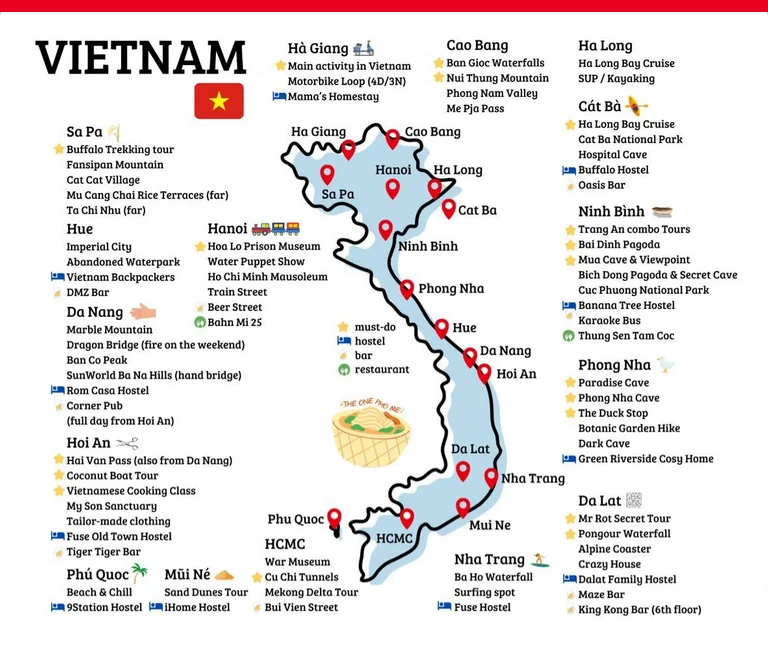
Our 21-day route starts in Hanoi—where our Hanoi hotel neighborhood guide helps you pick between Hoan Kiem, French Quarter and West Lake—with an Old Quarter street-food walk and a day trip to Hoa Lu and the Trang An boat ride in Ninh Binh. On day 3 you sail on Bai Tu Long Bay, a quieter part of the bay system than the main Ha Long Bay area, and spend the night on board.
From day 4 the route turns south: a flight to Hue for the Imperial Citadel, the train over the Hai Van Pass to Da Nang, Ba Na Hills and an evening in Hoi An’s old town. A short flight then takes you to Nha Trang for snorkelling at Hon Mun, followed by three nights in Mui Ne with two completely free days 🏖️.
The last week covers the south: the Cu Chi Tunnels on the drive into Ho Chi Minh City, a night in a Mekong Delta tour homestay and the Cai Rang floating market at dawn, then two nights on Phu Quoc before you fly home from Ho Chi Minh City.
Here is the whole Vietnam itinerary 3 weeks long at a glance:
| Days and base | Highlights | How you get there |
|---|---|---|
| Days 1–2: Hanoi | Old Quarter food walk, Hoa Lu and Trang An | Airport transfer |
| Day 3: Bai Tu Long Bay | Overnight cruise, kayaking | Road to the marina |
| Days 4–5: Hue | Imperial Citadel, Thien Mu Pagoda | Flight from Hanoi |
| Days 6–8: Da Nang | Ba Na Hills, Cam Thanh, Hoi An old town | Train over the Hai Van Pass |
| Days 9–11: Nha Trang | City tour, Hon Mun snorkelling | Flight to Cam Ranh |
| Days 12–14: Mui Ne | Two free beach days | About three hours by road |
| Days 15–17: Ho Chi Minh City and Mekong Delta | Cu Chi Tunnels, homestay, Cai Rang market | Road and boat |
| Days 18–19: Phu Quoc | West-coast sunset, island-hopping | Flight |
| Days 20–21: Ho Chi Minh City | Free evening, departure | Flight |
Prefer a private, unhurried trip?
Tell us your dates and pace. A local planner replies within one working day.
Matching your Vietnam three week itinerary to the regional weather
The most common planning mistake is assuming the weather is the same along the whole country. The national tourism board describes March to May as the best weather countrywide, while noting that some part of Vietnam has good weather in every month (Source: Vietnam National Authority of Tourism). The table below shows how the seasons change along a Vietnam three week itinerary:
| Place | Drier, clearer months | Wetter months |
|---|---|---|
| Hanoi | April to June, September to November | June to August |
| Ha Long Bay | April to June, September to November | June to August (storms) |
| Hue | March to August | September to February |
| Hoi An | February to August | September to January |
| Nha Trang | January to August | September to December |
| Ho Chi Minh City and Mekong | December to April | May to November |
| Phu Quoc | October to June | July to September |
Two details matter for planning. Outside the drier months in Ha Long Bay, tropical storms can sometimes cause cruise cancellations, and Hue can see occasional flooding from September to November (Source: Vietnam National Authority of Tourism). That means October and November are lovely in Hanoi, with cool, clear days around 25 degrees Celsius, but they fall in the rainy season of the central coast.
Adjusting the route to your travel month
- March to May: the most even weather along the whole route; a good time for the full north-to-south trip.
- September to December: enjoy the north, keep Hue, Hoi An and Nha Trang short and flexible, and end with more beach time on Phu Quoc from October; expect afternoon showers in the south until November.
- June to August: hot almost everywhere; Hue and Hoi An are dry, but allow a spare day around your Ha Long cruise, and note that Phu Quoc is stormy from July to September.
- Late December to March: Hanoi and the bay can be cold and misty, so pack warm layers for the first week.
For more regional advice, read our monsoon season in Vietnam guide and the destination guides on our Truly Voyage blog.
How three weeks feels day to day
A long itinerary is easier when you know where the busy days and the quiet days fall. On our 21-day route, the active parts are optional: the climb to the Mua Cave viewpoint, snorkelling at Hon Mun and off Phu Quoc, and crawling through a widened section of the Cu Chi Tunnels.
Pacing tips
- Arrival: keep your first day light after a long-haul flight; our route starts with an evening food walk.
- Rest days: days 13 and 14 in Mui Ne are completely free, and several afternoons are unguided.
- Early starts: the Cai Rang floating market means leaving the homestay by boat at 06:30.
- Luggage: our domestic flights include 20 kg of checked and 7 kg of cabin baggage, so pack for that limit.

Who it suits
- First-time visitors who want the north, the centre and the south in one trip
- Travellers who like beach time between sightseeing days
- Anyone who prefers short flights to long drives
Who may prefer something else
- Travellers who dislike frequent hotel changes, who may prefer fewer bases
- Anyone who wants a guide every day; several days are free time
How much does a premium Vietnam trip itinerary cost and how can Truly Voyage help?
Our 21-day Vietnam trip itinerary starts from US$1,850 per person; the final price depends on your hotels, travel dates and group size, and international flights are extra.

The listed price covers 20 nights in double, twin or triple rooms, including the cruise and the homestay; 20 breakfasts, 1 brunch, 11 lunches and 4 dinners; four domestic flights and the Hai Van Pass train; transfers; English-speaking guides on touring days; and entrance fees for the sites in the itinerary 💵.
Not included are international flights, visas, travel insurance, tips, drinks and meals not listed day by day. Peak-season and Tet surcharges apply, and some hotels add compulsory gala dinners on Christmas Eve and New Year’s Eve. Small groups share a vehicle with other travellers; larger groups travel in a private vehicle.
Travel insurance deserves attention if you are coming from North America. Medicare usually does not cover health care while you travel outside the U.S. (Source: Medicare.gov), and Canadian provincial and territorial health plans rarely cover the cost of medical care abroad (Source: Government of Canada). Choose a policy with overseas medical and cancellation cover.
For comparison, our shorter routes start from US$1,124 per person for the 14-day itinerary with Sapa, US$1,376 for the 15-day beach and culture tour and US$1,554 for the 15-day Vietnam and Cambodia tour. The full day-by-day plan for three weeks is on the 21-day Vietnam beaches tour page.
If you like this route but want it adjusted, our team in Hanoi can change the pace, the hotels or the order of the stops and check dietary needs and mobility limits against the hotels and included meals. During the trip you can reach the team by phone and WhatsApp. Send your dates through our Contact Us page.
Frequently Asked Questions
When is the best time for a three-week trip to Vietnam?
March to May gives the most even weather along a north-to-south route. From September to January, Hue and Hoi An are in their rainy season, so a trip in those months works best with fewer days on the central coast.
Do I need a visa for three weeks in Vietnam?
It depends on your passport. U.S. and Canadian citizens need a visa before they travel; the e-visa is valid for up to 90 days and costs 25 USD for a single entry or 50 USD for multiple entries. British citizens can visit for up to 45 days without a visa, which covers a 21-day trip.
Should I fly or take the train between regions?
Fly the long stretches. The train from Hanoi to Ho Chi Minh City can take up to 30 hours, while flights take one or two hours. A short train ride is worth keeping where the view is the point, such as Hue to Da Nang over the Hai Van Pass.
Is a three-week itinerary suitable for travellers in their 60s and 70s?
Yes, if you are comfortable with frequent moves. Our 21-day route has 11 check-ins, four flights, one train and two longer drives, balanced by two free days in Mui Ne and several free afternoons. The more active parts are optional, and we can reduce the number of moves if you tell us before you book.
How much does a three-week Vietnam trip cost?
Our 21-day route starts from US$1,850 per person, including hotels, four domestic flights, guides on touring days, entrance fees and the meals listed. International flights, visas, travel insurance and tips are extra, and peak-season and Tet surcharges can apply.
Conclusion
A three-week trip lets you see Vietnam from the bays of the north to the islands of the south, as long as the route follows the geography and the season. Fly the long stretches, keep a few free days, and match the order of your stops to the month you travel. If you would like help shaping the route, contact our team with your dates and pace.
Further Reading & Resources
Where the figures in this guide come from, plus related guides for planning your trip.
Sources
- Transport within Vietnam Vietnam National Authority of Tourism
- Weather and climate in Vietnam Vietnam National Authority of Tourism
- Vietnam travel advisory and entry requirements U.S. Department of State
- Travel advice and advisories for Vietnam Government of Canada
- Vietnamese visas and entry/exit U.S. Embassy & Consulate in Vietnam
- Vietnam entry requirements UK Foreign, Commonwealth & Development Office
- Travel outside the U.S. Medicare.gov
- Travel insurance Government of Canada
Related guides
Prefer a private, unhurried trip?
Tell us your dates and pace. A local planner replies within one working day.