


 By Vani
A good Mekong Delta food guide ties each dish to a named place, origin or legal status. This one covers ten: hu tieu My Tho, bun nuoc leo, lau mam, grilled snakehead, duong dua, banh xeo, ba khia, field rat, tung lo mo and coconut candy. Five My Tho noodle shops were certified in 2024, and breeding duong dua is banned in Vinh Long province, which now includes Ben Tre.
Mekong Delta regional cuisine gets sold as one long river-country feast, and the ten-dish list that usually follows is copied from whichever article ranks high. At Truly Voyage we have tried to do something less comfortable 🛶. Every dish here is tied to a documented place, origin or legal status, and where the popular version is wrong, weaker or out of date, we say so. That means naming the five My Tho noodle shops the city itself certified, explaining the Khmer roots of bun nuoc leo, noting why a coconut grub delicacy is banned from breeding in the Ben Tre area, and admitting that no Michelin restaurant badge exists for the delta to lean on. The Nine Dragons of the title is the Mekong’s Vietnamese name, Cuu Long. Treat the shops and dates below as a starting point, since restaurants close and rules change 📜.
If you would like to add a delta food day to a longer trip, see our Vietnam holidays.
How Do You Plan a Mekong Delta Food Trip?
Pick stops you can find on a map and check twice: a street address, a dated source and, for anything regulated, the current rule. This guide gives you those for each dish below.
Before you go
- Use street addresses: the five certified My Tho shops and the Can Tho lau mam restaurant below all have published addresses.
- Skip duong dua: breeding, storing and spreading it is banned in Vinh Long province, which now includes Ben Tre.
- Confirm before you travel: restaurants close and rules change, so check opening hours and current rules close to your date.

Who it suits
- Travellers who like to plan and want named places with addresses.
- Curious eaters interested in Khmer and Cham cooking as well as Vietnamese classics.
Who may prefer something else
- Travellers who want a fixed menu with no research, who may prefer a guided meal.
- Anyone who avoids fermented fish paste, shellfish or unusual meats such as field rat.
Which Ten Dishes Belong in a Mekong Delta Food Guide?
Ten dishes qualify because each one ties to a documented place, origin or status: hu tieu My Tho, bun nuoc leo, lau mam, ca loc nuong trui, duong dua, banh xeo mien Tay, ba khia, chuot dong, tung lo mo and keo dua 🍲.
| Dish | Home ground | Why it earns a place |
|---|---|---|
| Hu tieu My Tho | My Tho, now in Dong Thap province | Chewy noodle; five shops certified in 2024 |
| Bun nuoc leo | Soc Trang (now Can Tho city), Tra Vinh (now Vinh Long) | Khmer origin, refined by Soc Trang cooks |
| Lau mam | Chau Doc, An Giang | Fermented-fish hotpot; a named Can Tho stop |
| Ca loc nuong trui | Can Tho and across the delta | Snakehead grilled whole in burning straw |
| Duong dua | Ben Tre (now Vinh Long province) | Real delicacy, banned to breed |
| Banh xeo mien Tay | Western delta | Big pans, coconut milk, wild greens |
| Ba khia | Rach Goc, Ca Mau | Salted mangrove crab; craft heritage-listed |
| Chuot dong | Dong Thap especially | Field rat, now on mainstream menus |
| Tung lo mo | Cham villages, An Giang | Halal beef sausage most lists miss |
| Keo dua | Ben Tre | Hand-wrapped coconut candy |
Reading Place Names After the 2025 Mergers
On July 1 2025, Vietnam cut its provincial units from 63 to 34, and almost every dish above changed address on paper. My Tho was a city in Tien Giang province when it certified its noodle shops in 2024. The noodle craft village is now listed in My Phong Ward, Dong Thap Province, formerly part of Tien Giang (Source: Vietnam News). Soc Trang joined Hau Giang inside a Can Tho city that kept its name, while Tra Vinh and Ben Tre joined the old Vinh Long in a province that kept that name. Bac Lieu merged into Ca Mau, which kept its name, and Kien Giang merged into An Giang. Chau Doc, for its part, lost its city status, which our Chau Doc floating village guide explains.
We keep using Soc Trang, Tra Vinh, Ben Tre and My Tho as food regions, the way Vietnamese diners still do, because that is how these dishes are named on menus and in the press. Where a dish’s home now sits inside a different unit, the table says so. Nothing about the recipes moved. Only the paperwork did 🗺️.
What Makes Hu Tieu My Tho Different From Other Noodle Soups?
The chew 🍜. Hu Tieu My Tho’s texture traditionally depends on Go Cat rice, a local variety that has become increasingly scarce (Source: Vietnam News), and 5 restaurants were certified by the My Tho authorities in 2024, complete with published addresses (Source: Tuổi Trẻ Mực Tím). Ask for these by name rather than any noodle shop claiming the dish.

The bowl itself is simple. A clear broth simmered from pork bones, dried shrimp and dried squid, thin rice noodles, and sliced pork or ribs on top. What sets it apart from other hu tieu in the region is the noodle, which stays chewy without turning mushy when blanched, a texture that can surprise a first-time eater. The dish grew out of kueh teow noodle soup brought by Chinese immigrants and shaped by Khmer cooking, it originated in the former city of My Tho, and in 2013 the Asia Book of Records named it one of the top 100 dishes of Asia, a records-book accolade rather than a government honour (Source: Vietnam News).
That chew traditionally comes from Go Cat rice 🌾. The variety is now in short supply because of modern farming and shrinking cultivation areas, and producers have switched to other varieties, so the bowl in front of you may not be quite the bowl of a generation ago. The noodles are still made in a craft village in My Phong Ward, recognised by the province in 2007, where a cooperative of six household workshops employs about 30 people and the trademark dates to 2008. Two households have mechanised the entire process and together turn out three to four tonnes a day, at roughly 25,000 VND, about US$1, per kilogram, for local markets and neighbouring provinces rather than export (Source: Vietnam News). Scarcity is exactly why a certified shop list is worth having.
The Five Certified Shops, With Addresses
The title, translated as reputable, quality My Tho hu tieu shop for 2024, was first presented during the My Tho Hu Tieu Festival, scheduled for December 27 to 31 2024. Five shops were chosen from 16 food businesses and assessed against six criteria, with a Vietnam Chefs Association branch among the bodies involved, and the My Tho City People’s Committee presented the certificates (Source: Tuổi Trẻ Mực Tím). That makes it a quality title won by five of sixteen shops, not a legal certificate of authenticity, and a shop outside the list is not thereby a fake. It is simply unrated. It is also worth noticing who ran the scheme: the city that certifies its noodle shops is the same city promoting its noodle brand.
| Shop | Address as published | Note |
|---|---|---|
| Hủ tiếu 44 | 27 Lê Lợi | Long-established, informal shop with a traditional flavour, per Tuoi Tre |
| Quán Sake (also written Sa Kê) | 08 đường 30/4 | The name is spelled differently across reports |
| Cảng du thuyền Mỹ Tho (My Tho marina) | 1 Hoàng Sa | A restaurant at the My Tho marina |
| Nhà hàng Làng Việt | 194D Ấp Bắc | A restaurant rather than a noodle stall |
| Hủ tiếu (cá) Thảo | Ấp 1, Đạo Thạnh commune | A fish hu tieu (hủ tiếu cá) shop |
Addresses as published (Source: Tuổi Trẻ Mực Tím). Ward and commune names in those published addresses predate the July 2025 reform, so navigate by street and number and expect some administrative labels to have changed.
Judge the bowl on the noodle first. Chewy without going mushy is the signature, and if a shop’s strands turn soft you are eating a different style. Use the five addresses as your baseline, then compare any other bowl against them.
Where Did Lau Mam Actually Originate?
Lau mam, fermented fish hotpot, began in Chau Doc 🥘. A named and documented Can Tho restaurant serving it today is Lau Mam Da Ly at 89 Tan An Ward (Source: Can Tho Tourism Portal), a concrete stop rather than a generic recommendation.
The origin story is humbler than the price of a modern pot suggests. Lau mam began in Chau Doc, An Giang, as a dish for poor people, and has since been promoted into a symbol of southern Vietnamese cooking, commonly served at weddings across the southwest (Source: VietnamNet). Local accounts say Chau Doc’s claim rests on its fish-paste trade, with a market nicknamed the Kingdom of Mam of the western delta, and a craft that leans on the flood season, when water from the upper Mekong from about July to November brings the fish. Our ideal time to visit the Mekong Delta guide places that season on the calendar.

The paste is made by sealing fish and salt in a jar and fermenting it for about 30 days (Source: VietnamNet). The fish are traditionally cá sặc, Siamese mud carp, and cá linh varieties, and the paste is boiled with water and spices to build the broth, sometimes with coconut water. The pot itself holds fish such as snakehead, cá hú and basa, with a large range of vegetables, among them eggplant, which helps cut the strong smell, a slightly bitter leaf, and water lily and sesban flowers, all served in an aluminium pot with a central tube filled with hot charcoal 🌿. VietnamNet gives a price of 175,000 to 340,000 VND, about US$7 to US$13 (approx., at about 26,000 VND per US$), though the article does not date the range or say what portion it covers.
The Can Tho stop is where you can eat it, not where it began. The official Can Tho Tourism Portal lists Lau Mam Da Ly at 89 Tan An Ward, seating up to 500 guests and open 8am to 6:30pm (Source: Can Tho Tourism Portal). Listings can go out of date, so confirm the hours before you travel.
Check the opening hours before you go, since listings change, and ask the pot size and price before you order. A pot sized for four and a pot sized for ten are very different bills.

A JOURNEY SHAPED AROUND YOU
Start with what matters.
We can plan from there.
Tell us what you enjoy, how you like to travel and where you would like more time. We can discuss a private itinerary around your interests and preferred pace.
Is Bun Nuoc Leo Really a Khmer Dish?
Yes. Vietnamese food writing describes bun nuoc leo as originally a Khmer specialty that Soc Trang cooks refined into today’s noodle soup (Source: Tạp chí Công Thương).

Vietnamese food writing is consistent on this point: one food-culture piece calls the dish originally a Khmer specialty that Soc Trang cooks made their own.
What makes the dish worth ordering is the broth. The Khmer contribution is the base, built on mắm bò hóc, a Khmer fermented paste, plus ngải bún, a spice of Cambodian origin (Source: Tạp chí Công Thương). Ngải bún is an aromatic rhizome that helps cut the fishy smell. The bowl is often described as a blend of Khmer, Kinh and Hoa cooking, with banana blossom and water spinach as vegetables and crispy roasted pork belly on top 🥓. The Khmer communities behind the dish are covered in our Mekong Delta culture and people guide.
The broth changes with the paste. Soc Trang’s version is built on mắm bò hóc, while the bún nước lèo of Tra Vinh and Kien Giang and the fish noodle soup of Chau Doc are typically made from mắm cá linh or cá sặc. We found no independently certified list of bun nuoc leo shops comparable to My Tho’s, so this guide names none.
Ask which paste goes into the broth. Mắm bò hóc points to the Soc Trang Khmer style, while linh or sặc fish paste points to the Tra Vinh, Kien Giang and Chau Doc style, and tasting both is the fastest way to understand the dish.
What Happened to Duong Dua, the Coconut Grub?
Duong dua, the red palm weevil larva, is a real delta delicacy, but transporting, breeding, storing and spreading it is banned in Vinh Long province, which now includes Ben Tre. Fines run from 3 to 6 million VND, and 6 to 12 million VND for commercial purposes, about US$115 to US$460 at the extremes (Source: VOV). Do not assume it is legally farmed in the Ben Tre area today 🚫.
It is not a worm. It is the larval stage of the red palm weevil, Rhynchophorus ferrugineus. It eats the soft heart of the coconut palm, which is why the flesh is described as spongy and subtly sweet, and legend has it that Ben Tre locals once sent it as a tribute to Emperor Minh Mang. It is eaten live and dipped in fish sauce, grilled on skewers, in porridge, fried, in salads or steeped in rice wine. It is also a pest, and unmanaged larvae can hollow out and kill a palm, a serious matter in Vinh Long, which has about 122,000 hectares of coconut, around 61% of the national coconut area (Source: VOV). Our Ben Tre coconut canals guide covers how much rides on those palms 🥥.
Ben Tre merged into Vinh Long province on July 1 2025, so the rules that now apply there are Vinh Long’s. VOV’s report of 2 July 2026 says the province bans transporting, breeding, storing and spreading the pest, and sets the fines above (Source: VOV). The report does not set any penalty for diners, but a menu that offers duong dua is a red flag.
Do not go looking for it on a Ben Tre menu. Given the current ban, a restaurant that offers it is a compliance red flag, and we do not build it into itineraries. The pest risk is the reason, not squeamishness.
Ba Khia: The Heritage-Listed Crab From Rach Goc
Ba khia is the delicacy to chase instead 🦀. It is a small three-striped mangrove crab, Episesarma mederi, caught in brackish mangrove waterways. It is prized when small and carrying roe, and the traditional preparation is to salt-brine it in jars for roughly a week, after which it is ready to eat, mixed with lime, garlic, chilli, pineapple and sugar (Source: Báo Pháp luật Việt Nam). It is also stir-fried with tamarind or used in salads. Rach Goc in Ca Mau is the well-known production area, where local producers credit the mangrove plants and silt the crabs feed on for the yellow roe and firm, sweet meat. The peak catch runs around the 7th to 9th lunar months, according to the same report.

What holds heritage status is the craft of making salted ba khia, not the crab itself 🎖️. Báo Pháp luật Việt Nam reports that the craft was recognised as a national heritage craft in 2020 and is strongest in Rach Goc, and that tens of tonnes of salted crab are sold across the country each year (Source: Báo Pháp luật Việt Nam). Ca Mau, for the record, absorbed Bac Lieu in July 2025 and kept its name.
Why There Is No Michelin Shortcut in the Delta
This is why naming specific places and crafts matters: there is no Michelin Guide restaurant coverage anywhere in the Mekong Delta, a genuine gap unlike Ho Chi Minh City’s Michelin-listed scene ⭐. The 2026 Vietnam selection, unveiled on June 4 2026, covers 193 establishments in three cities only, Hanoi, Ho Chi Minh City and Da Nang, including 11 one-star restaurants, 72 Bib Gourmand and 110 Selected listings (Source: Vietnam News). One precision matters: Michelin’s separate hotel Keys list does include Legacy Mekong in Can Tho, so the delta is not absent from Michelin’s universe, only from its restaurant guide.
Credible food recommendations here therefore rely on local certification and press, not a Michelin badge. In this guide that means the My Tho city title, the official Can Tho Tourism Portal listing, and national craft recognition. Each of those has its own limits: local schemes are run by authorities that also promote their local brands, listings can be undated, and recognition of a craft is not an inspection of a kitchen. Use them the way you would use any dated, named, checkable source, and prefer a source that gives you a street address 📍.
If a Mekong Delta restaurant advertises a Michelin mention, ask which list. The Guide’s 2026 restaurant selection covers only Hanoi, Ho Chi Minh City and Da Nang, so a delta claim needs a very specific explanation.
Which Other Dishes Round Out the Ten?
Five more dishes complete the ten: ca loc nuong trui, banh xeo mien Tay, chuot dong, tung lo mo and keo dua. Each is documented, and none needs a Michelin badge to be worth the detour.
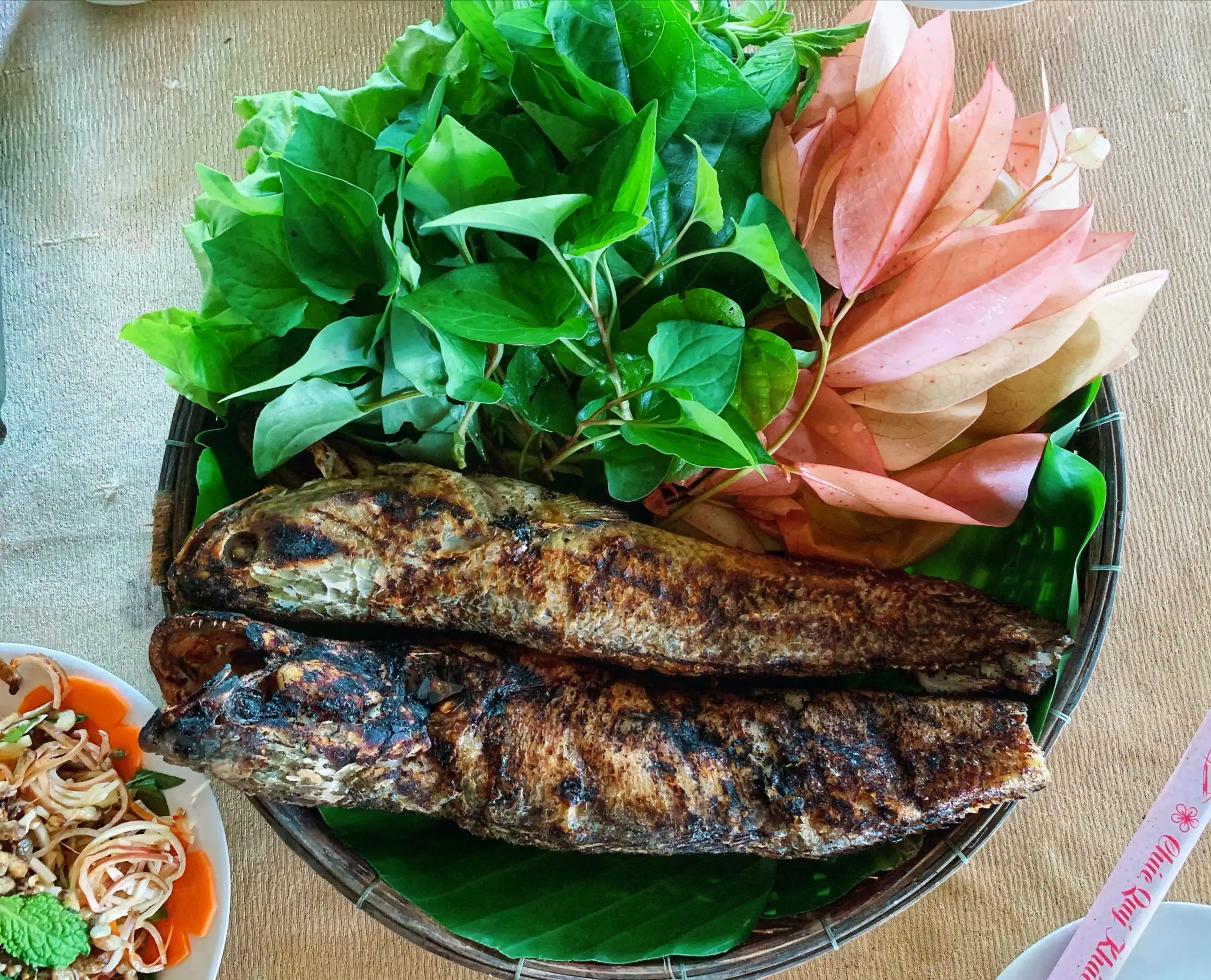
Ca Loc Nuong Trui: Snakehead Grilled Whole in Burning Straw
The method is the point 🔥. A whole snakehead is skewered on a bamboo or sugarcane stick, pierced through, and grilled directly over burning rice straw, with no scaling or gutting beforehand and traditionally no added spices or marinade. The charred straw and skin are peeled away afterwards to reveal the cooked flesh. It is a rustic field-cooking method, and it is usually eaten wrapped in rice paper with herbs and rice vermicelli and dipped in a sweet-sour sauce, a serving detail widely repeated though we did not find an authoritative source for it.

Banh Xeo Mien Tay: The Wild-Greens Pancake
Western-delta banh xeo is bigger than the central Vietnamese version and cooked in deep, large pans, which gives a thick centre and very thin, crisp edges 🥞. The batter combines rice flour with coconut milk, the defining richness, and turmeric for its gold colour, and the fillings run to shrimp, pork or mixed seafood with needle mushrooms, bean sprouts and whole mung beans. The most distinctive marker against Saigon-style banh xeo is the greens: it is traditionally wrapped in a wide range of wild leaves, sour ones that cut the richness, basil-like aromatic herbs and young mango leaves for a faint astringency, then dipped in sweet-sour fish sauce with sliced chilli. If the herb plate is only lettuce and a few standard herbs, you are likely eating the Saigon-style version.
Chuot Dong: Field Rat, Now Mainstream
Field rat has moved from subsistence food to a renowned specialty on the menus of many restaurants and tourist spots across the delta, especially in Dong Thap, and it is abundant during the flood season or just after harvest. Preparations include braising, frying, boiling with lemon leaves, stir-frying with lemongrass and chilli, cooking in coconut water and, widely praised, roasting in a sealed clay pot, chuot dong quay lu, where rats of 300 grams or more are marinated with garlic, lemongrass, chilli and fish sauce and turned every ten minutes. The texture is often compared to suckling pig. We found no single named vendor worth recommending, so we name none, and our ideal time to visit the Mekong Delta guide covers the flood-season timing.
Tung Lo Mo: The Cham Beef Sausage Most Food Lists Miss
Tung lo mo is a halal beef sausage from the Cham villages of An Giang: ground beef and fat, stuffed into cow intestine and sun-dried 🥩. Halal means the beef is prepared to Muslim dietary rules, which is why this is a dish of the Muslim Cham community, a small community along the Hau River, which one travel site puts at roughly 11,000 to 17,000 people in about nine villages, rather than a general An Giang street snack. Other Cham dishes reportedly include com ni and cà púa, beef in coconut curry. It is distinctive and often left out of generic delta food round-ups. Our Mekong Delta culture and people guide explains who the Muslim Cham are and where their villages sit.
Keo Dua: Coconut Candy From Ben Tre
Keo dua is made from coconut cream, granulated sugar and malt, with the malt made from sprouted glutinous rice 🍬. It is the one sweet in the ten, and its home is a wide production belt rather than a single village. One Vietnamese travel guide describes the craft as originating in Mo Cay Nam district and counts more than 180 producers across the province, spread over Mo Cay Nam, Mo Cay Bac, Chau Thanh and Ben Tre city, though it does not date that figure. The paste is cooked down, cut and wrapped by hand, and our Ben Tre workshops guide covers what actually happens at a candy workshop, why no single named factory receives every tour, and why the founding story of the well-known brand is its own account rather than verified history.
Frequently Asked Questions About Mekong Delta Food
Looking for fast facts? Here are the most common questions and direct answers regarding the unique regional dishes and specialties of the Nine Dragons.
What makes hu tieu My Tho different from other noodle soups?
The noodle.
It stays chewy without going mushy, a texture that traditionally comes from Go Cat rice, now scarce, so most producers use other varieties.
Which My Tho hu tieu shops are officially recognised?
Five shops were honoured in 2024.
Chosen from 16 food businesses against six criteria: Hu tieu 44, Quan Sake, the My Tho marina restaurant, Nha hang Lang Viet and Hu tieu Thao. It is a quality title, not a legal authenticity certificate.
Where did lau mam originate?
In Chau Doc, An Giang, as a dish for poor people.
The Can Tho restaurant with a documented listing is Lau Mam Da Ly at 89 Tan An Ward.
Is bun nuoc leo a Khmer dish?
Yes, Vietnamese food writing describes it as originally a Khmer specialty.
Soc Trang’s version is built on the Khmer paste mắm bò hóc and the spice ngải bún.
Is duong dua legal to eat in Ben Tre?
Transporting, breeding, storing and spreading it are banned.
Fines are 3 to 6 million VND, or 6 to 12 million VND for commercial purposes. The report we read sets no penalty for diners, but a menu that offers it is a red flag.
Does the Mekong Delta have any Michelin restaurants?
No.
The 2026 Michelin Guide Vietnam covers only Hanoi, Ho Chi Minh City and Da Nang. Michelin’s separate hotel Keys list does include Legacy Mekong in Can Tho.
What is ba khia, and is it heritage-listed?
A small mangrove crab, salted for about a week, known from Rach Goc in Ca Mau.
The craft of making it was recognised as a national heritage craft in 2020.
Conclusion
Build your food itinerary around documented addresses, not rankings ✨. Start with the five certified My Tho shops and the published Lau Mam Da Ly address, and check every other recommendation against a dated, named source that gives a street before you travel, because in a delta with no Michelin Guide, an address you can verify is the badge that matters.
Skip duong dua, and eat the ba khia instead. At Truly Voyage, we try to name the shop and the address before we plan the meal, since a dish without a verifiable place is a rumour.
Further Reading & Resources
Where the figures in this guide come from, plus related guides for planning your trip.
Sources
- Craft village preserves traditional art of Hủ tiếu Mỹ Tho noodle making Vietnam News
- 5 reputable, quality My Tho hu tieu venues (18 Jan 2025) Tuổi Trẻ Mực Tím · in Vietnamese
- Lau mam, the symbol of southern food VietnamNet
- Lau Mam Da Ly Can Tho Tourism Portal · in Vietnamese
- Vinh Long strictly bans breeding and spreading coconut grubs (2 Jul 2026) VOV · in Vietnamese
- The mysterious flavour of Soc Trang bun nuoc leo Tạp chí Công Thương · in Vietnamese
- Salted ba khia in Ca Mau, the appeal of a heritage craft Báo Pháp luật Việt Nam · in Vietnamese
- 11 stars shine in the MICHELIN Guide restaurant ceremony 2026 Hanoi, Ho Chi Minh City, Da Nang Vietnam News
Related guides
A JOURNEY SHAPED AROUND YOU
Start with what matters.
We can plan from there.
Tell us what you enjoy, how you like to travel and where you would like more time. We can discuss a private itinerary around your interests and preferred pace.

Vani is the Founder and Lead Travel Designer at Truly Voyage. With over a decade of experience and a deep passion for her Vietnamese heritage, she specializes in crafting bespoke, unhurried itineraries. Vani is dedicated to helping travellers experience the authentic soul of Southeast Asia with absolute financial security and 24/7 on-ground support.
0 Comment