


Mekong Delta culture people encounter is often misunderstood as a single Kinh identity. Are you missing the rich Khmer, Muslim Cham, and Hoa heritage? This guide reveals real 2019 census data, separates Hoa Hao from ethnic Chinese, and provides actionable festival dates. Discover the authentic multi-ethnic Delta and plan a richer, step-by-step cultural journey.
The Mekong Delta you actually encounter on the ground is a layered, multi-ethnic mix, not the single Kinh riverside image most brochures repeat 🌾. Kinh people are the majority everywhere, yet the delta also holds a large Khmer population outside Cambodia, a small Muslim Cham community along the Hau River, and a Chinese-descended Hoa community that arrived before most Vietnamese settlers did. Most guides stop there. I am Vani, founder of Truly Voyage, and this guide puts the 2019 census numbers behind each community, separates two names that get confused constantly, Hoa Hao Buddhism and the Hoa Chinese, and points you to concrete places and dates worth building a trip around. Where a popular figure or claim does not hold up, I correct it and say so.

Table of Contents
ToggleHow Many Khmer People Actually Live in the Delta?
The 2019 national census counted 1,319,652 Khmer people, concentrated heavily in the pre-merger provinces of Soc Trang, 30.18 percent of its population, and Tra Vinh, 31.53 percent. Over 450 Khmer Theravada Buddhist temples serve the delta, 120 of them within the newly expanded Can Tho alone, per a May 22 2026 government conference.
Two facts frame those numbers. The delta holds an extensive Khmer population (Source: Wikipedia), and about 95 percent of Khmer people are Theravada Buddhist (Source: Nhân Dân) 🛕. That is why the temple, not the village, is the natural unit for counting and visiting this community.
| Province (2019 boundaries) | Khmer population | Share of province | Share of national Khmer total |
|---|---|---|---|
| Soc Trang (now part of Can Tho) | 362,029 | 30.18% | 27.43% |
| Tra Vinh (now part of Vinh Long) | 318,231 | 31.53% | 24.11% |
| Kien Giang | 211,282 | 12.26% | 16.01% |
| An Giang | 75,878 | Not stated | Under 10% |
Add the two heartland provinces together and the concentration is stark. Soc Trang and Tra Vinh held 680,260 Khmer people in 2019, just over half of the national total, about 51.5 percent by my arithmetic from the census figures. The rest is mostly Kinh: Wikipedia’s Soc Trang page gives 64.83 percent Kinh for 2025, a directional figure rather than a census count (Source: Wikipedia).
The temple count gives the community a second, more current measure. Over 450 Theravada temples serve the Khmer across the delta, and 120 sit inside the expanded Can Tho city alone, a figure given by Vice Chairwoman Nguyen Thi Ngoc Diep of Can Tho’s People’s Committee at a May 22 2026 conference on preserving Khmer cultural values (Source: Vietnam.vn).

Two Khmer Heartlands, Two New Addresses
On July 1 2025, Vietnam cut its provinces from 63 to 34 (Source: Wikipedia). Soc Trang and Hau Giang merged into an expanded Can Tho city that kept the Can Tho name (Source: Tuổi Trẻ), and Tra Vinh merged with Ben Tre and the old Vinh Long into a Vinh Long province that kept that name (Source: VOV). The two provinces with the highest Khmer shares therefore no longer exist as provinces.
Keep using Soc Trang and Tra Vinh as place names and cultural regions, the way people still say Saigon, but do not describe them as current administrative units 🗺️. The census table above uses 2019 boundaries for exactly that reason, and the merger also explains why figures online now disagree: some reference pages still show 2019 counts, others mix in partly updated estimates on new boundaries. The 2019 census is the last clean, consistent baseline, so every population number in this guide comes from it unless stated otherwise.
Vani Tip: when you meet a Khmer population figure online, check the year and the boundary before you repeat it. Anything describing Soc Trang or Tra Vinh as a current province predates July 2025, and a figure that mixes 2019 counts with newer estimates will not add up. Build any number you publish on the 2019 census, and say that you did.
Is Hoa Hao Buddhism the Same as the Hoa Chinese Community?
No. Hoa Hao Buddhism and the Hoa Chinese ethnic community are unrelated despite the similar-sounding name. Hoa Hao is a Kinh-majority Buddhist reform movement founded in An Giang province in 1939, while Hoa refers to the ethnic Chinese community, 749,466 people nationally per the 2019 census.
The names are one tone mark apart. The communities are not related at all.
Written with diacritics, Hòa Hảo and Hoa are different words, and the tone marks that separate them vanish in most English-language writing, which is where the confusion lives. Hoa Hao takes its name from a village in An Giang, where Huynh Phu So founded the movement in 1939, and the resemblance to the word for the Chinese community is a coincidence. It is overwhelmingly practised by ethnic Kinh, concentrated in An Giang and the wider delta. Claims about its followers range from roughly 1 million to as high as 8 million depending on the source, which reflects self-reported versus independently verified counts, so treat the lower end as the safer figure to repeat (Source: Wikipedia).

Who Are the Hoa of the Delta?
The Hoa are Vietnam’s ethnic Chinese community, 749,466 people in the 2019 census, about 0.78 percent of the national population (Source: Wikipedia). Their delta roots are old. Ming-dynasty refugees and later migrants settled the region in the 17th and 18th centuries, before ethnic-Vietnamese settlement reached the same areas in large numbers 🏮. One figure stands out: Mac Cuu, a Chinese refugee who settled the Ha Tien and Kampot area around the 1680s and in 1708 pledged allegiance to the Nguyen lords, founding semi-autonomous rule that drew further Chinese settlement through the century. That is the historical root of Ha Tien’s Chinese heritage in Kien Giang.
Notable Hoa populations are found in Soc Trang, Kien Giang, Bac Lieu and Tra Vinh. I could not find a clean, current, province-by-province Hoa breakdown for the delta, so this guide does not invent a delta-wide percentage. What the sources do show is overlap: the Ok Om Bok boat races are described as a shared festival of the Kinh, Khmer and Hoa communities, covered further down this guide.
Vani Tip: if a guide or a sign mentions Hoa Hao, ask whether they mean the Buddhist movement or the ethnic Chinese community before you take notes. Both appear in the same delta provinces and the two words differ by a single tone mark, so a mixed-up note becomes a wrong caption later.
Want to Experience the Real Mekong Delta?
Let our local experts guide you beyond the typical tourist paths. Discover deep-rooted cultural heritage, authentic communities, and hidden histories.
Where Does the Muslim Cham Community Actually Live?
In a small cluster of riverside villages in An Giang, mainly around Tan Chau along the Hau River. The Muslim Cham of the delta are a distinct, much smaller community, roughly 17,000 people in about nine villages by one widely repeated estimate, and quite separate from the larger Cham communities of the central coast.
Nationally, the 2019 census counted 178,948 Cham (Source: Offroad Vietnam). Their beliefs are not uniform. One journal of Vietnamese ethnology divides Cham religion into four sub-groups, Brahman, Bani, Islam and Hroi, each with its own home areas (Source: Tạp chí Dân tộc học). In the central-coast heartland of Ninh Thuan and Binh Thuan, Brahmanism, a Hindu-derived tradition, draws about three-fifths of the local Cham, per the same ethnic-group profile. The Cham of the south, in An Giang, Tay Ninh, Dong Nai and Ho Chi Minh City, are the Muslim community this section is about (Source: Nhân Dân), and folding them into one community with the central-coast Cham is a common error in generic articles.
The An Giang figure needs a caveat. TheSmartLocal’s overview puts the province’s Cham community at about 17,000 people in nine villages, most around Tan Chau town and An Phu district, and separately cites about 11,000 Cham in An Giang as of 2019, most of them Muslim (Source: TheSmartLocal). A Vietnam News feature puts the Chăm Muslims of four districts along the Hau River, An Phu, Tan Chau, Phu Tan and Chau Phu, at around 13,000 (Source: Vietnam News). Counts differ by year and by whether the whole Cham community or only its Muslims are counted, so read this as a range of roughly 11,000 to 17,000 rather than one exact number.
The community’s history is usually told like this. Cham settled in An Giang from the 1750s, after General Nguyen Cu Trinh called on Cham in southeast Cambodia, then still under Nguyen rule, to settle the region, and more arrived during later regional conflicts and again during the Khmer Rouge years of 1975 to 1979 (Source: TheSmartLocal).

What Is Actually Worth Seeing in a Cham Village?
The Mubarak Mosque is the anchor 🕌. It is said to date from 1750 and was renovated in 1808 (Source: Wikipedia), and Vietnam News reports that it was recognised as a national architectural and spiritual heritage site in 1989. Masjid Jamiul Azhar, built in 1959 and renovated in 2012 (Source: TheSmartLocal), is a white and emerald green domed mosque in Chau Phong commune that the same Vietnam News feature calls one of the oldest and most beautiful in An Giang (Source: Vietnam News).
The everyday details are as interesting as the mosques. Traditional Cham houses stand high on stilts to cope with seasonal Mekong flooding, typically with four or five rooms and a south-facing façade, and doorways are deliberately low, so visitors bow as they enter (Source: Local Vietnam). Weaving continues in two traditions: hand-loomed Lanh My A silk, dyed in several rounds with natural mac nua fruit essence and priced at US$200 to US$300 per metre, and brocade weaving recognised as national intangible cultural heritage. The signature dish is tung lo mo, a halal beef sausage of ground beef and fat at roughly 80 to 20, stuffed into cow intestine and sun-dried, alongside com ni and beef in coconut curry (Source: TheSmartLocal). The villages sit naturally inside a Chau Doc base, and my Chau Doc floating village guide covers that end of An Giang.
Vani Tip: ask before you photograph anyone at prayer, and let your guide or the community’s own representative set the terms for entering a mosque. Dress to cover shoulders and knees as a default and expect to remove your shoes. It costs nothing, and it is the difference between being welcomed back and being tolerated.
What Can You Actually See and Visit?
Two concrete, datable stops anchor a Khmer-focused trip: Kh’Leang Temple in Soc Trang, a site dating to 1533, and Ok Om Bok, the Khmer moon-worship and boat-racing festival, which in 2025 ran November 3 to 5 in Can Tho with roughly 60 Ngo boat teams competing.
Kh’Leang Temple: A 1533 Site With a Twentieth-Century Hall
Kh’Leang Temple is a genuine Khmer heritage landmark, and its origins predate French colonial rule by centuries. It was first built in 1533, when the area was under Khmer control, before Vietnamese settlers took it over in the 17th and 18th centuries (Source: Wikipedia). That makes it worth including as a concrete historic stop rather than a generic temple visit. One correction matters for anyone describing it, though. The original was a bamboo or wooden building with a thatched roof, and the hall you walk into today is a twentieth-century rebuild: Lonely Planet dates the complete concrete rebuild to 1905 (Source: Lonely Planet), while a Vietnam News Agency report cites temple records placing the first main hall in 1532 and the current structure in 1918 (Source: Vietnam News Agency). So the site predates the colonial era, but the building itself does not, and sources disagree on both years by a year or a decade.
The temple was recognised as a national art and architecture monument in 1990 and houses a 6.8-metre Shakyamuni Buddha statue (Source: Vietnam National Authority of Tourism). It is also a working festival ground. In 2025, the Ok Om Bok moon-worship ceremony was held here at 7pm on November 4 (Source: Can Tho Tourism Development Centre).
Ok Om Bok: The Boat Race Worth Timing a Trip Around
Ok Om Bok, also spelled Ooc Om Boc, is a moon-worship and water-thanksgiving festival 🌕. The Khmer regard the moon as a deity governing the year’s harvests, and the festival is also a ritual farewell to the floodwaters flowing out to sea, which ties it to the end of the high-water season (Source: Nhân Dân). It falls around the full moon of the tenth lunar month, so its Gregorian date moves every year (Source: Wikipedia tiếng Việt).

The 2025 edition ran November 3 to 5 in Can Tho, at Phu Loi and Soc Trang wards, with Ngo racing on November 4 and 5 and water-lantern and Ca Hau boat performances on the Maspero River from the evening of November 3 (Source: Can Tho Tourism Development Centre). Around 60 men’s and women’s Ngo boat teams competed 🛶. The boats are 22 to 24 metres long, 1.2 metres wide, carved from single tree trunks, and carry 50 to 60 rowers each. Can Tho is described as the location with a large number of Ngo boats taking part nationally, and the same report frames the race as a shared festival for the Kinh, Khmer and Hoa communities (Source: Nhân Dân). Beyond racing, expect water-lantern releases, traditional Khmer games, Ram Vong folk dance and OCOP trade fairs.
For 2026, the confirmed programme I found comes from Vinh Long province, not Can Tho. Its Culture, Sports and Tourism Week runs November 18 to 24, with Ngo racing on November 21 and 22 on the Lang The River in Binh Phu commune, and the Ok Om Bok festival night at 7pm on November 24 at the Ao Ba Om historical site, including a moon-worship ceremony, a parade of temples and the release of floating lanterns (Source: Vietnam.vn, Báo Xây dựng). I did not find Can Tho’s 2026 dates, so confirm them separately.
Vani Tip: build the festival into your trip only after you have confirmed that year’s dates and venue with the organising committee. Ok Om Bok follows the lunar calendar, and the Ngo race has been held in different places in different years, so a date from last year’s article can be wrong by weeks or by a whole city.
Where Do the Kinh Fit In, and How Do the Communities Overlap?
Kinh people are the majority in every delta province, and the communities overlap constantly. The evidence is in shared festivals and shared buildings, not just in census tables.
The delta’s population was about 19 million in a 2022 estimate, growing unusually slowly because it is a net out-migration zone, with people leaving for Ho Chi Minh City and Binh Duong for work (Source: Wikipedia). Within it, the communities share more than a border. The Ok Om Bok race is framed as a festival for the Kinh, Khmer and Hoa, and Kh’Leang’s main hall is described as reflecting cultural interaction among the Kinh, Khmer and Hoa communities (Source: Vietnam News Agency). Even the brick kilns of Mang Thit, covered in my Ben Tre workshops guide, trace more than a century of craft exchange among Khmer, Kinh and Hoa people (Source: Tạp chí KH&CN Trường ĐHXD Miền Tây). My Mekong Delta food guide covers how these communities show up on the plate 🍜.
How Do You Plan a Trip Around These Communities?
Treat the Khmer and Cham stops as separate legs. The Khmer heartlands sit in Can Tho city, the old Soc Trang, and in Vinh Long province, the old Tra Vinh, while the Muslim Cham villages sit along the Hau River in An Giang.
| Community | Where to look | Anchor stop or event |
|---|---|---|
| Khmer | Can Tho city (old Soc Trang), Vinh Long (old Tra Vinh) | Kh’Leang Temple; Ok Om Bok |
| Muslim Cham | Hau River villages, An Giang | Mubarak Mosque; Masjid Jamiul Azhar |
| Hoa | Soc Trang, Kien Giang, Bac Lieu, Tra Vinh | Shared festivals such as Ok Om Bok |

A Can Tho base suits the Khmer leg and pairs with the morning market described in my Cai Rang floating market guide, and a Chau Doc base suits the Cham villages. Ok Om Bok arrives as the flood season recedes, so my best time to visit the Mekong Delta guide helps you place a November trip against the high-water months, and my Mekong Delta transport guide covers the road network between these bases.
Real Customer Experience: A Step-by-Step Cultural Journey
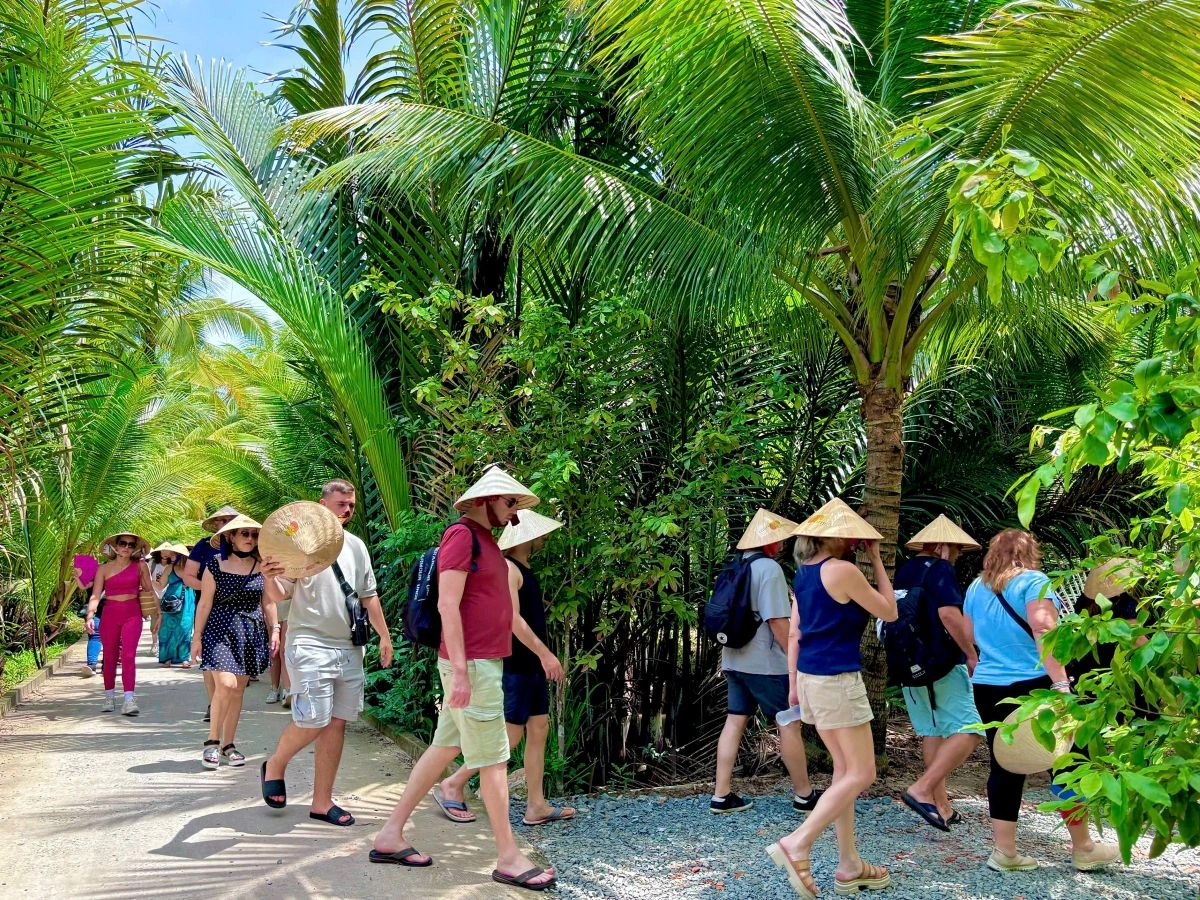
To see how this cultural mapping works on the ground, here is how our recent guests navigated these diverse communities step-by-step:
- Step 1: They anchored in Can Tho, starting with the vibrant morning market before exploring local Khmer Theravada temples to understand the community’s spiritual core.
- Step 2: They took a guided drive to the Soc Trang area to explore Kh’Leang Temple, witnessing the historic architectural blend firsthand and walking through the festival grounds.
- Step 3: They traveled up the Hau River to Chau Doc, entering the stunning Masjid Jamiul Azhar in An Giang while guided by a local Cham representative, learning about Lanh My A silk weaving along the way.
This structured approach gave them unhurried time to appreciate each distinct culture without rushing.
Vani Tip: do not try to cover the Khmer heartland and the An Giang Cham villages in one day. They sit in different parts of the delta, and both deserve unhurried time. Pair the Cham villages with a Chau Doc day, and give Soc Trang its own stop or a Can Tho base.
Frequently Asked Questions About Mekong Delta Culture and People
How many Khmer people live in the Mekong Delta?
Quick Answer: The 2019 census counted 1,319,652 Khmer nationally, concentrated in the delta. Soc Trang (362,029) and Tra Vinh (318,231) held just over half of them, about 51.5 percent.
Is Hoa Hao Buddhism the same as the Hoa Chinese community?
Quick Answer: No. Hoa Hao is a Kinh-majority Buddhist reform movement founded in An Giang in 1939. Hoa is the ethnic Chinese community, 749,466 people nationally in 2019. The names differ by one tone mark.
Where do the Muslim Cham live in the delta?
Quick Answer: In about nine villages along the Hau River in An Giang, mainly around Tan Chau and An Phu, roughly 11,000 to 17,000 people depending on the source, home to the Mubarak Mosque, said to date from 1750.
Is Kh’Leang Temple really from 1533?
Quick Answer: The site dates to 1533, though temple records give 1532. The standing hall is a twentieth-century rebuild, dated 1905 or 1918 depending on the source.
When is Ok Om Bok, and where is the boat race?
Quick Answer: Around the full moon of the tenth lunar month. It ran November 3 to 5 in Can Tho in 2025. For 2026, Vinh Long has announced racing on November 21 and 22 and the festival night on November 24.
Are Soc Trang and Tra Vinh still provinces?
Quick Answer: No. Since July 1 2025, Soc Trang is part of Can Tho city and Tra Vinh is part of Vinh Long province. Keep using the names as cultural regions.
How many Khmer temples are there in the Mekong Delta?
Quick Answer: Over 450, with 120 in the expanded Can Tho city, according to a May 22 2026 government conference.
Conclusion
If you can build an event date into your trip, consider Ok Om Bok. This year, Vinh Long has announced Ngo racing on November 21 and 22 and the moon-worship night on November 24 at Ao Ba Om, but confirm it, and Can Tho’s own dates, with the organisers before you book a room, because the festival follows the lunar calendar and moves between hosts. Put Kh’Leang Temple in the same leg, and let a local guide, not a caption, tell you which parts of it are original. At Truly Voyage, we confirm festival dates and venues directly before we build a trip around them, since a wrong date is a critical mistake on this itinerary that cannot be fixed on the ground.
Ready for an Unforgettable Cultural Voyage?
Let’s design a custom itinerary that perfectly captures the diverse heart of the Mekong Delta, tailored exclusively for you.
Further Reading & Resources
- Wikipedia — delta population, out-migration and the Khmer population. Direct Link
- Wikipedia — 2019 census Khmer figures by province. Direct Link
- Nhân Dân — Khmer religion and the 2019 baseline. Direct Link
- Wikipedia — the directional 2025 Kinh share in Soc Trang. Direct Link
- Vietnam.vn — the temple counts from the May 22 2026 conference. Direct Link
- Wikipedia — the 63 to 34 province consolidation. Direct Link
- Tuổi Trẻ — the Can Tho merger. Direct Link
- VOV — the Vinh Long merger. Direct Link
- Wikipedia — the 1939 founding and the follower-count range of Hoa Hao. Direct Link
- Wikipedia — the 2019 census figure and the Hoa community’s delta history. Direct Link
- Offroad Vietnam — the 2019 Cham figure and central-coast Brahmanism. Direct Link
- Nhân Dân — where the southern Muslim Cham live. Direct Link
- Tạp chí Dân tộc học — the four Cham religious sub-groups. Direct Link
- TheSmartLocal — An Giang Cham numbers, history, silk and food. Direct Link
- Vietnam News — the Muslim Cham estimate and the mosques. Direct Link
- Wikipedia — the 1750 and 1808 dates of Mubarak Mosque. Direct Link
- Local Vietnam — stilt houses and brocade weaving. Direct Link
- Wikipedia — the Kh’Leang temple’s 1533 origins. Direct Link
- Lonely Planet — the 1905 rebuild of Kh’Leang. Direct Link
- Vietnam News Agency — the 1532 and 1918 dates. Direct Link
- Vietnam National Authority of Tourism — the 1990 monument recognition. Direct Link
- Nhân Dân — the 2025 race details. Direct Link
- Can Tho Tourism Development Centre — the 2025 programme and venues. Direct Link
- Vietnam.vn (Báo Xây dựng) — the announced 2026 programme. Direct Link
- Wikipedia tiếng Việt — the lunar timing of the festival. Direct Link
- Tạp chí KH&CN Trường ĐHXD Miền Tây — the Khmer, Kinh and Hoa craft exchange behind the Mang Thit kilns. Direct Link

Vani is the Founder and Lead Travel Designer at Truly Voyage. With over a decade of experience and a deep passion for her Vietnamese heritage, she specializes in crafting bespoke, unhurried itineraries. Vani is dedicated to helping travellers experience the authentic soul of Southeast Asia with absolute financial security and 24/7 on-ground support.
0 Comment