


A Mekong Delta homestay promises authentic farming life, but hidden realities like cold showers often surprise guests. Wondering if the $85–$185 cost is justified or which region delivers genuine comfort? This guide breaks down real prices, guest reviews, and smart booking tips to ensure your rural stay matches your expectations seamlessly.

Homestay listings all promise roughly the same thing, an authentic night with a real farming family, and the marketing photos rarely show you the concrete-base bed or the cold shower waiting on the other side of that promise 🚿. Neither of those is a reason to skip it. They are simply the honest trade-off nobody states plainly enough before you book. I am Vani, founder of Truly Voyage, and this guide prices an actual 2-day, 1-night package against real operator listings, pulls the specific comfort details straight out of guest reviews rather than marketing copy, and settles a question almost nobody answers honestly: whether flood season genuinely improves the experience or is just a seasonal selling point with no real evidence behind it.
Table of Contents
ToggleHow Much Does a Real Homestay Package Cost?
Organised 2-day, 1-night homestay packages run roughly US$85 to US$185 per person, and the price falls as group size grows 💵. Treat quotes well outside that range as either a stripped-down or a heavily premium version of the same format.
Three currently listed operator packages illustrate the spread clearly rather than leaving it as a vague estimate (Sources: Privatetour.com, Daytripvietnam.com, Viator).
| Package | Price |
|---|---|
| 2-day, 1-night Vinh Long homestay, private tour with Ho Chi Minh City pickup | US$166 per adult (children 3–11 at 75%, infants free) |
| 2-day, 1-night Mekong homestay, group-tiered pricing | US$182 for 2 people, falling to US$90 per person for 9 or more |
| 2-day, 1-night small-group homestay, My Tho/Ben Luc route | From US$85 per person |
Table 1: Mekong Delta homestay package price comparison based on group size and inclusions.
That US$85 to US$185 range bundles transport, a guide, meals and activities on top of the homestay stay itself, and it is the figure worth quoting since it reflects how the large majority of travellers actually book this experience.
Booking a homestay directly, without a bundled tour, is generally cheaper, but no reliably current lodging-only figure exists with enough confidence to publish as a hard number, so treat any specific direct-booking price you see quoted elsewhere with real caution.

💡 Vani Tip: if your budget is tight, travel with a slightly larger group rather than as a solo pair. The jump from roughly US$182 for two people down to around US$90 per person at nine or more shows how steeply group size drives the per-person price down on this specific format.
How Comfortable Is It Actually?
Genuine guest reviews describe concrete-base beds, cold, low-pressure showers, and mosquito nets as standard at rustic properties 🛏️, and some locations are motorbike-access only. Set your expectations around a working farming home, not a boutique resort.

One frequently cited review of Hong Thai Homestay in Quoi Son, Ben Tre, is worth quoting precisely because it is so specific: a bed consisting of a concrete base with a mattress, a permeable concrete floor around the toilet, and a shower with cold water and very low pressure.
What makes this detail genuinely useful rather than simply discouraging is how reviewers themselves responded to it (Source: TripAdvisor). That same property holds a rating of excellent from 92 of 115 ratings, meaning guests overwhelmingly treated these conditions as an accepted trade-off for authenticity rather than a dealbreaker.
Mosquitoes are a genuine, repeatedly mentioned reality 🦟, particularly toward evening, and independent guides consistently recommend repellent and light, covering clothing rather than assuming the host will handle it invisibly. Accessibility is a real, practical constraint too: some of the more authentic, rustic properties are reachable only by motorbike, not by car, which matters if you are arranging your own transport rather than joining a bundled tour.
What’s Actually Included in a Typical Package?
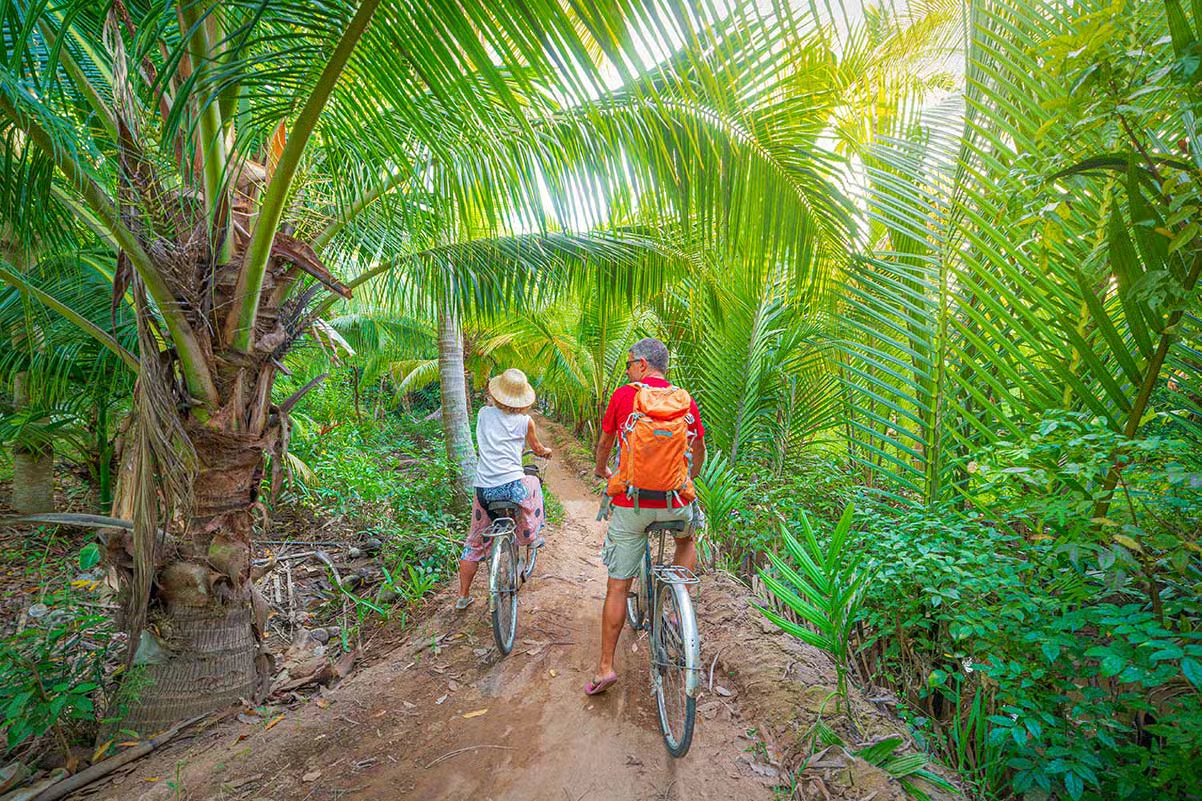
Rowing, cycling between orchards, and a shared family meal are the standard included activities across most packages, but confirm in advance whether your specific homestay includes a sampan or cycling segment, since inclusions vary more between operators than the marketing copy suggests 🛶.
A realistic composite, built from multiple current tour listings and guest-review threads, looks like this. Meals are typically home-cooked by the host family, fresh fish, local vegetables and tropical fruit, usually across three to four meals over a 2-day, 1-night package. Activities generally include a boat trip, often incorporating a sampan segment, bicycle rides through orchards and villages, light participation in farm or household chores, sometimes a cooking class, and occasionally don ca tai tu folk music, itself a UNESCO-recognised Intangible Cultural Heritage genre, performed by the host family or local musicians.
My separate sampan rowing guide covers that specific segment, including the genuine technique behind it, in full. None of this is guaranteed uniformly across every operator, which is exactly why confirming your specific package’s inclusions before booking matters more here than for a more standardised product.
Real Experience: A 2-Day Vinh Long Homestay Journey (Step-by-Step)

Wondering how a typical itinerary actually unfolds? Here is a step-by-step look at a recent guest’s authentic stay in the Vinh Long region:
- Step 1: Arrival & Settlement 🚤 — After a relaxing boat transfer, guests arrive at a riverside farming home. Rooms feature the expected concrete-base beds, a simple fan, and essential mosquito nets.
- Step 2: Afternoon Activities 🚲 — The host leads a guided cycle through narrow village paths, passing vibrant local fruit orchards and crossing small canal bridges.
- Step 3: The Family Dinner 🍲 — Guests join the host family in the kitchen to help prepare traditional elephant ear fish, enjoying a shared dinner accompanied by warm conversations and local rice wine.
- Step 4: Morning Departure 🌅 — An early wake-up call to catch the morning light before heading out to a nearby floating market.
This real-world timeline highlights that the true value lies in cultural immersion rather than standard hotel comforts.
The Comfort-Versus-Authenticity Trade-off, Explained
This trade-off is not something this guide is inferring. It is stated plainly inside the industry’s own messaging (Source: Saigon Day Trip). At least one operator’s own materials say directly that homestays are not for travellers wanting luxury-resort standards, and that Ben Tre and Can Tho increasingly offer upgraded, air-conditioned, hot-water homestays specifically for travellers who want more comfort than the classic format provides.
The practical rule that falls out of this is worth stating directly rather than glossing over: the more a homestay markets itself as farming-family authentic, the more rustic its actual facilities tend to be, and the reverse holds too. A homestay advertising AC and hot water has generally traded some of that authenticity for comfort, not added comfort on top of an unchanged authentic core 🏡. Neither version is the wrong choice. Knowing which one you are actually booking before you arrive is what matters.
💡 Vani Tip: message your operator directly and ask two specific questions before you pay: whether your room has a private or shared bathroom, and whether hot water is available. Generic package descriptions routinely leave both details vague, and they are exactly the two details that determine how rustic your actual stay will feel.
Ready for an Authentic Mekong Adventure?
Explore our curated tours that perfectly blend rustic charm with unforgettable local experiences. Let us handle the logistics so you can focus on the culture.
Which Region Should You Pick?
Cai Be and Vinh Long are confirmed as a core homestay region alongside Ben Tre and Can Tho. All four sit within reach of the coconut-canal and floating-market circuit, so your choice of base mostly comes down to which landmarks you want to pair the stay with 🗺️.
| Region | What it pairs with |
|---|---|
| Vinh Long / Cai Be | A classically farming-family flavoured option of the four; combines with Cai Be floating market, Tan Phong islet orchards and An Binh Island |
| Ben Tre | Coconut-country homestays with a wide comfort range, from rustic eco-stays to upgraded AC properties; pairs with our Ben Tre coconut canals guide |
| Can Tho | Homestays here typically pair with a Cai Rang floating market morning, covered in our Cai Rang floating market guide |
Table 2: Mekong Delta homestay regions and their popular sightseeing combinations.

Vinh Long and Cai Be together carry a strong claim to being the genuine centre of this specific niche, since the combination of overnight farming-family stays, orchard visits and a working floating market shows up there more consistently across independent sources than in the other two regions. Ben Tre’s range is wide, useful if you are genuinely unsure how rustic you want the experience to be and would rather keep both a basic and an upgraded option realistically available. Can Tho’s version suits travellers who are already anchoring a trip around Cai Rang and would rather not add a separate homestay-specific detour.
💡 Vani Tip: pick your region by working backwards from the rest of your itinerary rather than choosing the homestay first in isolation. The overnight stay itself is broadly comparable across all four regions, so let the landmarks you already want to see decide where you sleep, not the other way around.
Does Flood Season Help or Hurt the Experience?
Flood season, mua nuoc noi, runs roughly August to November, the 7th to 10th lunar month, though its exact timing has become less predictable due to upstream dams and El Nino. No strong source confirms whether flooding specifically helps or hurts homestay logistics, so treat that as an open question rather than a settled selling point 🌧️.

During flood season, water levels rise significantly, canals swell, and local farming families genuinely shift activity, moving from rice farming toward harvesting flood-borne aquatic products such as snakeskin gourami fish and lotus stems, a real and distinctive seasonal culture rather than a marketing invention (Source: Vietnam News). Timing itself has become noticeably less reliable in recent years. In 2019, the flood arrived later and receded earlier than the historical norm, attributed to both El Nino-driven drought conditions and upstream hydropower dam regulation on the Mekong’s mainstem, which means treating flood season as a fixed, bookable calendar window is riskier than older guidebooks assume.
For the homestay experience specifically, this guide will not overstate a claim the evidence does not support. Flood season genuinely offers highly visually striking flooded-orchard and canal scenery, along with distinctive seasonal food. No source found explicitly confirms whether the flooding itself makes homestay logistics, path and garden access in particular, better or worse. Dry season, roughly December through April, remains a universally comfortable, lower-risk recommendation across general Mekong Delta travel guidance, while flood season is better understood as the pitch for a more adventurous, photography-motivated traveller rather than a guaranteed upgrade to the homestay experience itself.
💡 Vani Tip: if flood-season scenery is specifically why you are timing a trip around August to November, build in flexibility rather than locking a homestay to one exact week. Given how unpredictable recent flood timing has become, a rigid single date risks missing the water levels you are actually travelling to see.
Is a Mekong Delta Homestay Worth It?
Yes, provided you book it as what it actually is, a working farming home with real, documented comfort trade-offs, rather than as a rustic-themed resort.
Everything in this guide points toward the same honest conclusion. The price is real and reasonable for what is included, the comfort level genuinely varies by property and price point, and the specific friction points, concrete-base beds, cold showers, mosquitoes, motorbike-only access at some properties, are documented directly in guest reviews rather than invented for this article. Reviewers who experienced exactly those conditions still rated their stay highly, which says more about how well a homestay can deliver on the experience it is actually selling than any marketing copy could. If you arrive expecting a boutique property, you will likely be disappointed regardless of which region or operator you choose. If you arrive expecting a real farming family’s home, shared honestly rather than staged, the trade-offs in this guide read as the price of admission rather than a flaw.
How Do You Book One the Smart Way?
Beyond the group-size pricing tip already covered, one small but concrete booking-channel detail is worth knowing before you commit to a platform 📱. At least one guest reviewer specifically noted that booking a homestay directly by phone came out cheaper than booking the identical stay through Booking.com, a detail worth acting on rather than dismissing as a one-off anecdote, since direct booking commonly avoids a platform’s commission on smaller, independently run properties like these.
💡 Vani Tip: find the property’s own direct contact details, even if you discovered it through a booking platform first, and ask whether calling or messaging directly gets you a better rate than the listed platform price. It costs you one extra message and has a real chance of saving you money on exactly this kind of small, independently operated homestay.
Frequently Asked Questions About Mekong Delta Homestays
How much does a real Mekong Delta homestay cost?
Quick Answer: Organised 2-day, 1-night packages run roughly US$85 to US$185 per person, bundling transport, a guide, meals and activities, with the price falling sharply as group size increases.
Is a Mekong Delta homestay comfortable?
Quick Answer: It varies considerably by property.
Rustic homestays commonly have concrete-base beds, cold low-pressure showers and mosquito nets, while upgraded properties in Ben Tre and Can Tho offer air conditioning and hot water at a higher price point.
What’s actually included in a homestay package?
Quick Answer: Typically home-cooked meals, a boat trip often including a sampan segment, bicycle rides through orchards, light participation in farm chores, and sometimes a cooking class or folk music performance, though inclusions vary meaningfully between operators.
Which region should I choose for a homestay?
Quick Answer: Vinh Long and Cai Be offer a classically farming-family-flavoured version, Ben Tre offers a wide comfort range from rustic to upgraded, and Can Tho suits travellers already anchoring a trip around Cai Rang floating market.
Does flood season make a homestay better or worse?
Quick Answer: It offers striking flooded scenery and distinctive seasonal food, but no source confirms whether it specifically helps or hurts homestay logistics, so treat any claim either way with scepticism.
Is a Mekong Delta homestay worth it?
Quick Answer: Yes, provided you book it expecting a real, sometimes rustic farming home rather than a boutique resort.
Guest reviews consistently rate the experience highly despite documented basic conditions.
How do I book a homestay the smart way?
Quick Answer: Travel in a larger group to lower the per-person price, and try contacting the property directly rather than booking solely through a platform, since direct booking has been reported cheaper for at least one property.
Conclusion
Book a 2-day, 1-night package somewhere inside the US$85 to US$185 per person range, and go in expecting a real working farming home rather than a resort with a rustic theme, since that expectation gap is a major predictor of disappointment in the reviews this guide draws from.
Message your operator directly about bathroom setup and hot water before you pay, choose your region based on which landmarks you want to pair the stay with, and if you are timing a trip around flood season specifically, build in enough flexibility to cope with how unpredictable that timing has become. At Truly Voyage, we confirm the exact inclusions and comfort level of every homestay we book, precisely because the gap between marketing copy and an actual concrete-base bed is where most disappointment on this kind of trip actually comes from.
Need Help Planning Your Rural Stay?
Let us ensure your Mekong Delta homestay exceeds expectations without the unwanted surprises. Reach out to our team of Vietnam experts today!
Further Reading & Resources
- Saigon Day Trip — the comfort-versus-authenticity trade-off in operators’ own words. Direct Link
- TripAdvisor — the documented concrete-bed and cold-shower guest review. Direct Link
- Privatetour.com — private-tour pricing for the Vinh Long route. Direct Link
- Daytripvietnam.com — group-tiered pricing structure. Direct Link
- Viator — the small-group entry-level pricing. Direct Link
- Vietnam News — flood season timing, seasonal food culture, and its recent unpredictability. Direct Link

Vani is the Founder and Lead Travel Designer at Truly Voyage. With over a decade of experience and a deep passion for her Vietnamese heritage, she specializes in crafting bespoke, unhurried itineraries. Vani is dedicated to helping travellers experience the authentic soul of Southeast Asia with absolute financial security and 24/7 on-ground support.
0 Comment